

Community support is one of the most reliable accelerators in anxiety recovery. When you feel genuinely witnessed by others who understand what you’re going through, something shifts. The fear of being “too much” or “broken” starts to lose its grip. Research backs this up: participants in a peer-led online intervention were 10 times more likely to seek anxiety reduction resources compared to those without peer support, even when clinical anxiety scores improved similarly across both groups.
The role of community in anxiety recovery works through several overlapping mechanisms:
- Reduces isolation, which is one of the primary drivers of worsening anxiety symptoms
- Provides emotional validation, so you stop interpreting your symptoms as personal failure
- Normalizes shared experience, making it easier to discuss what you’re going through
- Builds coping skills through observing how others manage similar challenges
- Encourages help-seeking, the critical first step toward formal treatment
How social connection actually changes anxiety in your brain and body
Anxiety isn’t just a mental state. It triggers a persistent stress response that raises cortisol, tightens muscles, and keeps your nervous system on high alert. Loneliness amplifies this cycle by feeding negative thought loops with no external input to interrupt them.
Social connection works against this in measurable ways. Physical proximity and emotional warmth from others can increase oxytocin, which directly counters the stress response. Community involvement also shifts cognitive attention outward, disrupting the internal symptom-monitoring that keeps anxiety alive. When you’re genuinely engaged with other people, your brain has less bandwidth for catastrophizing.
Research on sense of community shows that people with stronger feelings of belonging report lower levels of anxiety, depression, and stress. The mechanism isn’t magic. A more balanced time perspective, meaning less fixation on past regrets or future fears, appears to mediate the relationship between social belonging and reduced psychological distress.
What types of community support actually help with anxiety?
Not all support looks the same, and that’s a feature, not a flaw. Different sources of connection serve different needs, and combining multiple types tends to produce better outcomes than relying on any single one.
- Informal peer groups: Friends, neighbors, or coworkers who share similar experiences offer belonging without clinical structure. The value here is spontaneity and low stakes.
- Family and close friends: Personalized encouragement from people who know your history can be grounding, though family dynamics sometimes complicate this.
- Support groups for anxiety: Structured groups, whether in-person through organizations like the Anxiety and Depression Association of America (ADAA) or through hospital-affiliated programs, blend peer connection with some degree of clinical oversight.
- Professional-backed communities: Programs that pair group therapy with peer interaction give you both skill-building and emotional validation in the same space.
- Online communities and digital platforms: Accessible at any hour, these communities for mental health remove geographic barriers and reduce the social pressure that can make in-person groups feel overwhelming at first.
The key insight from research is that peer support increases help-seeking and emotional validation, but it rarely reduces clinical anxiety scores on its own. Professional intervention stays essential. Think of peer community as the environment that makes formal treatment feel possible.
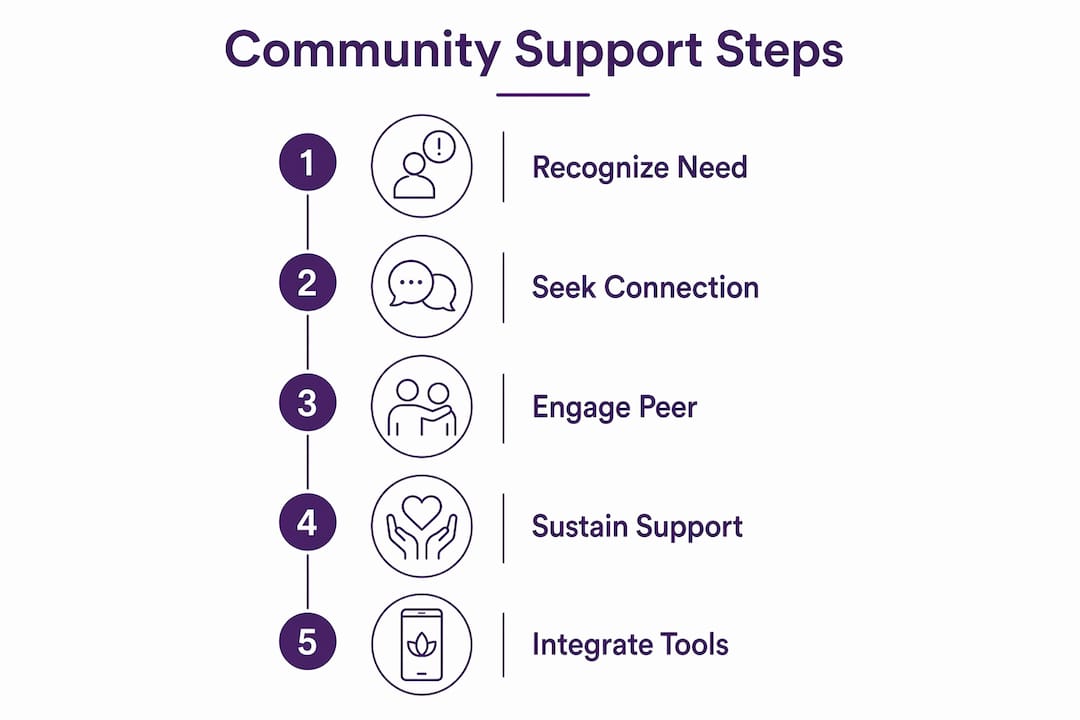
How to build and maintain a support network when anxiety makes it hard
Starting is the hardest part. Anxiety often makes the very thing that would help, reaching out to others, feel dangerous. A few strategies cut through that barrier without requiring you to overhaul your social life overnight.
- Start small and specific: A single online forum, one weekly group call, or a text thread with two trusted people is enough to begin. Commitment creep is real; don’t promise yourself more than you can sustain.
- Align the community with your values: A group built around running, faith, creative writing, or parenting will feel more natural than one organized purely around symptoms.
- Combine peer support with professional resources: Use your anxiety self-help plan alongside group participation, not instead of it.
- Volunteer or contribute: Giving back within a community, even in small ways, shifts your role from passive recipient to active participant. That shift matters for self-perception.
- Address stigma directly: Many people avoid support groups because they fear being labeled. Knowing that help-seeking behavior is widely regarded as a key milestone in mental health recovery can reframe that fear.
Sustaining connections requires less effort than building them, but it does require consistency. A group you check in with weekly, even briefly, stays alive. One you visit only during crises tends to fade.
How AI-powered tools work alongside community support
Technology has created a new category of support that sits between solo self-help and live peer interaction. AI-powered mental health tools, including mindfulness apps, therapy chatbots, and personalized self-care platforms, function as accessible spaces you can turn to at 2 AM when no group meeting is scheduled.

Cognicareai’s directory of AI mental health tools is built around exactly this gap. The tools it catalogs adapt to your specific needs, whether that means guided breathing exercises, cognitive reframing prompts, or connecting you to specialized therapy applications. They don’t replace peer support or clinical care. They fill the hours between.
Pro Tip: When evaluating an AI mental health tool, look for one that tracks your mood over time rather than just responding to single sessions. Pattern recognition over weeks gives you and your therapist far more useful data than any one-off check-in.
Moderation matters in digital communities too. Moderated peer support platforms prevent the negative echo chambers that can develop in unmanaged groups, where symptom-sharing spirals into collective catastrophizing rather than mutual encouragement. The best digital communities combine active facilitation with genuine peer connection.
Challenges and pitfalls you should know before joining a support community
Community support isn’t uniformly positive. A few real risks are worth naming.
Dependency without growth is one of the most common traps. A group that validates your anxiety without ever challenging you to try new coping strategies can feel supportive while actually keeping you stuck. Healthy communities encourage progress, not just comfort.
Toxic positivity is the flip side. Groups that insist everything will be fine, or that dismiss the severity of clinical anxiety, can make members feel worse for struggling. You want a space that holds both honesty and hope.
Unmoderated online spaces carry specific risks. Without active facilitation, conversations can drift toward harmful comparisons, misinformation about medications, or competitive suffering. Before committing to any online group, check whether it has clear community guidelines and active moderators.
Finally, peer support is not a clinical substitute. If your anxiety is severe, integrated clinical support alongside community involvement gives you a foundation that peer connection alone cannot provide.
How to engage with community when anxiety is at its worst
Severe anxiety symptoms create a paradox: the moments you most need connection are the ones when reaching out feels most impossible. A few approaches work specifically for high-symptom periods.
Lower the bar for participation. Lurking in an online forum, reading others’ posts without commenting, still counts as engagement. Passive exposure to shared experience reduces isolation without requiring you to perform wellness you don’t feel.

Use asynchronous formats first. Text-based communities, email lists, or recorded group sessions let you engage on your own timeline. Real-time interaction can feel overwhelming when anxiety is acute; asynchronous formats remove that pressure.
Tell one person, not the group. Direct messaging a single trusted member of your community is far less threatening than posting publicly. One honest exchange often does more than a group announcement.
Pair digital tools with human contact. On days when reaching out feels impossible, an AI-assisted technique can help you regulate enough to then send that text or attend that meeting. The tools work best as a bridge, not a destination.
Key Takeaways
Community support accelerates anxiety recovery by reducing isolation, increasing help-seeking, and providing the emotional validation that makes formal treatment feel approachable.
| Point | Details |
|---|---|
| Peer support drives help-seeking | Participants in peer-led groups were 10 times more likely to seek anxiety resources than those without peer support. |
| Belonging reduces distress | Higher sense of community correlates with lower anxiety, depression, and stress through balanced time perspective. |
| Multiple support types work best | Combining informal peers, family, structured groups, and professional care outperforms any single source. |
| Moderation protects digital communities | Active facilitation prevents echo chambers and keeps online groups therapeutically beneficial. |
| AI tools fill the gaps | AI-powered mental health tools complement community support during off-hours and high-symptom periods. |