
An anxiety self-help plan step by step is a structured, evidence-based approach you follow independently to reduce symptoms, regulate your nervous system, and rebuild confidence in daily life. Clinicians recognize this framework under the broader term structured self-management, which draws from cognitive behavioral therapy (CBT), exposure therapy, and physiological regulation techniques. This guide walks you through every phase: the tools you need, breathing protocols, cognitive strategies, daily routines, and how to stay on track when progress stalls. You do not need a therapist to start. You need a plan.
What essential tools do you need to start your anxiety self-help plan?
Before you practice a single technique, you need the right setup. Effective self-help for anxiety combines four core categories of tools: breathing and relaxation exercises, grounding techniques, thought records, and structured self-monitoring. Each one targets a different layer of anxiety, from the physical to the cognitive.
Here is what to gather before you begin:
- A journal or notebook. Use it to log anxious thoughts, track triggers, and record your progress. Apps like Daylio or Reflectly work if you prefer digital.
- A timer or phone app. Breathing exercises require precise timing. A simple stopwatch or a dedicated app like Insight Timer keeps you on track.
- Reminders. Set two or three daily alarms to prompt practice sessions. Consistency matters more than duration.
- A quiet, comfortable space. NHS inform recommends practicing in a calm environment, especially when you are learning new skills.
- Basic self-care foundations. Sleep, nutrition, and moderate exercise are not optional extras. A 30-day anxiety self-care plan structures the first phase entirely around mindfulness and body awareness before adding behavioral routines, because the body must be stable before the mind can follow.
Pro Tip: Start with just one tool at a time. Trying to implement breathing exercises, journaling, and grounding simultaneously leads to overwhelm. Pick breathing first, practice it for a week, then add the next layer.
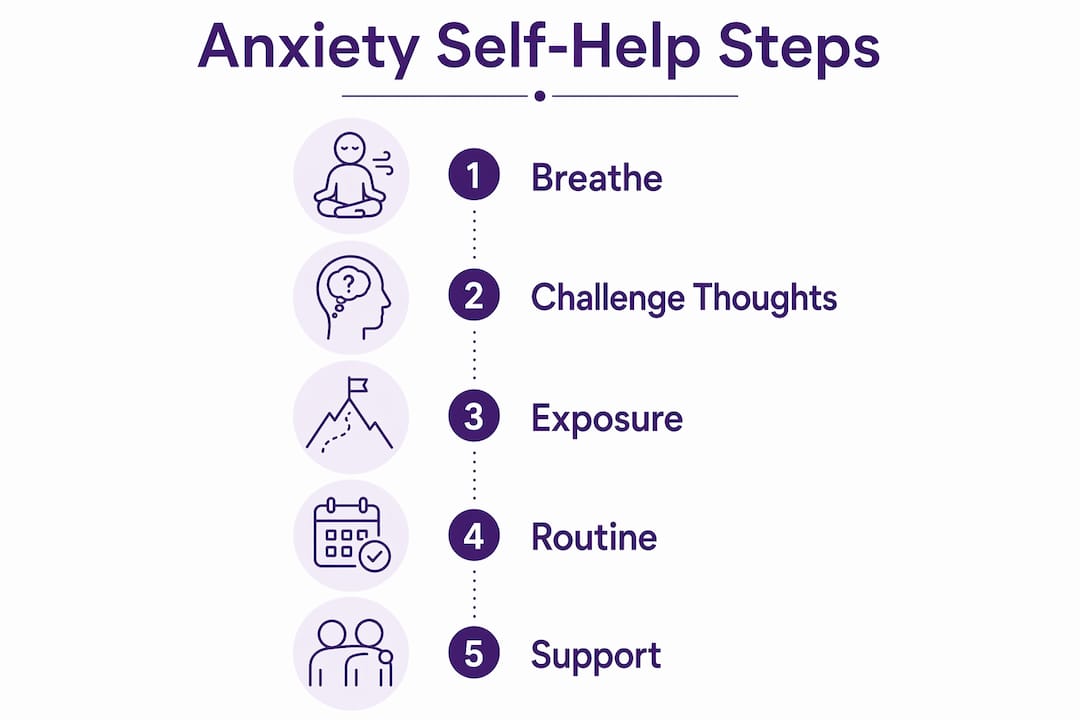
The Cleveland Clinic advises that effective anxiety self-help combines physiological regulation, cognitive strategies, gradual exposure, and social support. That combination is your roadmap. This article follows that exact sequence.
How to practice breathing and relaxation exercises step by step
Breathing is the fastest physiological lever you have. When anxiety spikes, your breathing becomes shallow and rapid, which signals danger to your brain and amplifies the panic cycle. Slowing your breath interrupts that loop directly.
Follow this protocol from Bradford District Care NHS Foundation Trust:
- Rate your distress on a scale of 0 to 10. Write it down.
- Hold your breath for 3 counts to reset your rhythm.
- Inhale for 3 seconds through your nose.
- Hold for 2 seconds.
- Exhale for 4 seconds through your mouth. The longer exhale activates your parasympathetic nervous system.
- Repeat for 3 full cycles, then re-rate your distress. Most people drop 2 to 3 points.
- Continue until you feel noticeably calmer.
This paced breathing rhythm (3-2-4 counts) is prescribed specifically to reduce panic intensity. It works because the extended exhale is longer than the inhale, which is the key physiological trigger for calming.
Practice this technique when you are not anxious. Practicing during calm states builds automaticity, meaning the skill becomes easier to access when you actually need it during a panic episode. Aim for two to three sessions daily, each lasting about 10 minutes.
“Stop if you feel dizzy or uncomfortable. Breathe normally for a minute, then try again with a slightly shorter hold. Discomfort during early practice is common and not dangerous.”
Pro Tip: Attach your breathing practice to an existing habit, like your morning coffee or brushing your teeth at night. This “habit stacking” approach removes the need for willpower and makes practice automatic within two weeks.
Use a physical “cue” to trigger relaxation throughout the day. Some people press their thumb and forefinger together during practice. Over time, that gesture alone begins to signal calm to the nervous system. It sounds simple, but the conditioning effect is real and well-documented in behavioral psychology.
What cognitive and behavioral strategies help manage anxiety step by step?
Breathing calms the body. Cognitive strategies calm the mind. These two work together, and skipping the cognitive layer is why many people plateau after initial progress.
Challenging anxious thoughts
Anxious thoughts follow predictable distortion patterns: catastrophizing (“This will go terribly wrong”), mind-reading (“Everyone thinks I’m incompetent”), and all-or-nothing thinking. The CBT approach is to treat these thoughts as hypotheses, not facts.
When an anxious thought appears, ask three questions: What is the evidence for this thought? What is the evidence against it? What would I tell a friend who had this thought? Write your answers in your journal. This process, called a thought record, weakens the emotional charge of the thought over repeated use.
Use coping statements to replace catastrophic predictions. Phrases like “I have handled this before,” “Anxiety is uncomfortable but not dangerous,” and “This feeling will pass” are not affirmations. They are accurate, evidence-based corrections to distorted thinking. Keep a short list in your phone for quick access during high-anxiety moments.
Exposure therapy: the most powerful behavioral tool
Exposure therapy reduces anxiety effectively by gradually confronting feared situations until fear subsides. Research shows lasting improvements in 60 to 80% of people who complete a structured exposure program. That is not a minor effect size. It is the strongest outcome data in anxiety treatment.
Build a graded exposure ladder. List 8 to 10 situations that trigger your anxiety, ranked from least to most distressing. Start at the bottom. A successful exposure hierarchy begins with less intimidating situations to build confidence before progressing to harder triggers. Stay in each situation until your anxiety drops by at least half before moving up the ladder.
Here is how avoidance compares to exposure over time:
| Approach | Short-term effect | Long-term effect |
|---|---|---|
| Avoidance | Immediate relief | Anxiety grows stronger |
| Safety behaviors | Temporary comfort | Maintains fear response |
| Graded exposure | Temporary discomfort | Anxiety decreases durably |
| Coping statements | Mild immediate relief | Builds cognitive resilience |
Avoidance and safety behaviors reinforce panic and anxiety. Every time you avoid a feared situation, your brain records it as confirmation that the situation was genuinely dangerous. Exposure reverses that recording.
How to build supportive daily routines to sustain anxiety management progress
Single techniques work in moments. Routines work over months. The difference between people who manage anxiety well long-term and those who cycle through crises is almost always the presence of a consistent daily structure.
Build your routine around these four pillars:
- Mindfulness and grounding. The 5-4-3-2-1 technique, which involves naming 5 things you see, 4 you can touch, 3 you hear, 2 you smell, and 1 you taste, shifts attention outward from internal bodily symptoms to external sensory input. This interrupts the anxiety feedback loop at the source. Practice it once daily even when you feel fine.
- Exercise. Moderate physical activity for about 30 minutes daily reduces baseline anxiety by lowering cortisol and increasing GABA activity in the brain. Walking, cycling, and yoga all qualify. You do not need a gym membership.
- Sleep hygiene. Anxiety and poor sleep are bidirectional. A consistent sleep schedule, no screens 30 minutes before bed, and a cool room temperature are the three highest-impact changes most people can make without medication.
- Nutrition. Caffeine amplifies anxiety symptoms in most people. Reducing coffee intake and stabilizing blood sugar through regular meals removes a significant physiological stressor that many people overlook entirely.
Pro Tip: Track your mood and anxiety level each morning on a simple 1-to-10 scale in your journal. After two weeks, patterns emerge. You will see which days, times, and situations correlate with higher anxiety, and that data makes your plan far more precise.
For building sustainable daily habits, start with the smallest possible version of each behavior. A two-minute mindfulness check-in beats a 20-minute session you skip three days out of five.
How to troubleshoot common challenges and maintain your plan long term
Most people hit a wall around week three or four. Progress feels slow, motivation drops, and skipping practice sessions starts to feel justified. This is normal, and it does not mean the plan is failing.
Here are the most common obstacles and how to address them:
- Irregular practice. Missing sessions is not failure. It is data. Review your schedule and identify what made practice difficult. Shift the time, shorten the session, or simplify the technique. Consistency at 60% effort beats perfection at 0%.
- Discouragement after a bad day. Anxiety does not decrease in a straight line. Setbacks are part of the process, not evidence that you are not improving. Compare your current baseline to where you were four weeks ago, not to yesterday.
- Avoiding exposure steps. This is the most common and most consequential obstacle. Engaging gradually with feared situations retrains your anxiety response. If a step feels too large, break it into two smaller steps. The ladder is yours to adjust.
- Plateau in progress. If you have been consistent for six to eight weeks and symptoms have not shifted, that is a signal to seek professional support, not a reason to abandon self-help entirely.
“Self-help works best as a foundation, not a ceiling. If you have been practicing consistently and still feel significantly impaired, a licensed therapist or psychiatrist can build on the skills you have already developed.”
Recognize when professional help is warranted. Panic attacks that occur daily, anxiety that prevents you from working or maintaining relationships, or symptoms accompanied by depression all indicate that self-help alone is insufficient. The AI-assisted techniques available through digital platforms can also supplement your plan between therapy sessions.
Key takeaways
A structured anxiety self-help plan works because it combines physiological regulation, cognitive restructuring, graded exposure, and consistent daily routines into a single, repeatable system.
| Point | Details |
|---|---|
| Start with breathing | Practice the 3-2-4 paced breathing protocol twice daily to build automaticity before anxiety peaks. |
| Challenge thoughts with evidence | Use thought records to treat anxious predictions as hypotheses, not facts, and replace them with coping statements. |
| Build a graded exposure ladder | List feared situations from least to most distressing and work up gradually to retrain your anxiety response. |
| Anchor routines to existing habits | Attach mindfulness, exercise, and journaling to daily anchors to remove reliance on willpower. |
| Seek support when progress stalls | Six to eight weeks of consistent practice with no improvement signals that professional guidance is the right next step. |
Why I think most anxiety self-help advice misses the most important point
Most articles about coping strategies for anxiety hand you a list of techniques and leave you to figure out the sequencing yourself. That is the actual problem. The techniques are not the hard part. Knowing which one to use, when, and in what order is what separates people who improve from people who stay stuck.
In my experience working with mental health content and the research behind it, the single biggest predictor of whether a self-help plan succeeds is whether the person practices breathing and grounding before they need them. Not during a panic attack. Not after a hard week. During ordinary Tuesday mornings when nothing is wrong. That is when the skill gets wired in.
The second thing most guides get wrong is framing exposure as optional. It is not. Breathing and cognitive work reduce the intensity of anxiety. Exposure reduces the frequency. You need both. Skipping exposure because it feels uncomfortable is exactly the avoidance pattern that keeps anxiety alive.
The third overlooked factor is self-compassion. Not as a soft concept, but as a practical tool. People who treat setbacks as information rather than failure stay in the process longer. Longer practice time produces better outcomes. It really is that direct.
If you take one thing from this article, make it this: the plan only works if you practice it when you do not feel like you need it. That counterintuitive habit is what makes every other technique actually function under pressure.
— dushyantha
How Cognicareai can support your anxiety self-help journey
Building and sticking to a structured anxiety plan is easier when you have the right digital tools alongside you.
Cognicareai is a directory of AI-powered mental health tools designed to complement exactly the kind of self-help plan this article describes. From guided breathing apps and mindfulness programs to AI-driven journaling tools that track mood patterns over time, the platform connects you with personalized resources matched to your specific needs. Whether you are looking for top mindfulness apps to anchor your daily grounding practice or want to explore tools that support cognitive reframing, Cognicareai makes it straightforward to find what fits your plan. Explore the directory and add the right tools to your routine today.
FAQ
What is an anxiety self-help plan?
An anxiety self-help plan is a structured, step-by-step program that combines breathing techniques, cognitive strategies, graded exposure, and daily routines to reduce anxiety symptoms independently. It draws from evidence-based approaches including CBT and exposure therapy.
How often should I practice breathing exercises for anxiety?
Practice breathing exercises two to three times daily for best results, ideally during calm periods rather than only during anxiety episodes. Regular practice builds the automaticity needed to use the skill effectively under stress.
How long does it take for a self-help anxiety plan to work?
Most people notice measurable improvement in four to eight weeks of consistent practice. Exposure therapy typically requires 8 to 12 structured sessions to produce lasting reductions in anxiety frequency and intensity.
When should I seek professional help instead of self-help?
Seek professional support if daily panic attacks, significant functional impairment, or co-occurring depression are present. Self-help works well as a foundation, but a licensed therapist or psychiatrist can accelerate progress when symptoms are severe.
What is the 5-4-3-2-1 grounding technique?
The 5-4-3-2-1 technique involves naming 5 things you see, 4 you can touch, 3 you hear, 2 you smell, and 1 you taste. It redirects attention from internal anxiety symptoms to external sensory input, interrupting the panic feedback loop.