

Emotional intelligence is defined as the ability to recognize, understand, and manage your own emotions and those of others to improve workplace performance. Research from the Yale School of Management confirms that high EI drives faster promotions and higher salaries across industries. Understanding why emotional intelligence matters professionally is no longer optional for career growth. The World Economic Forum’s Future of Jobs Report consistently ranks emotional and social skills among the top competencies employers demand. TalentSmartEQ research shows that EQ governs how work gets done amid complexity, driving decision-making, collaboration, and adaptability in ways that technical skills alone cannot.
Why emotional intelligence matters professionally: the core components
Emotional intelligence, often abbreviated as EI or EQ, is a measurable set of four skills: self-awareness, self-management, social awareness, and relationship management. Each one plays a distinct role at work, and confusing EI with empathy alone is one of the most common mistakes professionals make.
- Self-awareness is the ability to recognize your own emotional states and how they affect your thinking and behavior. A manager who notices rising frustration before a performance review can adjust their tone and deliver clearer, more constructive feedback.
- Self-management is the ability to regulate your emotions and impulses. A professional who stays composed during a client conflict protects both the relationship and the deal.
- Social awareness means reading the emotional climate of a room or team. A team lead who senses low morale after a restructure can address it before disengagement spreads.
- Relationship management is the ability to influence, coach, and resolve conflict effectively. This is where EI becomes visible in leadership, negotiation, and team cohesion.
A common misconception is that EI means being “nice” or overly accommodating. Psychology Today notes that empathy alone is insufficient for professional EI. Self-regulation and impulse control are equally critical. A leader who empathizes with a struggling employee but cannot manage their own anxiety will still make poor decisions under pressure.
Pro Tip: Use the “strategic pause” technique before responding in emotionally charged situations. Forbes research confirms that pausing before reacting improves composure and the quality of professional decisions. Count to five, breathe, then respond.

How does emotional intelligence affect workplace outcomes?
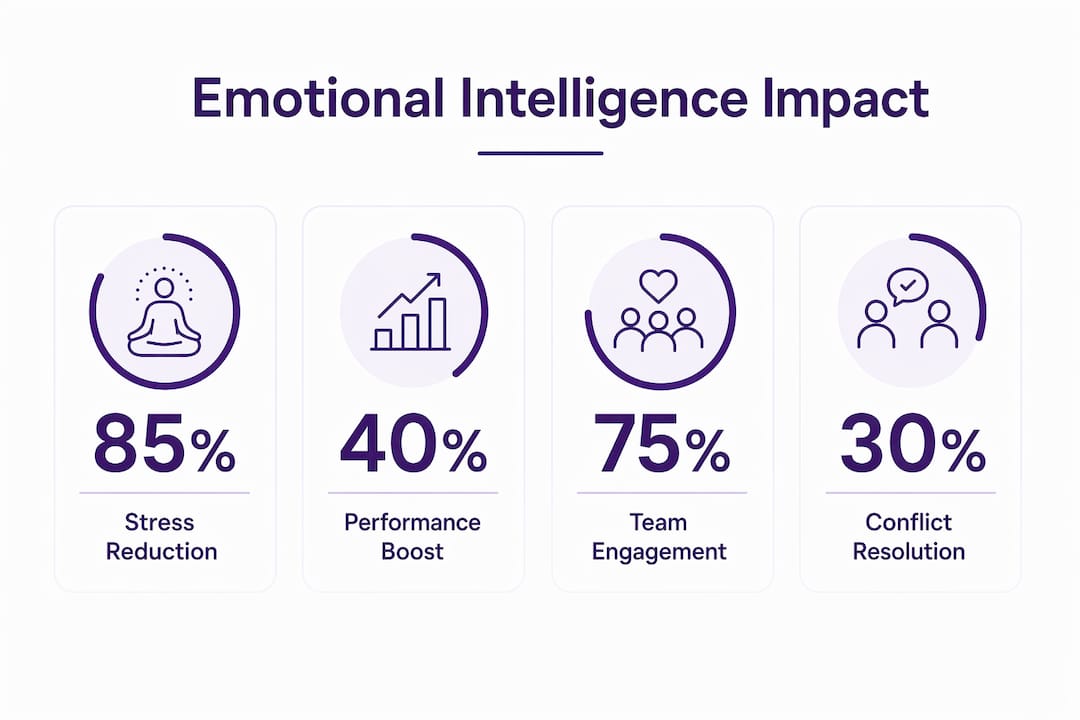
The evidence linking EI to measurable workplace results is substantial. Professionals with high EI consistently outperform peers on leadership effectiveness, team collaboration, and stress resilience.
“EI-trained individuals showed better memory retention, decision-making, and pain tolerance during stress, demonstrating that emotional intelligence training directly improves cognitive performance under pressure.”
— Scientific Reports, 2026
A 2026 study published in Scientific Reports found that EI training improves stress regulation and performance in high-stress occupations. That finding matters because most professional roles involve sustained pressure, tight deadlines, and interpersonal friction. Professionals who can regulate their emotions under those conditions make better decisions and recover faster.
The table below shows how EI training affects key performance indicators in professional settings.
| Performance Area | Without EI Training | With EI Training |
|---|---|---|
| Decision-making under stress | Reactive, impulsive | Deliberate, measured |
| Team communication | Frequent misalignment | Clearer, more consistent |
| Conflict resolution | Escalation or avoidance | Direct, constructive dialogue |
| Career progression | Slower advancement | Faster promotions, higher salaries |
| Stress recovery | Prolonged disruption | Faster return to baseline |
TalentSmartEQ research also identifies a direct link between low EI and disengagement and communication breakdowns at work. Operational failures often trace back to employees who cannot manage emotions and relationships, not to technical flaws in systems or processes. That reframing changes how organizations should think about performance problems.
Is emotional intelligence more important than IQ at work?
IQ measures cognitive ability: pattern recognition, logical reasoning, and the capacity to learn new information. It predicts academic performance well. At work, however, IQ establishes a baseline but does not determine how effectively a professional collaborates, leads, or adapts to change.
The Yale School of Management states that EQ skills govern real-world performance beyond what IQ alone can deliver. A highly intelligent analyst who cannot manage conflict or read team dynamics will consistently underperform a slightly less analytical peer with strong EI. The table below contrasts the two.
| Attribute | IQ | EI |
|---|---|---|
| What it measures | Cognitive and analytical ability | Emotional and social competence |
| Predicts | Academic achievement, technical mastery | Leadership, collaboration, career advancement |
| Fixed or trainable | Largely fixed after adolescence | Trainable with consistent practice |
| Workplace application | Task execution, problem-solving | Relationship management, conflict resolution |
| Limits | Cannot compensate for poor communication | Amplifies IQ by improving how skills are applied |
The practical implication is clear. IQ gets you hired. EI determines how far you go. In complex team environments, the professional who can read the room, manage their reactions, and build trust consistently outperforms the one who relies on technical skill alone. The emotional intelligence challenge for AI-driven workplaces makes this gap even more pronounced, as automation handles routine cognitive tasks and human EI becomes the primary differentiator.
How can professionals develop emotional intelligence at work?
EI is trainable. TalentSmartEQ confirms that developing EI requires consistent practice through self-reflection, active listening, and structured feedback. The following steps give professionals a practical path forward.
- Start with a self-reflection habit. Spend five minutes at the end of each workday reviewing one emotional reaction you had. Ask what triggered it, how you responded, and what a better response would have looked like.
- Practice active listening in every meeting. Focus entirely on the speaker before forming a response. Summarize what you heard before adding your own view. This builds social awareness and signals respect.
- Request a 360-degree EI assessment. TalentSmartEQ research shows that 360-degree feedback reveals blind spots that self-evaluation consistently misses. Comparing your self-perception against feedback from peers and supervisors gives you an accurate picture of your EI gaps.
- Build foresight into decisions. Psychology Today research links self-awareness and foresight to better goal achievement. Before acting on an emotional impulse, ask how this decision will look in six months.
- Embed EI habits into leadership behavior. Name emotions in team conversations. Acknowledge when a project is stressful. Model the composure you want your team to adopt. Behavior is contagious in both directions.
Pro Tip: Self-assessments of EI have significant blind spots. Never rely on self-evaluation alone. Pair it with peer feedback tools to get an honest picture of how your emotional behavior actually lands with colleagues.
The benefits of emotional intelligence compound over time. Professionals who invest in emotional wellness at work report stronger relationships, greater resilience, and more consistent career growth. EI development is not a one-time workshop. It is a daily practice that reshapes how you show up in every professional interaction.
Key Takeaways
Emotional intelligence is the single most trainable professional skill that directly determines leadership effectiveness, career advancement, and team performance.
| Point | Details |
|---|---|
| EI drives career outcomes | High EI professionals earn faster promotions and higher salaries than peers with equivalent technical skills. |
| Four core components | Self-awareness, self-management, social awareness, and relationship management each serve a distinct professional function. |
| EI outperforms IQ at work | IQ sets a baseline; EI determines how effectively professionals collaborate, lead, and adapt under pressure. |
| Training produces real results | EI training improves stress regulation, decision-making, and memory retention even in high-pressure occupations. |
| 360-degree feedback is essential | Self-assessment alone misses critical blind spots; peer and supervisor feedback gives an accurate development picture. |
The skill that separates good professionals from great ones
I have worked with professionals across industries who had every technical credential imaginable and still struggled to get promoted, build teams, or hold a room. The pattern was almost always the same. They could solve the problem on paper but could not manage the people around the problem.
What changed things for the ones who broke through was not another certification. It was the moment they started paying attention to their own emotional reactions and taking responsibility for how those reactions affected others. That shift is what EI actually looks like in practice. It is not soft. It is one of the hardest things a professional can do consistently.
The AI-driven workplace makes this more urgent, not less. As automation handles more cognitive tasks, the professionals who thrive will be the ones who can navigate ambiguity, build trust quickly, and lead through uncertainty. Those are EI skills. The organizations that recognize this are already investing in EI training at the leadership level. The professionals who recognize it early have a real advantage.
— dushyantha
AI tools that support emotional intelligence and well-being at work
Building emotional intelligence takes more than good intentions. It requires consistent support, honest feedback, and tools that help you track your emotional patterns over time.
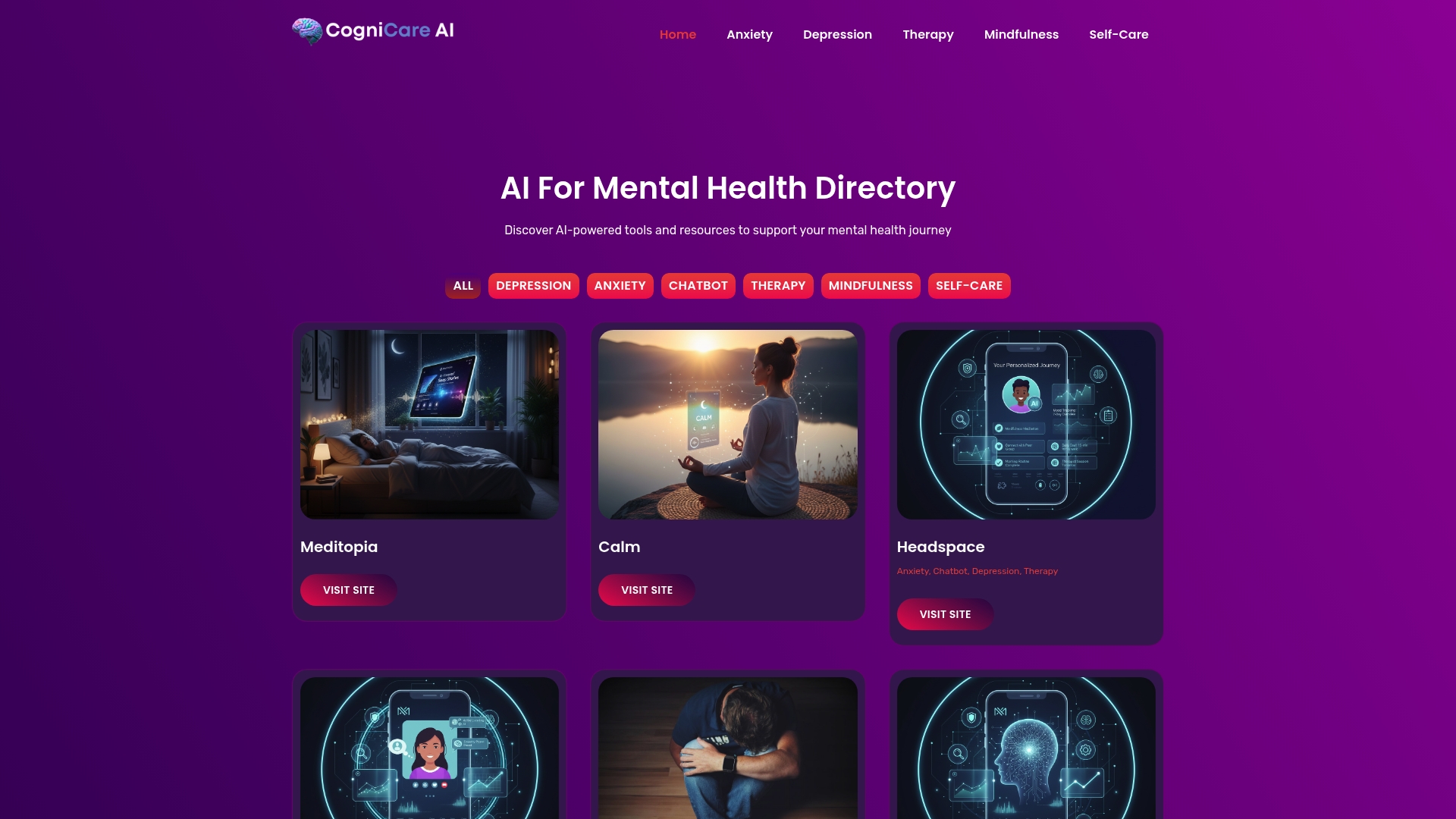
Cognicareai offers a curated directory of AI-powered mental health and wellness tools designed for professionals who want to strengthen their emotional resilience. From AI mental health tools that support self-awareness to AI-enhanced mindfulness apps that reduce workplace stress, the platform connects you with resources tailored to your specific needs. Whether you are working on stress regulation, improving focus, or building better emotional habits, Cognicareai’s top mindfulness apps give you a practical starting point backed by real evidence.
FAQ
What is emotional intelligence in the workplace?
Emotional intelligence in the workplace is the ability to recognize, manage, and apply emotions effectively in professional interactions. It covers self-awareness, self-management, social awareness, and relationship management.
Can emotional intelligence be developed as an adult?
Yes. TalentSmartEQ confirms that EI is a trainable skill set that improves with consistent practice, self-reflection, and structured feedback such as 360-degree assessments.
Why does emotional intelligence matter more than IQ for career success?
IQ predicts task performance, but EI determines how well professionals collaborate, lead, and adapt. Yale School of Management research shows EI drives faster promotions and higher salaries beyond what technical ability alone can achieve.
How does emotional intelligence reduce workplace stress?
EI-trained professionals use superior emotion-regulation techniques that improve decision-making and cognitive performance under pressure, as confirmed by a 2026 Scientific Reports study on high-stress occupations.
What is the best way to measure emotional intelligence at work?
The most reliable method is a 360-degree EI assessment that compares self-perception against feedback from peers and supervisors, revealing blind spots that self-evaluation consistently misses.