

Digital tools improve mental health by delivering accessible, anonymous, and clinically validated support that traditional care systems cannot always provide. A meta-analysis of 48 randomized controlled trials with 28,071 participants confirmed statistically significant reductions in depression, anxiety, and stress. Nearly 50% of adults aged 18–44 now use digital mental health tools, with 60% favoring mental health apps and roughly half using general chatbots. The standard industry term for this category is digital mental health interventions (DMHIs). This article uses both terms to keep things clear and searchable.
Why digital tools improve mental health: the core categories
Digital mental health interventions fall into four main categories, each working through a different mechanism.
- AI-powered chatbots and conversational agents. These tools use natural language processing to simulate therapeutic dialogue. They deliver cognitive behavioral therapy (CBT) techniques, psychoeducation, and mood tracking through text-based conversations. AI chatbots reduced depression scores by up to 60% in healthcare workers, according to a 2026 meta-analysis.
- Self-guided mental health apps. These apps deliver structured programs built on CBT, mindfulness, and acceptance and commitment therapy (ACT). People work through modules at their own pace, often with push notifications to maintain consistency.
- Teletherapy and online therapy platforms. These connect people with licensed therapists through video, phone, or text. They remove geographic barriers without sacrificing the human relationship that drives therapeutic outcomes.
- Wearables and passive monitoring tools. Devices like smartwatches track sleep, heart rate variability, and activity levels. They feed data into apps that flag early signs of mood changes, giving people and their care teams a clearer picture over time.
Each category addresses a different point of need. Someone in a rural area with no local therapist benefits most from teletherapy. Someone managing daily anxiety between sessions benefits most from a self-guided app or chatbot.

How do digital tools effectively reduce symptoms?
The clinical evidence for digital mental health interventions is now strong enough to inform treatment guidelines. The 48-RCT meta-analysis found standardized mean differences of -0.27 for depression, -0.20 for anxiety, and -0.26 for stress. These are modest but meaningful effect sizes. They indicate that digital tools produce real, measurable relief at a population scale.
Digital CBT and teletherapy achieve effect sizes of 0.5–0.8, comparable to in-person therapy. That finding matters because it removes the assumption that digital care is a lesser substitute.
| Active element | How it works | Evidence strength |
|---|---|---|
| Psychoeducation | Teaches people to recognize thought patterns | Strong across CBT-based apps |
| Self-monitoring | Daily mood logs build self-awareness | Moderate to strong |
| Relaxation techniques | Guided breathing and body scans reduce physiological stress | Strong in mindfulness apps |
| Structured homework | Exercises between sessions reinforce learning | Strong in digital CBT |
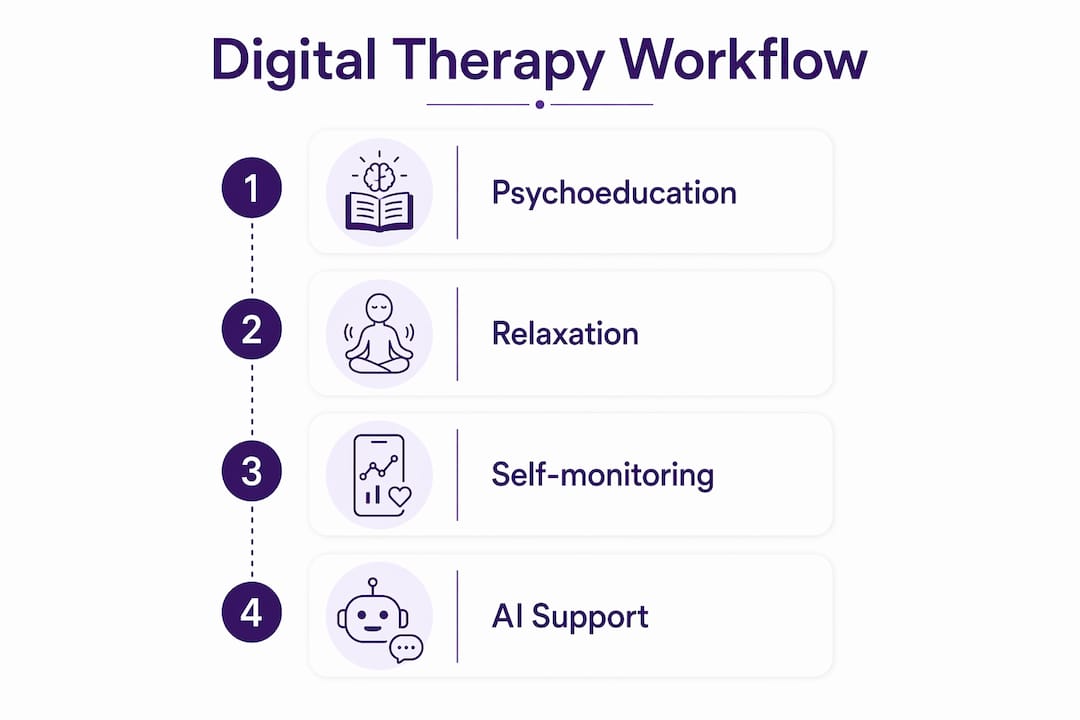
Tools combining psychoeducation, relaxation, and self-monitoring consistently outperform single-function apps. The combination matters because mental health improvement requires multiple reinforcing inputs, not just one technique.
The therapeutic alliance can also form digitally through socioaffective alignment, where AI adjusts its communication style to match a person’s emotional state and personality traits. This personalization increases engagement and trust, which are the same factors that predict success in face-to-face therapy.
Pro Tip: When evaluating a mental health app, check whether it includes at least two active elements from the table above. Single-function apps tend to produce weaker and shorter-lived results.
What barriers do digital tools overcome in traditional mental health care?
Traditional mental health care has four persistent barriers: stigma, geography, cost, and scheduling. Digital tools address all four directly.
- Stigma and anonymity. User reports confirm that people feel more comfortable and less judged using digital tools than walking into a therapist’s office. Anonymity removes the fear of being seen seeking help, which is a real deterrent for many people, especially men and younger adults.
- Geographic access. Rural populations, people with mobility limitations, and those in underserved communities face serious shortages of local mental health providers. Teletherapy and self-guided apps reach these groups without requiring travel or relocation.
- Cost. A single therapy session can cost $100–$300 without insurance. Many mental health apps cost less per month than a single copay. Lower-intensity digital supports with automated guidance show strong effectiveness in low-resource settings, making them a practical first step for people who cannot afford regular therapy.
- Scheduling and availability. Digital tools operate 24/7. A person experiencing anxiety at 2:00 AM can open a breathing exercise or start a CBT module immediately. That immediate access prevents small distress from escalating into a crisis.
The combination of these four advantages explains why adoption rates are rising fastest among adults aged 18–44. This group faces high rates of anxiety and depression but also faces the most scheduling and cost constraints.
What are the risks of relying on digital mental health tools?
Digital tools carry real risks, and ignoring them does a disservice to people who need genuine care.
“Rapid AI adoption in mental health has outpaced our understanding of its effects. Governance must place user well-being at the center, not engagement metrics. Unguided use of general-purpose AI chatbots poses risks of emotional dependence and mismanagement of crises.” — WHO expert workshop on responsible AI for mental health
The WHO’s warning is specific. General-purpose AI chatbots, meaning tools not designed for mental health, can give harmful responses during a crisis. They are not trained to recognize suicidal ideation or psychosis. Using them as a substitute for clinical care in severe conditions is dangerous.
Human-in-the-loop approaches address this risk directly. When a digital tool includes clinical triggers, such as alerts that notify a care coordinator when a person’s responses indicate crisis, outcomes improve and safety increases. Fully autonomous systems without any professional touchpoint carry higher risk.
The WHO consensus on digital tool roles is clear: digital mental health tools belong within stepped-care models. They work best as a first step or a between-session support, not as a standalone replacement for professional care. Mental health professionals are increasingly urged to evaluate AI tools themselves before recommending them to people in their care.
Pro Tip: Before downloading any mental health app, check whether it lists a clinical advisory board or references specific evidence-based protocols like CBT or DBT. That information signals the tool was built with professional oversight.
How can you integrate digital tools into your mental health routine?
Getting real benefit from digital mental health tools requires more than downloading an app and opening it once. Sustained, structured use produces the outcomes the research supports.
- Choose evidence-based tools. Look for apps or chatbots that cite specific therapeutic frameworks, such as CBT, mindfulness-based stress reduction (MBSR), or dialectical behavior therapy (DBT). Cognicareai’s directory of AI-powered mental health tools organizes options by condition and approach, making it easier to find a match.
- Build daily use into an existing habit. Sustained daily use of digital tools, especially those integrated into messaging platforms, produces better engagement and outcomes than occasional use. Attach your app check-in to something you already do, like morning coffee or your commute.
- Combine digital support with professional care when needed. Digital tools work best as a complement to therapy, not a replacement. Use an app to practice skills your therapist teaches, or to track mood data you can share at your next session.
- Use tools with crisis protocols. If you are managing moderate to severe symptoms, choose a tool that includes a crisis line link or a human escalation path. This is a non-negotiable safety feature.
- Reassess every 4–6 weeks. If your symptoms are not improving, the tool may not be the right fit. Switching to a different modality, such as moving from a self-guided app to teletherapy, is a sign of good self-awareness, not failure.
Key Takeaways
Digital tools improve mental health most effectively when they combine multiple evidence-based techniques, include human oversight, and are used consistently as part of a broader care plan.
| Point | Details |
|---|---|
| Clinical evidence is strong | Meta-analyses confirm significant reductions in depression, anxiety, and stress across tens of thousands of participants. |
| Multi-element tools outperform single-function apps | Apps combining psychoeducation, self-monitoring, and relaxation produce better outcomes than one-technique tools. |
| Anonymity drives adoption | People engage more openly with digital tools because they feel less judged than in face-to-face settings. |
| Human oversight improves safety | Tools with clinical triggers or human-in-the-loop features reduce crisis risk and improve outcomes. |
| Daily use matters | Consistent, habitual engagement with digital tools produces stronger and more lasting mental health benefits. |
Why I think we are still underusing digital mental health tools
Most people treat mental health apps the way they treat gym memberships: they sign up with good intentions and stop after two weeks. The research does not fail them. The habit does.
What I find genuinely underappreciated is how much the combination of tools matters. A person using a mindfulness app for breathing exercises, a CBT-based chatbot for thought records, and a teletherapy session twice a month is building a layered support system. Each layer reinforces the others. That is how digital tools reach their full potential, not as a single app, but as an ecosystem.
The WHO’s caution about general-purpose AI is worth taking seriously. A general chatbot is not a therapist. It was not trained on clinical data, and it does not know when to refer someone to emergency services. Specialized, evidence-based tools are a different category entirely. The distinction matters, and most people do not know it exists.
My honest view: digital mental health tools are not the future of care. They are the present. The gap is not in the technology. It is in how people choose, use, and combine these tools. Anyone willing to be deliberate about that process will get real results.
— dushyantha
Cognicareai: a practical starting point for digital mental health support
Finding the right digital mental health tool is harder than it should be. Thousands of apps exist, and most do not disclose their clinical foundations clearly.
Cognicareai organizes AI-powered mental health tools by condition, approach, and evidence base, so you can find what fits your situation without sorting through marketing claims. Whether you are managing anxiety, depression, or daily stress, the platform connects you with specialized therapy applications, AI chatbots, and mindfulness resources that are built on real clinical frameworks. For a structured overview of what is available and how each tool works, the 2026 AI mental health guide is a clear, no-jargon starting point.
FAQ
What makes digital mental health tools clinically effective?
Digital tools are most effective when they combine psychoeducation, self-monitoring, and relaxation techniques within a structured program. A meta-analysis of 48 RCTs confirmed significant symptom reductions across depression, anxiety, and stress.
Are digital therapy tools as good as in-person therapy?
Digital CBT and teletherapy produce effect sizes of 0.5–0.8, which are comparable to in-person therapy outcomes. They are not identical experiences, but the clinical results are similar for mild to moderate conditions.
Who benefits most from digital mental health tools?
Adults aged 18–44, people in rural or underserved areas, and those who face cost or scheduling barriers benefit most. Anonymity and 24/7 access also make digital tools more approachable for people who avoid traditional care due to stigma.
Can digital tools replace a therapist?
Digital tools work best as a complement to professional care, not a replacement. The WHO recommends integrating them into stepped-care models where human oversight remains available for moderate to severe conditions.
How do I know if a mental health app is safe to use?
Look for apps that reference specific evidence-based protocols like CBT or MBSR, list a clinical advisory board, and include a crisis escalation path. General-purpose AI chatbots without these features carry higher risk for people managing serious symptoms.