

Hybrid mental health support is defined as a treatment model that integrates traditional face-to-face therapy with digital tools such as video sessions, mental health apps, symptom tracking, and AI-powered resources within a single, coordinated care plan. Clinically, this approach is often called blended care or integrated mental health care, and the terms are used interchangeably across research and practice. About 21.5% of mental health outpatients in the US currently receive this type of care, making it one of the fastest-growing mental health support models available. The model works because it preserves the depth of human connection while using technology to extend care beyond the therapy room.
What is hybrid mental health support, exactly?
Hybrid mental health support combines in-person therapy sessions with digital touchpoints, all organized into one treatment plan tailored to you. The in-person component typically involves regular sessions with a licensed therapist, psychiatrist, or counselor. The digital layer adds video calls, app-based exercises, asynchronous messaging, and remote symptom monitoring between those sessions. Switching between in-person and virtual sessions and using digital tools for homework and psychoeducation are the most common examples of how this plays out in real practice.
What makes hybrid care distinct from simply “also using an app” is the integration. A therapist in a true hybrid model reviews your symptom tracking data before your next session, adjusts your treatment plan based on what the app captures, and assigns digital exercises that directly reinforce what you discussed in person. The technology is not a separate product. It is a clinical extension of the therapeutic relationship.
Hybrid care models improve accessibility for rural, underserved, or mobility-challenged populations by mixing in-person and remote modalities. This means someone managing depression in a rural county can attend monthly in-person sessions and receive weekly video check-ins without driving three hours each way.

What digital tools are included in hybrid mental health services?
The digital layer of hybrid care is broader than most people expect. Tools range from synchronous options, meaning live real-time interaction, to asynchronous formats that work on your own schedule.
Synchronous tools include:
- Video therapy sessions via platforms like Zoom for Healthcare or dedicated telehealth services
- Live phone check-ins for medication follow-ups or crisis support
- Real-time chat with a counselor or support specialist
Asynchronous tools include:
- Mobile apps delivering CBT modules, mindfulness exercises, and mood journals
- AI chatbots that provide guided support between sessions
- Wearables that track sleep, heart rate variability, and stress indicators
- Secure messaging threads with your care team
- VR-based exposure therapy programs for phobias and PTSD
Digital navigators assist patients with technology use and sustain engagement, which improves care outcomes. A digital navigator is a trained support person, often a peer specialist or care coordinator, who helps you set up apps, troubleshoot login issues, and stay consistent with digital homework. Their role is underappreciated but critical, especially for older adults or anyone with limited tech experience.
Clinicians expect digital tools to support homework completion, skills practice, and psychoeducation in 72.5% to 71.3% of cases. That statistic tells you what therapists actually want from the technology: not entertainment, but structured clinical reinforcement.
Pro Tip: Ask your therapist directly whether they review your app data before sessions. If they do not, the digital component is supplemental, not truly integrated.
What are the benefits of hybrid therapy vs. traditional or fully digital care?
The case for hybrid care over either extreme is well-supported. Fully in-person therapy is limited by geography, scheduling, and cost. Fully digital care lacks the relational depth that drives lasting change. Hybrid care captures the strengths of both.
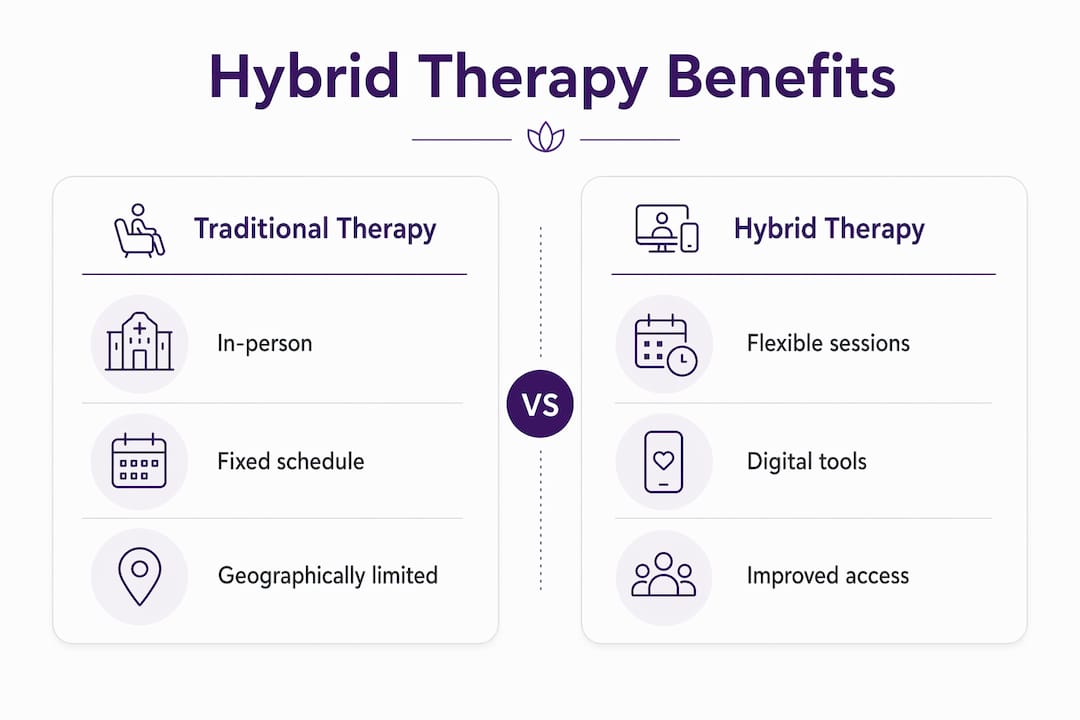
| Benefit | How hybrid care delivers it |
|---|---|
| Accessibility | Remote sessions remove travel barriers for rural or mobility-limited patients |
| Continuity of care | Symptom tracking and app check-ins maintain momentum between sessions |
| Personalization | Clinicians adjust treatment plans using real-time digital data |
| Reduced no-shows | Flexible scheduling and video options lower appointment dropout rates |
| Cost efficiency | Fewer in-person visits reduce overhead for clinicians and travel costs for patients |
Combining remote psychotherapy with onsite support yields improved retention and patient satisfaction. Retention is the metric that matters most in mental health treatment. Dropout is the single biggest predictor of poor outcomes, and hybrid models address it directly by making care easier to maintain.
The human-in-the-loop concept is the mechanism behind this. When a clinician oversees the digital data you generate, rather than leaving you to interpret it alone, the technology becomes clinically meaningful. An app that tracks your anxiety scores is useful. A therapist who reviews those scores and adjusts your session focus based on them is transformative.
Digital mental health tools achieve better clinical outcomes when integrated with human support. This is not a minor effect. It is the core argument for hybrid care over self-directed digital tools.
Pro Tip: When comparing providers, ask whether your therapist receives and reviews your app data. That single question separates genuine hybrid care from a therapy practice that hands you an app and calls it integrated.
What challenges should you know before choosing hybrid mental health services?
Hybrid care is not without friction. Understanding the challenges upfront helps you choose a provider who has solved them rather than one who has simply added a digital veneer to traditional practice.
Clinicians face time burden and workflow challenges when implementing hybrid models, and adequate training and management support are key facilitators of successful adoption. This means the quality of your hybrid care experience depends heavily on whether your provider’s organization has invested in making the model work operationally.
Key challenges to watch for include:
- Technology access gaps. Patients without reliable internet, smartphones, or digital literacy can be excluded from the digital layer entirely, which undermines the model’s equity promise.
- Data privacy concerns. Mental health data is among the most sensitive personal information. Verify that any app your provider recommends complies with HIPAA and has a clear data retention policy.
- Lack of real integration. Many providers describe their care as hybrid simply because they offer telehealth appointments. True hybrid care requires coordinated scheduling, shared data review, and defined escalation protocols.
- Clinician overload. Without operational planning including scheduling cadence and escalation protocols, hybrid models can strain clinicians who are already managing full caseloads.
- Onboarding gaps. Technology literacy and tailored onboarding are critical for sustained engagement. Providers who hand you an app without a walkthrough are setting you up to abandon it within two weeks.
When evaluating a hybrid provider, ask three direct questions: How do your digital tools connect to my treatment plan? Who reviews my app data and how often? What happens if I need more support between sessions?
How to make hybrid mental health support work for you
Getting the most from hybrid care requires active participation on your end, not passive consumption of whatever tools your provider assigns.
-
Have an honest conversation with your therapist about format preferences. Some people find video sessions equally effective as in-person. Others need the physical presence of a therapist to feel safe enough to open up. Knowing your preference and communicating it shapes a better plan.
-
Commit to digital homework consistently. Blended care digital components reinforce in-person therapy through homework, skills practice, and psychoeducation. Skipping the app exercises between sessions is the equivalent of skipping physical therapy exercises between appointments. The in-person session loses half its value.
-
Use symptom tracking as a communication tool, not just a log. Screenshot your mood trends before sessions. Bring specific data points to your therapist. “My anxiety scores spiked every Tuesday for three weeks” is a more productive conversation starter than “I’ve been feeling more anxious lately.”
-
Ask about a digital navigator if you struggle with the technology. Many hybrid programs, especially those affiliated with larger health systems, offer peer specialists or care coordinators who can walk you through setup and troubleshoot issues. You do not have to figure it out alone.
-
Reassess your format mix every few months. Flexible treatment plans that adapt to varied patient needs are a defining feature of quality hybrid care. If your anxiety has stabilized, you might shift from weekly video check-ins to biweekly in-person sessions. If you are in a high-stress period, adding daily app-based CBT exercises makes sense. The model should flex with you.
-
Leverage AI-powered tools for skill reinforcement outside sessions. Therapy chatbots and AI-guided exercises extend the work of therapy into your daily life, which is where behavior change actually happens.
Pro Tip: Set a recurring five-minute calendar reminder before each therapy session to review your app data. Walking in with specific observations makes every session more productive.
Key takeaways
Hybrid mental health support works best when digital tools are clinically integrated with human oversight, not treated as optional add-ons to traditional therapy.
| Point | Details |
|---|---|
| Definition of hybrid care | Blended care combines in-person therapy with digital tools like apps, video sessions, and symptom tracking in one coordinated plan. |
| Digital tool variety | Synchronous video and asynchronous apps, AI chatbots, and wearables all serve distinct clinical roles within hybrid models. |
| Core benefit | Human oversight of digital data, the human-in-the-loop model, is what separates effective hybrid care from self-directed app use. |
| Key challenge | Operational planning, onboarding support, and data privacy are the three areas where hybrid providers most commonly fall short. |
| Patient action | Consistent digital homework and proactive data sharing with your therapist maximize the clinical value of hybrid care. |
Why hybrid care is the model I keep coming back to
I have spent years watching the mental health field swing between two poles: the conviction that nothing replaces the therapy room, and the enthusiasm that technology will solve the access crisis on its own. Both positions miss the point.
What the evidence actually shows is that neither extreme delivers consistently. Fully in-person care is inaccessible for too many people, and fully digital care lacks the relational accountability that keeps people engaged when things get hard. Hybrid care is not a compromise. It is a more honest design.
The detail that most articles skip is the quality of integration. I have seen providers call themselves hybrid because they added a Zoom option during the pandemic and never went back. That is not hybrid care. Real hybrid care means your therapist knows what your app data showed last Tuesday and has an opinion about it. It means your escalation protocol is written down somewhere, not improvised when you text at 11 PM.
The populations who benefit most are not the ones you might expect. Yes, rural patients gain access. But I have also seen high-functioning urban professionals benefit enormously from asynchronous check-ins because their schedules make weekly in-person sessions nearly impossible to sustain. Hybrid care meets people where they actually live, not where the system assumes they should be.
My honest advice: do not evaluate a hybrid provider by their app. Evaluate them by how their clinicians use it. The technology is only as good as the human reviewing it. Explore how AI and clinical care can work together responsibly, and you will ask much better questions of any provider you consider.
— dushyantha
Explore AI-powered hybrid mental health tools with Cognicareai
Cognicareai is built specifically for people who want the benefits of hybrid mental health support without the friction of finding and vetting every tool individually. The platform offers a curated directory of AI-powered resources, including mindfulness apps, CBT-based tools, and therapy chatbots, all designed to complement your existing care rather than replace it. Whether you are managing anxiety, depression, or stress, Cognicareai helps you find personalized AI mental health tools that fit your treatment plan. The goal is simple: make the digital layer of your care as effective as the human layer. Start exploring at Cognicareai and find the tools that work for your specific mental health journey.
FAQ
What is the difference between hybrid and telehealth mental health support?
Telehealth support refers specifically to remote delivery of care via video or phone. Hybrid mental health support is broader: it combines both in-person and telehealth sessions with additional digital tools like apps and symptom tracking within one integrated treatment plan.
Is hybrid mental health care as effective as traditional in-person therapy?
Research shows that digital mental health tools achieve better clinical outcomes when paired with human support, and hybrid models that include clinician oversight of digital data produce results comparable to or better than in-person-only care for many conditions.
How do I know if a provider offers true hybrid care or just telehealth?
Ask whether your therapist reviews your app data, whether your digital tools connect directly to your treatment plan, and whether there is a defined protocol for escalating care between sessions. Providers who cannot answer these questions clearly are offering telehealth, not integrated hybrid care.
What mental health conditions are best suited to hybrid care?
Hybrid care has strong evidence for anxiety disorders, depression, and stress-related conditions. It is also used effectively for medication management follow-ups and crisis prevention check-ins, where scheduling flexibility and continuity are critical.
Can I use AI tools as part of my hybrid mental health plan?
Yes. AI-powered chatbots and app-based CBT modules are common digital components in hybrid models. They work best when your therapist is aware of and engaged with the tools you are using, reinforcing the human-in-the-loop principle that drives better outcomes.