

Emotional well-being technology is the category of digital tools — apps, wearables, AI chatbots, and web-based platforms — designed to assess, monitor, and support your emotional self-regulation and mental health. According to NIMH, these tools expand access and support ongoing monitoring, but they are not replacements for professional therapy or crisis intervention. If you want to start safely today, look for tools with evidence-based CBT modules, explicit HIPAA or privacy disclosures, and some form of clinician involvement.
Three signals that a tool is worth your time:
- Evidence basis: Does it cite peer-reviewed research or clinical trials, not just user ratings?
- Privacy clarity: Does it state clearly whether your data trains its AI models?
- Clinical connection: Can a therapist or clinician access your data or review your progress?
Cognicareai’s curated directory filters tools by exactly these criteria, which is why it’s a useful starting point for anyone new to this space.
Table of Contents
- What types of emotional well-being technology exist?
- How does emotional well-being technology actually detect and respond to emotion?
- Is emotional health technology actually effective?
- Where does emotional well-being tech help most?
- What are the real risks, privacy concerns, and regulatory guardrails?
- How do you choose and safely use these tools?
- How Cognicareai helps you find the right tool
- How did emotional well-being technology develop over time?
- Who are the key players in the U.S. emotional health tech market?
- Who uses these tools, and how fast is adoption growing?
- How do these tools integrate with traditional care and telehealth?
- What does emotional well-being technology typically cost?
- What’s coming next in emotional health tech?
- Key Takeaways
- The gap between what this technology promises and what actually matters
- Cognicareai makes finding the right mental health tool straightforward
- Useful sources for further reading
What types of emotional well-being technology exist?
Emotional well-being technology spans several distinct categories, each with different capabilities, data sources, and levels of clinical involvement. Knowing the difference helps you match a tool to what you actually need.
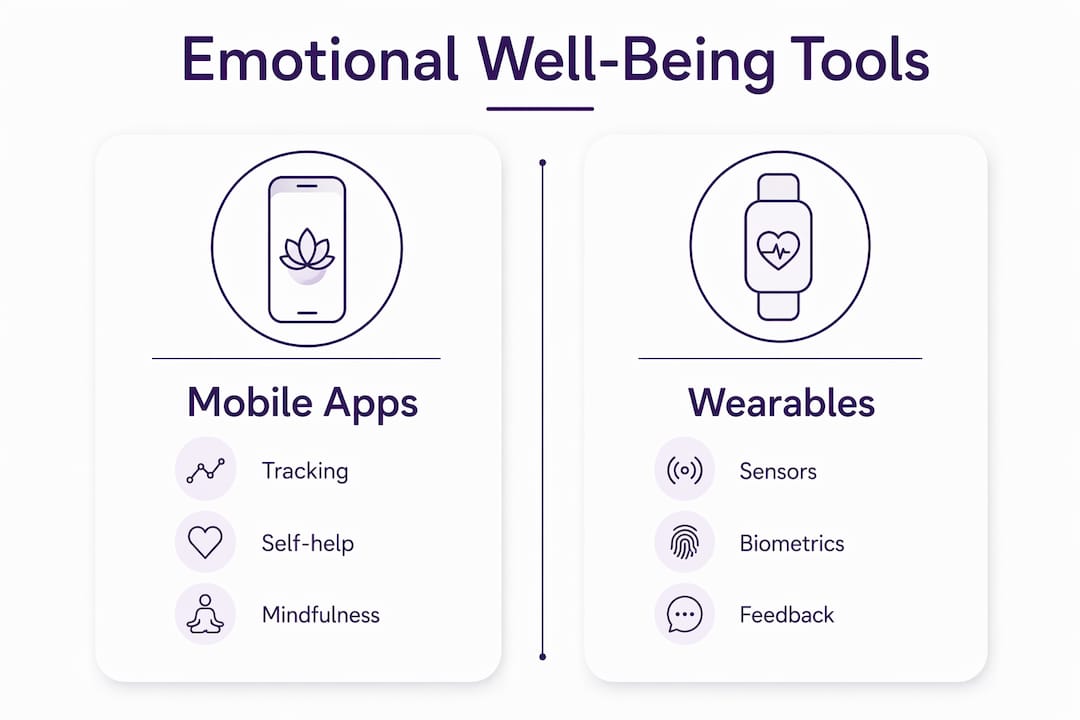
- Mobile apps: Mood trackers, guided meditation tools, and CBT-based skill trainers. Low barrier to entry; user effort is high since you drive the experience.
- Wearable sensors: Devices that passively collect physiological data — heart rate variability (HRV), skin conductance, sleep patterns — to detect stress or emotional shifts without requiring you to log anything.
- Conversational agents (chatbots): AI-driven text or voice interfaces that deliver therapeutic exercises, check-ins, or psychoeducation. Some are purely scripted; others use large language models to adapt responses.
- Web-based comfort spaces: An emerging design direction where intentionally crafted digital environments serve as low-barrier, personalized spaces for emotional reflection and relief.
- Digital therapeutics (DTx) modules: Clinically validated software programs that deliver structured therapeutic protocols — often CBT or DBT — and may carry FDA clearance.
- Clinician-facing dashboards: Platforms that aggregate user-collected data and present it to a therapist for session review, turning passive tracking into richer clinical assessment.
| Category | Typical purpose | Data sources | User effort | Clinical involvement |
|---|---|---|---|---|
| Mobile apps | Skill practice, mood logging | Self-report | High | Low to none |
| Wearable sensors | Passive stress/emotion detection | Physiological signals | Very low | Optional |
| Chatbots / AI agents | Guided check-ins, psychoeducation | Conversation, self-report | Moderate | Low to moderate |
| Comfort websites | Reflection, emotional relief | User interaction | Low | None |
| Digital therapeutics (DTx) | Structured therapy protocols | Self-report, behavioral | Moderate to high | Often required |
| Clinician dashboards | Clinical data review | Aggregated app/sensor data | Low (user side) | High |
How does emotional well-being technology actually detect and respond to emotion?
The mechanics behind these tools are more layered than most people expect. Affective computing systems combine multimodal signals — facial expressions, vocal tone, physiological markers like HRV, and behavioral patterns such as phone usage frequency — to infer your emotional state and then trigger an appropriate response.

The basic flow works like this: sensors or self-report inputs feed data into a model that classifies your likely emotional state. If the model detects elevated stress, it might push a two-minute breathing exercise or a grounding prompt. That’s a just-in-time micro-intervention, and it’s one of the most clinically promising features of this category.
Personalization happens through baseline calibration. A tool learns what “normal” looks like for you specifically over days or weeks, then flags deviations. Longitudinal memory allows the system to adapt content over time — if breathing exercises consistently improve your logged mood, the tool surfaces them more often. For a deeper look at how AI drives this personalization, the AI mental health tools explainer on Cognicareai covers the mechanics in practical terms.
Pro Tip: When using an AI companion or chatbot, share patterns and context rather than just raw data points. Tell it “I’ve been sleeping poorly for three days and feel irritable” rather than just logging a mood score of 3. That narrative context helps the system build a more accurate and useful personalized memory.
Is emotional health technology actually effective?
The honest answer: promising, but with real caveats. A narrative review of affective computing for mental health found that affective adaptation — where a tool actively responds to your detected emotional state — increases engagement and can improve therapeutic effectiveness. The caveat is that validity concerns remain, particularly across diverse populations where training data may not be representative.
“Effective digital interventions require collaboration between mental health professionals and software engineers — engagement and clinical validity are both needed.” — NIMH researchers, via the National Institute of Mental Health
Study designs matter when you’re reading effectiveness claims. Randomized controlled trials (RCTs) offer the strongest evidence. Observational app analytics — the kind most consumer apps cite — show what users report, not what a controlled study confirms. Pilot studies sit in between: useful for generating hypotheses, not for proving efficacy at scale.
When a product claims to be “clinically validated,” ask one question: validated by whom, in what study design, and in which population? A pilot study with 40 college students is not the same as a multi-site RCT. The reasons digital tools improve mental health are real, but the strength of evidence varies considerably by product.
Where does emotional well-being tech help most?
These tools add the clearest value in specific, bounded situations rather than as all-purpose mental health solutions.
- Acute stress management: Breathing prompts, grounding exercises, and biofeedback delivered in the moment — when you can’t reach a therapist but need something now.
- Mood monitoring between sessions: Logging daily mood data gives your clinician a longitudinal picture that a weekly 50-minute session alone can’t provide. NIMH notes that apps can enrich clinical assessment when clinicians review this kind of user-collected data.
- Skill practice and habit-building: CBT thought records, mindfulness exercises, and behavioral activation prompts work well as daily practice tools — the kind of repetition that makes skills stick between therapy appointments.
- Workplace well-being programs: Employers increasingly offer digital mental wellness platforms as benefits, expanding access for employees who might not seek traditional therapy. Deliberate, mindful technology use — purposeful app selection paired with screen-time awareness — reduces harms and supports better outcomes in these contexts.
- Underserved and rural populations: Geography, cost, and stigma all limit access to in-person care. Digital tools lower every one of those barriers simultaneously.
The common thread across all these use cases is supplementation, not substitution. These tools work best alongside human care, not instead of it.

What are the real risks, privacy concerns, and regulatory guardrails?
A critical academic reflection covering AI-mediated emotional support from 2020 to 2025 documents both the promise and the psychosocial risks of this category. The risks that don’t get enough attention:
- Affective dependence: Relying on an AI companion for emotional regulation can erode your capacity to tolerate distress independently or seek human connection.
- Simulated empathy: Chatbots that mirror empathic language may feel supportive without providing genuine relational understanding — a distinction that matters for long-term mental health.
- Algorithmic bias: Models trained on non-representative datasets can misclassify emotional states, particularly for users from underrepresented racial, cultural, or linguistic backgrounds.
- Algorithmic fatigue: Constant nudges and check-ins can become exhausting rather than supportive, especially for users with anxiety.
Privacy checklist before you download anything:
- Does the app have an explicit, readable privacy policy?
- Does it state whether your conversations or data are used to train its AI models?
- Is data encrypted in transit and at rest?
- Does it share data with third-party analytics or advertising platforms?
- If a clinician is involved, is the platform HIPAA-covered?
On the regulatory side: most consumer mental wellness apps are not regulated medical devices. But if an app claims to diagnose, treat, or mitigate a mental health condition, it may fall under the FDA’s Software as a Medical Device (SaMD) framework. Clinician-integrated platforms that handle protected health information are subject to HIPAA. Red flags to walk away from: no privacy policy, vague data-use language, claims that the app replaces therapy, or aggressive data monetization.
This article is general information, not professional advice. Confirm current regulations and your specific situation with a qualified clinician or legal professional.
How do you choose and safely use these tools?
Start with a structured evaluation before you commit to any tool.
- Check the evidence level. Look for published RCTs or peer-reviewed studies, not just testimonials or app store ratings.
- Confirm clinician involvement. Is the content designed or reviewed by licensed mental health professionals?
- Read the privacy policy. Specifically look for data-training language and third-party sharing disclosures.
- Assess data portability. Can you export your mood logs or session data if you switch tools or share them with your therapist?
- Understand the cost model. Is it free with a premium tier, subscription-based, or covered by insurance or an employer benefit?
- Check accessibility features. Does it support screen readers, multiple languages, or low-bandwidth use?
Questions worth asking your clinician before starting: Is this platform HIPAA-covered? Will you be able to review my data? Does the evidence behind this tool apply to someone with my specific diagnosis or situation?
For your first 30 days with a new tool, track two things: whether you’re actually using it consistently, and whether you notice any change in the specific symptom or behavior you targeted. If neither is true after a month, the tool isn’t the right fit. Escalate to a clinician if symptoms worsen or if you’re using the app to avoid seeking care you actually need.
| Evaluation criterion | What to look for |
|---|---|
| Evidence level | Published RCTs or peer-reviewed validation |
| Clinician involvement | Licensed professional design or oversight |
| Privacy policy | Explicit data-training and sharing disclosures |
| Data portability | Export options for personal or clinical use |
| Cost model | Transparent pricing; insurance or employer coverage |
| Accessibility | Screen reader support, language options |
How Cognicareai helps you find the right tool
Cognicareai operates as a curated directory of AI-powered mental health tools, filtered by evidence quality, privacy standards, and clinical relevance. Rather than searching through hundreds of apps with no framework, you can filter by condition (anxiety, depression, stress), tool type (chatbot, mindfulness app, CBT module), and evidence level.
A typical flow for someone looking for anxiety support: filter by “anxiety” and “CBT-based,” then review the privacy and evidence badges Cognicareai assigns each tool. The directory flags whether a tool has published clinical validation and whether its privacy policy explicitly addresses data training. That’s the kind of pre-screening that would otherwise take hours of independent research.
For the best outcomes, pair any tool you find through Cognicareai with your existing care plan. Share the tool’s mood logs or session summaries with your therapist. Clinician-integrated use of app data consistently produces richer clinical assessment than either the tool or the clinician working alone.
Pro Tip: Before your next therapy session, export a week’s worth of mood logs from your app and bring them in. Most clinicians find longitudinal self-report data far more useful than trying to reconstruct a week from memory in a 50-minute session.
How did emotional well-being technology develop over time?
The field has roots in two separate traditions that eventually converged. Cognitive behavioral therapy (CBT) was first adapted for computer-delivered formats in the 1990s, with early programs like Beating the Blues offering structured self-guided modules via desktop software. These were text-heavy, static, and required significant user motivation — but they demonstrated that structured psychological content could be delivered without a therapist in the room.
Affective computing emerged as a research discipline around the same time, pioneered by MIT Media Lab researcher Rosalind Picard, whose 1997 book of the same name argued that machines capable of recognizing and responding to human emotion would be fundamentally more useful. The smartphone era, beginning around 2007, fused these two traditions. Suddenly, a device with sensors, persistent connectivity, and a personal relationship with its owner was in everyone’s pocket.
Between 2015 and 2020, the mental wellness app market expanded rapidly, with thousands of apps entering the market. Quality varied enormously. The COVID-19 pandemic accelerated adoption sharply, as lockdowns eliminated access to in-person care and drove demand for digital alternatives. By 2020–2025, AI reshaped access to emotional support and also created new sociotechnical tensions around algorithmic mediation and relational authenticity.
Who are the key players in the U.S. emotional health tech market?
The U.S. market includes several distinct segments. Consumer wellness apps like Calm and Headspace dominate mindfulness and meditation, with large user bases and brand recognition. Woebot Health operates an AI-driven CBT chatbot with published clinical research behind it. Talkspace and BetterHelp sit at the intersection of digital platforms and human therapist access, offering text-based therapy through licensed professionals.
On the clinical and enterprise side, companies like Spring Health and Lyra Health partner with employers to provide mental health benefits that combine digital tools with therapist matching. The FDA has cleared a small number of digital therapeutics — Pear Therapeutics’ reSET was an early example in substance use disorder — establishing a regulatory pathway for software that functions as a medical device.
Cognicareai occupies a different position: a discovery and curation layer that helps users navigate this fragmented market by filtering tools against evidence and privacy criteria, rather than being a single-product platform itself.
Who uses these tools, and how fast is adoption growing?
Younger adults have driven adoption most visibly. Millennials and Gen Z show higher rates of mental health app use than older cohorts, partly because of lower stigma around mental health discussion and higher comfort with digital self-management. Workplace adoption has expanded the demographic considerably — employer-sponsored mental wellness programs reach employees across age groups who might not seek out an app independently.
Access gaps remain real. Rural populations, lower-income users, and communities of color face barriers including cost, limited broadband access, and tools that were not designed with their cultural contexts in mind. Algorithmic bias in emotion-detection models is a documented concern for users whose expressions, speech patterns, or physiological baselines differ from the populations used to train those models.
How do these tools integrate with traditional care and telehealth?
The most effective integration pairs a digital tool with an active clinical relationship. A therapist who can review a client’s two-week mood log arrives at a session with far more context than memory alone provides. Some platforms are built specifically for this workflow, allowing clinicians to assign exercises, review completion rates, and flag concerning patterns between appointments.
Telehealth expanded dramatically after 2020, and many telehealth platforms now incorporate digital mental health tools as part of their service stack. The CBT principles that underpin many digital interventions translate well to this hybrid model: structured homework between sessions, tracked in an app, reviewed in a video appointment.
HIPAA compliance is the critical variable here. A standalone consumer app is generally not a covered entity under HIPAA. A platform that connects you to a licensed clinician and handles your health information almost certainly is. Know which category your tool falls into before sharing sensitive information.
What does emotional well-being technology typically cost?
Consumer apps range widely in cost, with many offering free entry points and premium subscriptions. Wearables often require an upfront hardware purchase plus optional subscription fees for advanced features.
Clinician-integrated platforms and digital therapeutics often operate through insurance or employer benefits rather than direct consumer pricing. Some DTx products require a prescription and are billed through insurance. Employer-sponsored programs through platforms like Spring Health or Lyra Health are typically fully covered as a workplace benefit, with no out-of-pocket cost to the employee.
The cost of doing nothing is worth factoring in. Untreated anxiety and depression carry real productivity, relationship, and health costs. A $15/month app that meaningfully supports your coping skills between therapy sessions is a different calculation than a $15/month app you open twice and abandon.
What’s coming next in emotional health tech?
Several directions are moving fast. Passive sensing is getting more accurate — newer wearables can detect HRV changes associated with stress with enough precision to trigger interventions before you consciously register that you’re anxious. Large language models are making conversational agents substantially more natural and contextually aware, though the ethical questions around simulated empathy are sharpening alongside the capability.
Comfort websites represent a quieter but genuinely interesting design direction: personalized web environments built as portable, low-barrier spaces for emotional relief and self-reflection. Think of them as the digital equivalent of a calming physical space, accessible from any browser. Regulatory frameworks are also maturing — the FDA’s SaMD pathway is becoming better understood by developers, which should gradually raise the floor on clinical validation for apps that make therapeutic claims.
The most important trend may be integration: tools that talk to each other, share data with clinicians, and fit into a coordinated care plan rather than operating as isolated apps. That’s where the field is heading, and it’s the model Cognicareai’s curation approach is built around.
Key Takeaways
Emotional well-being technology works best as a clinically informed supplement to human care, not a standalone solution — the tools that produce real outcomes are those paired with evidence-based content, clear privacy practices, and some form of clinician oversight.
| Point | Details |
|---|---|
| Definition | Digital tools that assess, monitor, and support emotional self-regulation using apps, sensors, AI, and web platforms. |
| Evidence standard | Look for published RCTs or peer-reviewed validation; app analytics alone do not confirm clinical efficacy. |
| Key risks | Affective dependence, algorithmic bias, and privacy exposure are the most documented concerns to evaluate before adopting a tool. |
| Integration matters | Pairing a digital tool with a clinician’s care plan consistently produces better outcomes than using either alone. |
| Cognicareai’s role | Cognicareai curates AI-powered mental health tools filtered by evidence quality and privacy standards, simplifying safe discovery. |
The gap between what this technology promises and what actually matters
Most coverage of emotional well-being technology focuses on what these tools can do at their best. That’s useful, but it misses the more important question: what conditions have to be true for them to actually help you?
The honest answer from the research is that the technology itself is rarely the limiting factor. The limiting factor is almost always integration. A mood-tracking app used in isolation, with no clinician reviewing the data and no structured response to what it reveals, produces data you probably won’t act on. The same app, connected to a therapist who reviews your logs and adjusts your care plan accordingly, becomes a genuinely useful clinical instrument.
The other thing worth saying plainly: the sociotechnical tensions that AI-mediated emotional support creates are real, not theoretical. When an algorithm becomes your primary source of emotional validation, something shifts in how you relate to uncertainty, discomfort, and other people. That’s not an argument against using these tools. It’s an argument for using them deliberately, with awareness of what you’re trading and what you’re not.
Cognicareai’s curation model matters precisely because the market is noisy. Most apps make claims they can’t fully support. Filtering by evidence quality and privacy standards before you even open an app is the single most protective thing you can do. Start there.
Cognicareai makes finding the right mental health tool straightforward
Finding a trustworthy mental wellness app shouldn’t require a research degree. Cognicareai’s directory cuts through the noise by pre-screening AI-powered mental health tools against evidence quality, privacy standards, and clinical relevance — so you spend your time using a tool that fits, not evaluating whether it’s safe to try.
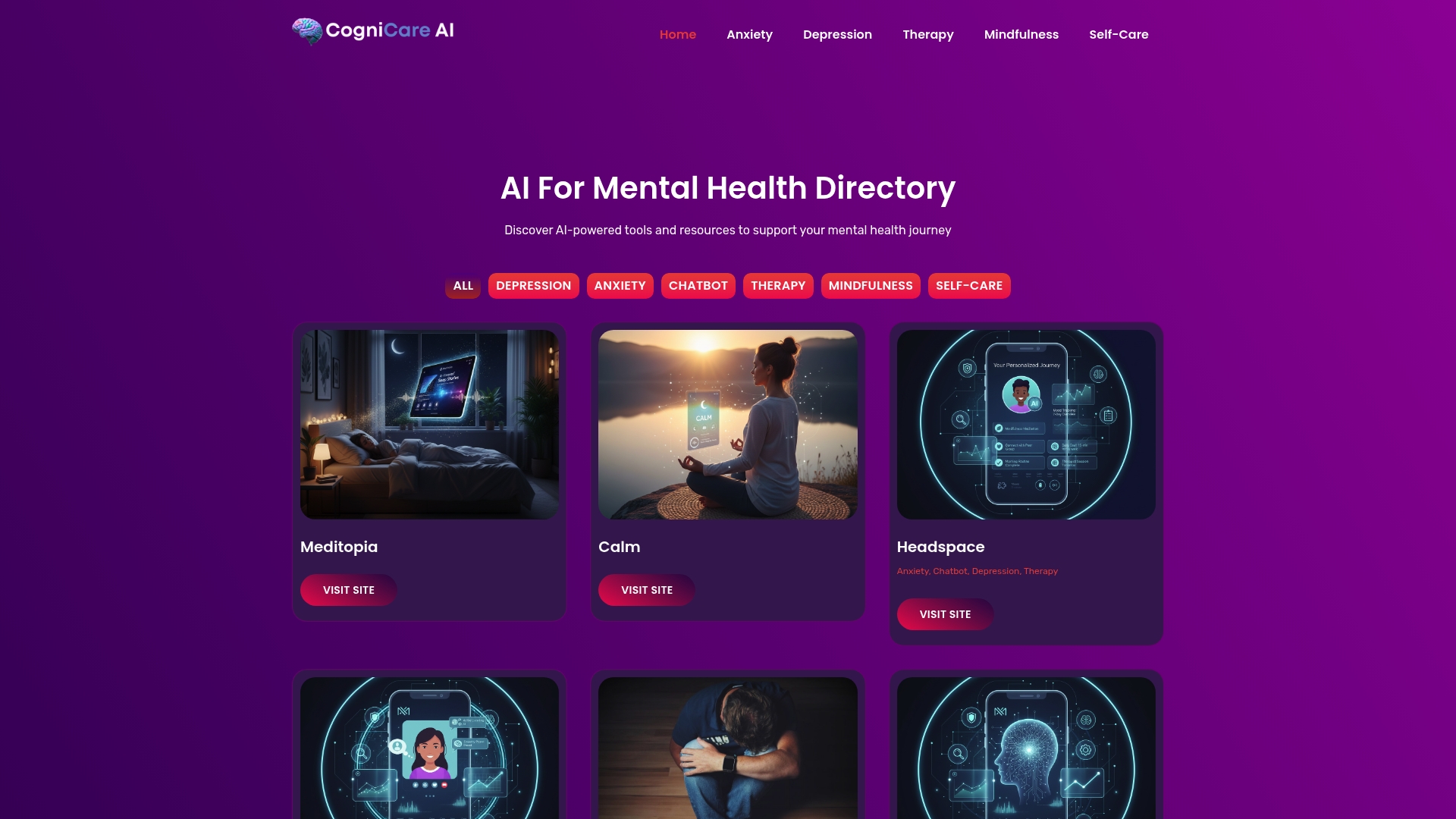
Whether you’re managing everyday stress, looking for structured CBT practice between therapy sessions, or exploring mindfulness apps built with AI personalization, the directory gives you a filtered starting point rather than a wall of options. Every tool listed includes clarity on its evidence basis and data practices. Browse the directory and find a tool matched to your situation — and if symptoms are serious or worsening, bring what you find to a licensed clinician who can integrate it into your care.
Useful sources for further reading
- Technology and the Future of Mental Health Treatment — NIMH: The National Institute of Mental Health’s authoritative overview of digital tools, their benefits, and their limits in clinical and self-care contexts.
- Emotionally Adaptive Support: A Narrative Review of Affective Computing for Mental Health — Frontiers in Digital Health: Comprehensive review of how affective computing systems detect and respond to emotional states, including evidence quality and population validity concerns.
- Artificial Intelligence and the Reconfiguration of Emotional Well-Being (2020–2025) — MDPI: Critical academic reflection on the psychosocial risks and ethical tensions created by AI-mediated emotional support.
- Digital Well-being Through the Use of Technology — PMC: Peer-reviewed research on how technology use patterns affect mental and emotional well-being outcomes.
- The Future of Emotional Technology: Comfort Websites — Codrops: Design-focused exploration of comfort websites as an emerging low-barrier emotional technology format.
- Understanding Digital Wellbeing: Impacts, Strategies, and Healthier Technology Practices — Springer Nature: Research on deliberate technology use strategies that reduce harm and support better emotional outcomes.
- Tech and Mental Health: Using Digital Tools to Improve Well-Being — NYU Shanghai: Accessible overview of how digital tools are being applied to mental health improvement in practice.