

A mental health directory is a centralized, searchable database listing licensed mental health providers, treatment centers, and support programs to connect individuals with appropriate care. Think of it as the mental health equivalent of a professional registry. You search by location, specialty, or insurance, and the directory returns a list of vetted options. Platforms like SAMHSA’s National Helpline Locator and Psychology Today’s therapist finder are two of the most widely used examples. If you’ve ever typed “therapist near me” and felt overwhelmed by the results, a structured directory is the tool that cuts through the noise.
What is a mental health directory and how does it work?
A mental health directory is a structured online resource that organizes provider listings so you can search by specific criteria rather than scrolling through generic search results. The term “mental health directory” is widely used, though professionals in the field often call these resources provider locators or therapist finders. Both terms describe the same core function: matching people who need mental health services with qualified professionals or programs.

Government and private directories operate differently, and understanding that distinction matters. SAMHSA’s locator, maintained by the Substance Abuse and Mental Health Services Administration, covers thousands of treatment facilities and programs nationwide. It focuses on facilities, clinics, and treatment centers rather than individual clinicians. Private platforms like Psychology Today, TherapyDen, and Open Path Collective list individual therapists with detailed profiles showing credentials, therapy approaches, accepted insurance, and session fees.
The core mechanism is the same across all directories. You enter a ZIP code or city, apply filters based on your needs, and browse results. Some directories let you filter by specialty areas like trauma, eating disorders, or LGBTQ+ affirming care. Others let you filter by therapy modality, such as cognitive behavioral therapy or EMDR. The depth of filtering varies significantly between platforms.
What types of mental health directories exist?
The two primary categories are government-maintained directories and private or commercial platforms. Each serves a distinct purpose, and using only one type limits your search.
| Directory type | Primary focus | Best used for |
|---|---|---|
| Government (e.g., SAMHSA) | Treatment facilities, clinics, programs | Finding inpatient care, substance use programs, community mental health centers |
| Private (e.g., Psychology Today) | Individual therapists, counselors, psychiatrists | Finding outpatient therapy, specialty care, private practice providers |
| Nonprofit (e.g., Mental Health America) | General resources, screening tools, referrals | Initial orientation, understanding options, finding local affiliates |
| Specialty directories (e.g., TherapyDen) | Niche populations, specific identities | LGBTQ+ care, culturally specific therapy, trauma-focused providers |
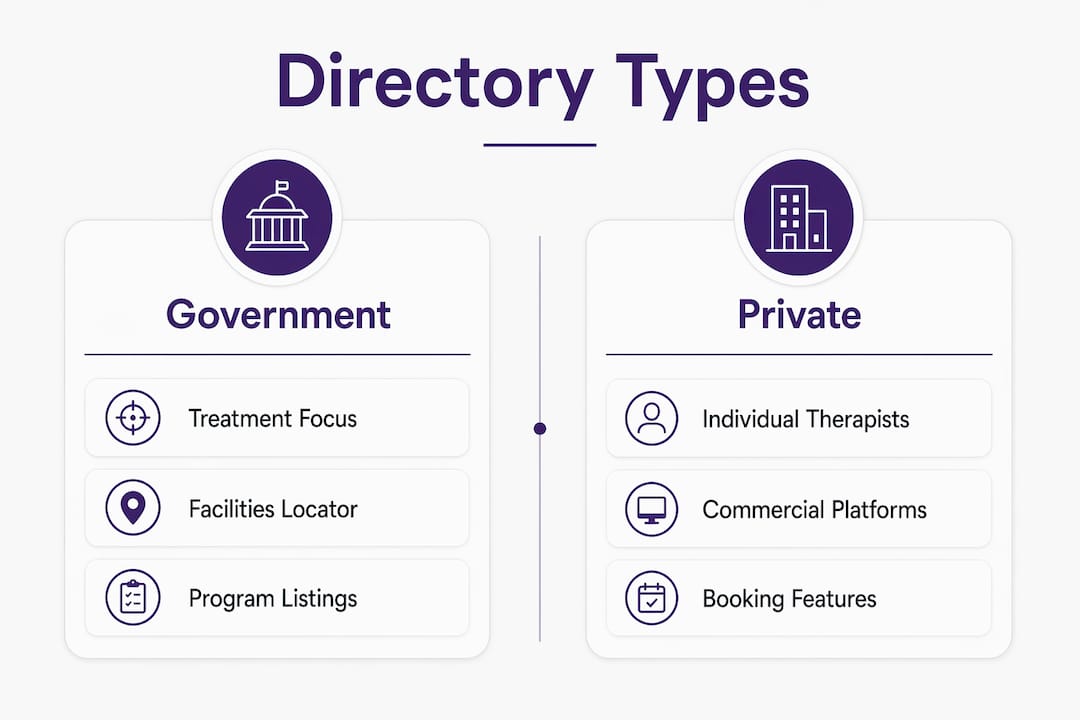
Government directories update on an annual cycle, which means a facility listed today may have changed its services or intake status since the last update. Private directories rely on providers to update their own profiles, which creates inconsistency. Some profiles on major platforms have not been updated in years.
Key differences between directory types include:
- Scope: Government directories cover facilities and programs. Private directories cover individual clinicians.
- Filter depth: Private platforms offer more granular filters, including therapy type, fee range, and identity-affirming practices.
- Verification: Government directories verify facility licensing. Private directories vary in how thoroughly they verify individual credentials.
- Cost to list: Many private directories charge providers a monthly fee to maintain a profile, which means some qualified providers simply are not listed.
Combining both government and private directories gives you the broadest possible view of available mental health resources in your area.
How to use a mental health directory effectively
Using a directory well takes more than typing in your ZIP code. The process has distinct steps, and skipping any of them increases the chance you’ll contact providers who aren’t a good fit or aren’t currently accepting new clients.
- Start with your location and insurance. Enter your ZIP code and filter by your insurance plan first. This eliminates providers who would result in out-of-pocket costs you haven’t budgeted for.
- Apply specialty filters. If you’re dealing with anxiety, trauma, or a specific diagnosis, filter by that specialty. Private directories allow filtering by credentials, specialty, fees, and insurance, so use every relevant filter before reviewing results.
- Read full profiles carefully. Look at the provider’s stated therapy approaches, years of experience, and any personal statement they’ve written. A therapist who specializes in CBT for OCD is a different fit than one who focuses on relationship issues using psychodynamic therapy.
- Build a shortlist of three to five providers. Mental Health America recommends contacting multiple providers simultaneously because availability varies widely. Waiting on one response before contacting others adds weeks to your search.
- Contact providers directly. Directories typically lack real-time booking, so you’ll need to call or email. Ask about current availability, typical wait time for an intake appointment, and whether they’re accepting new clients.
- Verify insurance independently. Call your insurance company to confirm the provider is in-network. Directory information can be outdated, and an out-of-network session can cost two to three times more than an in-network one.
Pro Tip: Before you contact any provider, write down three specific questions: Do you have experience treating [your specific concern]? What is your current wait time for new clients? What does a typical first session look like? These questions save time and help you assess fit before committing to an intake appointment.
One critical distinction: directories serve people seeking ongoing or non-urgent care. If you’re in crisis, the 988 Suicide and Crisis Lifeline and the Crisis Text Line (text HOME to 741741) are the right resources. Directories target non-crisis support, and using them during an acute crisis adds unnecessary delay.
What are the benefits and limitations of mental health directories?
Directories solve a real problem. Before platforms like Psychology Today or SAMHSA’s locator existed, finding a therapist meant asking your primary care doctor for a referral, calling your insurance company, or relying on word of mouth. Directories centralized that fragmented process.
Core benefits include:
- Centralized access to hundreds or thousands of providers in one place
- Filtering by insurance, specialty, location, and fee range
- Provider profiles that let you assess fit before making contact
- Broad geographic coverage, including rural areas where referral networks are thin
- Access to both facility-based and individual practitioner listings
Limitations you need to know:
- Profile information may be outdated. A provider listed as accepting new clients may have a six-month waitlist.
- No real-time scheduling. Every directory requires you to contact providers directly, which adds time and effort to the process.
- Listings are not endorsements. Being listed in a directory does not mean a provider has been vetted for quality of care.
- Coverage gaps exist. Providers who don’t pay listing fees or who practice in underserved areas may not appear in private directories.
CDC and HHS guidance explicitly cautions against treating directories as definitive provider endorsements. Always cross-reference a provider’s name against your insurance company’s own network list. This step prevents surprise bills that can arrive weeks after your first session.
The gap between listed availability and actual availability is the single biggest frustration users report. A directory tells you a provider exists and accepts your insurance. It does not tell you whether they have an opening this month or this year.
Best practices for finding mental health support through directories
The most effective searches combine preparation, persistence, and a realistic timeline. Most people who struggle to find a therapist through a directory made one of three mistakes: they contacted only one provider, they skipped the insurance verification step, or they didn’t prepare specific questions before reaching out.
Preparing specific questions before contacting providers is one of the most consistently recommended practices among mental health professionals. Ask about diagnosis-specific experience, intake timelines, and current openings. These three questions alone filter out most mismatches before you’ve invested time in a phone consultation.
Additional practices that improve your success rate:
- Use both directory types. Search SAMHSA for facility-based options and a private platform like Psychology Today for individual therapists. Mixing both resource types gives you coverage across the full spectrum of available services.
- Check the profile update date. Some directories display when a profile was last updated. Prioritize recently updated profiles.
- Look for telehealth options. Telehealth listings expand your geographic reach significantly. A therapist licensed in your state but located two hours away can still serve you via video. Telehealth services have expanded access for people in areas with limited local providers.
- Report inaccurate listings. Most directories have a mechanism for flagging outdated or incorrect information. Using it improves the resource for everyone.
- Understand therapy model descriptions. Terms like “trauma-informed,” “person-centered,” and “solution-focused” describe specific approaches. A quick search on any of these terms before reviewing profiles helps you identify which model fits your needs.
Pro Tip: If your first round of contacts yields no available providers, expand your search radius or add telehealth as a filter. Mental Health America’s guidance on iterative provider search confirms that persistence across multiple contacts is the most reliable path to securing timely care.
Finding a therapist through a directory is rarely a one-step process. Build a backup list, stay organized, and treat the search as a short project rather than a single task.
Key takeaways
A mental health directory is a navigation tool, not a guarantee of care. Its value depends entirely on how you use it.
| Point | Details |
|---|---|
| Definition and purpose | A mental health directory is a searchable database connecting users to licensed providers, facilities, and programs. |
| Use both directory types | Combine government directories like SAMHSA with private platforms to cover facilities and individual therapists. |
| Verify insurance independently | Always confirm in-network status directly with your insurer. Directory data can be outdated. |
| Contact multiple providers | Reach out to three to five providers simultaneously to reduce wait times and improve your chances of finding availability. |
| Directories are not crisis tools | For urgent needs, use 988 or the Crisis Text Line. Directories serve ongoing, non-emergency care searches. |
Why directories matter more than most people realize
I’ve spent years watching people give up on finding mental health support after one or two failed attempts through a directory. The frustration is real. You filter carefully, find someone who looks like a perfect fit, send a message, and hear nothing back for two weeks. That silence feels like rejection, but it’s almost always a capacity problem, not a fit problem.
What I’ve found is that most people treat a mental health directory the way they’d treat a restaurant review site. They browse, pick one option, and expect it to work. Mental health provider searches don’t work that way. The supply of available therapists in most metro areas is genuinely constrained, and the gap between “listed” and “available” is wider than most directories acknowledge.
The directories that do this best are the ones investing in real-time data. AI-powered tools that flag stale profiles or surface providers with confirmed availability are starting to appear, and they change the experience meaningfully. Cognicareai is one example of a platform moving in this direction, using AI to match users with resources that fit their specific situation rather than returning a generic list.
My honest advice: use directories as a starting point, not a final answer. Pair them with your insurance company’s own provider list, ask specific questions before booking, and give yourself two to three weeks for the process. The people who find good care through directories are almost always the ones who treated it as a structured search rather than a quick lookup.
— dushyantha
Take your mental health search further with Cognicareai
Finding the right provider through a directory is a strong first step. What comes next, managing day-to-day mental health between sessions, is where many people need additional support.
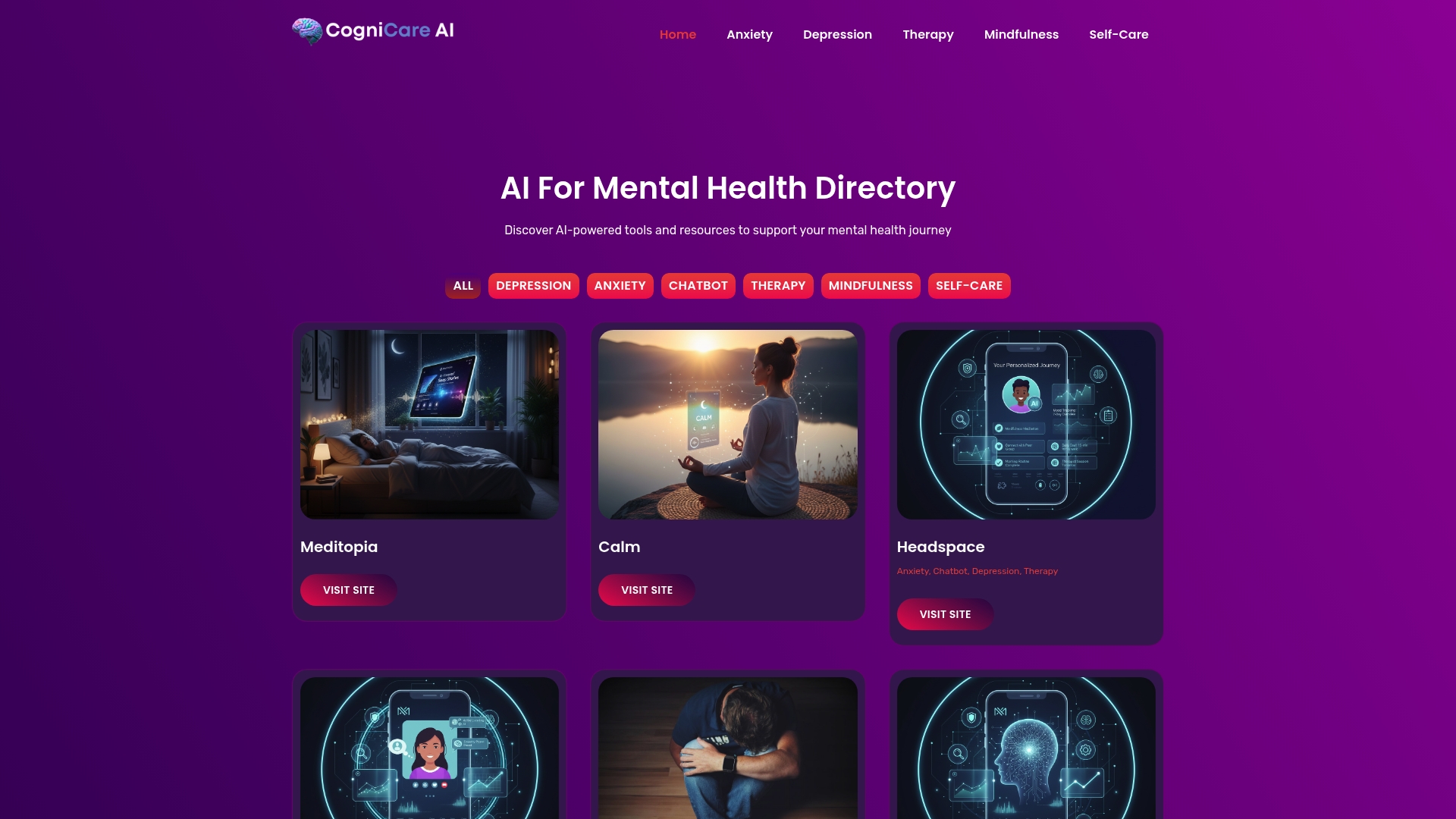
Cognicareai offers a directory of AI-powered mental health tools designed to complement the care you find through traditional provider searches. From mindfulness apps and self-care programs to AI chatbots that adapt to your specific mental health needs, Cognicareai fills the gap between appointments. Users report stronger coping strategies and better emotional resilience when they combine professional care with the personalized tools available through Cognicareai. Explore the full range of AI tools to find what fits your situation.
FAQ
What is a mental health directory?
A mental health directory is a centralized, searchable online database listing licensed mental health providers, treatment facilities, and support programs. It helps individuals find appropriate care by filtering results based on location, specialty, insurance, and other criteria.
How is SAMHSA’s locator different from Psychology Today?
SAMHSA’s locator focuses on treatment facilities and programs, while Psychology Today lists individual therapists and clinicians with detailed profiles. Using both gives you the broadest search coverage across facility-based and outpatient care.
Can I book appointments directly through a mental health directory?
Most directories do not offer real-time appointment booking. You use the directory to identify providers, then contact them directly by phone or email to confirm availability and schedule an intake appointment.
What should I do if I can’t find an available provider?
Mental Health America recommends contacting three to five providers simultaneously rather than waiting on one response. Expanding your search to include telehealth providers also significantly increases your options.
Are mental health directories safe to use in a crisis?
Directories are not designed for crisis situations. If you are in crisis, contact the 988 Suicide and Crisis Lifeline by calling or texting 988, or text HOME to 741741 to reach the Crisis Text Line. Directories serve non-urgent, ongoing care searches.