

Self-compassion practices during depression are intentional acts of kindness toward yourself that clinical research recognizes as a protective factor against depressive rumination and harsh self-judgment. The formal term used in psychology is self-compassion, defined by researcher Kristin Neff as treating yourself with the same care you would offer a close friend in pain. When depression tells you that you are failing, self-compassion interrupts that cycle. This guide gives you concrete, research-backed tools to start building that skill today, even on your hardest days.
What are effective self-compassion practices during depression?
Self-compassion is a learnable skill, not a personality trait you either have or lack. That distinction matters enormously when you are depressed, because depression will tell you that kindness toward yourself is impossible or undeserved. The practices below are designed to work even when motivation is low.
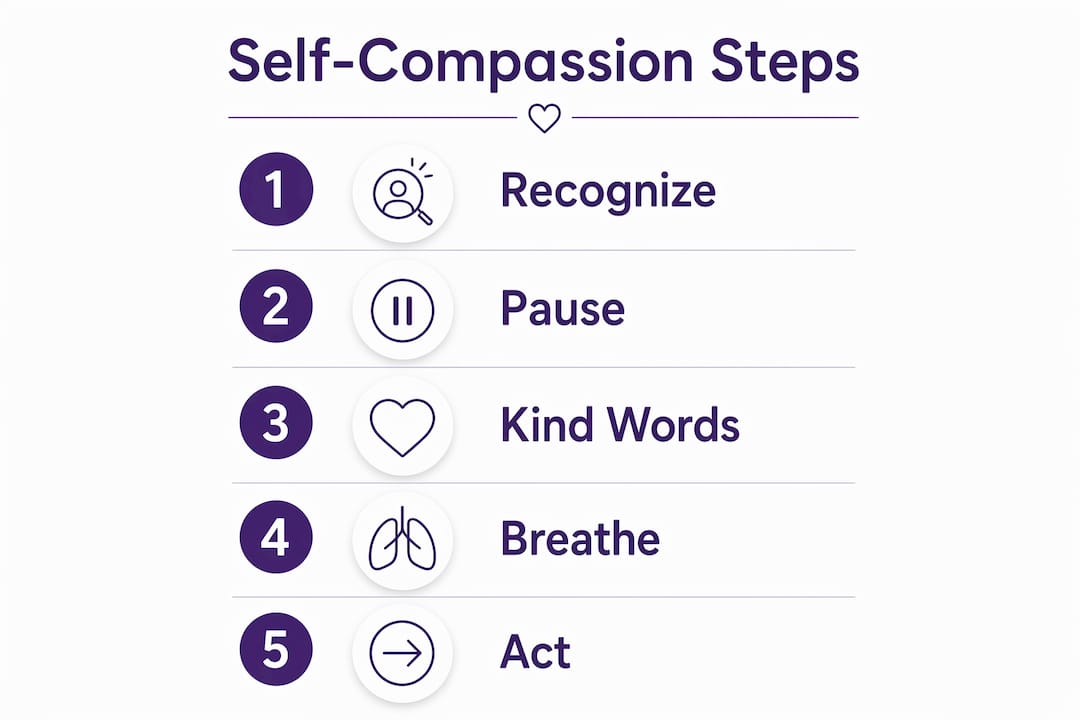
Shift your perspective with the “close friend” test. When your inner critic fires up, ask yourself: “What would I say to a friend going through exactly this?” Then say that to yourself. Harvard Health identifies this reframe as one of the most direct ways to activate self-compassion, because most people are far gentler with others than with themselves.

Use positive self-talk as a daily practice. Recognize the critical thought, name it (“There’s that harsh voice again”), and replace it with a neutral or kind statement. You are not trying to force positivity. You are simply refusing to let the critical thought go unchallenged.
Try these core self-compassion exercises:
- Mindful breathing: Sit comfortably, place one hand on your chest, and take three slow breaths. Acknowledge that you are struggling. That acknowledgment is the first act of self-compassion.
- Loving-kindness meditation: Silently repeat phrases like “May I be safe. May I be well. May I be at peace.” Start with just two minutes. The Insight Timer app and UCLA Mindful both offer free guided versions.
- Body scan: Lie down and slowly move your attention from your feet to your head, noticing sensations without judgment. This is especially useful when depression makes your body feel heavy or numb.
- Supportive touch: Place a hand over your heart or wrap your arms around yourself. Physical self-contact activates the body’s soothing system and works as a grounding technique when words feel hollow.
Pro Tip: You do not need to believe the kind words at first. Repeat them anyway. The goal is practice, not instant belief.
Behavioral activation is the fifth practice worth naming here. Depression creates a motivation-action reversal, meaning action must come before motivation returns. One small compassionate act, like making tea or stepping outside for five minutes, is enough to start shifting your state.
How do you build self-compassion skills over time during depression?
Building self-compassion skills sustainably requires structure, especially when depression flattens your energy and disrupts your routine. The good news is that even brief, imperfect practice accumulates over time.
-
Start with the Mindful Self-Compassion (MSC) program. Developed by Kristin Neff and Christopher Germer, the MSC course runs 8 weeks, with 2.5-hour weekly group sessions and daily home practice. It is one of the most studied self-compassion programs in clinical psychology. Many therapists now offer it in group or individual formats, and online versions are available through the Center for Mindful Self-Compassion.
-
Anchor practice to an existing habit. Pair a one-minute loving-kindness phrase with your morning coffee or a body scan with your nightly wind-down. Habit stacking removes the decision-making burden that depression makes so costly.
-
Use the “one breath” reset. On days when a full practice feels impossible, one conscious breath counts. Brief, incomplete practices are more effective than abandoning practice entirely because you feel you cannot do it “right.” Wholeosophy’s mindfulness research confirms that messy, partial efforts still produce benefit.
-
Dispel the self-pity myth. Self-compassion is not self-pity or laziness. Research from Harvard Health shows that self-compassion after setbacks actually increases motivation to improve, because it removes the shame that keeps people stuck. Shame is paralyzing. Kindness is activating.
-
Accept imperfection as part of the practice. You will miss days. You will do a body scan while half-asleep. That is fine. Consistency over weeks matters far more than perfection on any single day.
Pro Tip: Set a two-minute timer on your phone labeled “Kind Moment.” When it goes off, do one breath and one kind phrase. That is a complete practice.
What are common challenges when practicing self-compassion during depression?
Depression creates specific obstacles to self-compassion that are worth naming directly so you can prepare for them.
The motivation trap. Depression reverses the normal motivation-action sequence. You wait to feel ready before acting, but the feeling never comes. The solution is to act first, even when it feels pointless. Small initial actions like a two-minute walk or writing one kind sentence in a journal are enough to begin shifting your mood state.
Harsh self-criticism and shame. Many people with depression carry deep shame about being depressed at all. Self-compassion directly targets this. Self-compassion reduces shame after setbacks, which in turn increases motivation to keep going. Bedre Health’s clinical analysis identifies shame reduction as the primary mechanism by which self-compassion counters depressive stagnation.
Performance pressure in practice. Treating self-compassion like a task you can fail at is counterproductive. There is no correct way to feel during a body scan. There is no minimum quality for a loving-kindness phrase. The practice is the attempt, not the outcome.
“You don’t have to feel compassion to practice it. You just have to show up for yourself the way you would show up for someone you love.”
Acute depressive episodes. During severe episodes, even simple practices can feel out of reach. Low-barrier mindfulness techniques like three-breath resets or a 60-second body scan are specifically designed to bypass overwhelm. These are not lesser versions of practice. They are the right tool for the moment.
Social support without overload. Reaching out to one trusted person, not a group, reduces isolation without triggering the social anxiety that depression often amplifies. You can also explore healthy coping mechanisms that combine social connection with low-pressure self-care strategies.
How to integrate self-compassion with complementary self-care techniques
Self-compassion works best as part of a broader self-care framework. The practices below are evidence-based and directly support the emotional work of building self-kindness.
Sleep hygiene is foundational. Approximately 80% of individuals with clinical depression experience disturbed sleep. That statistic means poor sleep is not a side effect of depression for most people. It is a central feature. Keeping a consistent sleep and wake time, even on weekends, stabilizes mood regulation and makes self-compassion practice more accessible the next day.
Aerobic exercise is a clinical-grade tool. 30 minutes of moderate aerobic exercise most days of the week reduces depression symptoms at a level comparable to antidepressants for mild to moderate depression. Exercise does not require a gym. A brisk 30-minute walk counts. The key is consistency, not intensity.
Pro Tip: Pair your walk with a loving-kindness phrase. Repeat “May I be well” silently with each step. You get the exercise benefit and the self-compassion practice in one session.
The table below shows how self-compassion and complementary practices work together:
| Practice | Primary benefit | Best time to use |
|---|---|---|
| Loving-kindness meditation | Reduces self-criticism and rumination | Morning or before sleep |
| Consistent sleep schedule | Stabilizes mood and energy | Every day, non-negotiable |
| 30-minute aerobic exercise | Reduces symptoms comparably to antidepressants | Midday or early afternoon |
| Supportive touch or body scan | Grounds you during acute distress | Any time, especially during low points |
| Minimal social contact | Reduces isolation without overwhelm | Once daily, one trusted person |
Positive sensory experiences also matter. Nature exposure, even a ten-minute sit in a park, lowers cortisol and creates a small but real mood shift. These are not luxuries. They are adaptive self-care rituals that support the emotional work you are doing.
Key takeaways
Self-compassion during depression is a clinically recognized, learnable skill that reduces rumination, lifts shame, and restores motivation through consistent, low-barrier practice.
| Point | Details |
|---|---|
| Self-compassion is a skill | Treat yourself as you would a close friend; this is learnable with structured practice. |
| Act before motivation arrives | Depression reverses motivation and action; small acts first restore mood and momentum. |
| Brief practice still works | One breath or one kind phrase counts; incomplete practice beats no practice every time. |
| Sleep and exercise amplify results | Consistent sleep schedules and 30 minutes of aerobic exercise directly reduce depressive symptoms. |
| Shame reduction drives recovery | Self-compassion removes shame after setbacks, which is the primary mechanism that restores motivation. |
What I have learned from watching people practice self-compassion through depression
The first thing most people get wrong is waiting until they feel ready. I have seen this pattern repeatedly. Someone learns about loving-kindness meditation, feels nothing during the first three attempts, and concludes it does not work for them. What actually happened is that they ran into the hardest part of depression: the gap between knowing something is good for you and feeling any pull toward it.
The small moments are where the real change happens. Not the 20-minute meditation sessions. The two-second pause before responding to a critical thought. The hand placed over the heart during a hard phone call. These micro-practices accumulate in ways that a weekly session never quite captures.
I also think the self-pity myth does more damage than almost any other misconception in mental health. People resist self-compassion because they confuse it with making excuses or wallowing. The research says the opposite is true. Kindness toward yourself after a setback increases your likelihood of trying again. Shame keeps you frozen. Compassion gets you moving. That is not soft thinking. That is how motivation actually works in a depressed brain.
The most honest thing I can say is this: self-compassion is not a cure for depression, and it should not be positioned as one. It is a tool that makes the other tools more accessible. When you are a little kinder to yourself, sleep hygiene feels less punishing, exercise feels less impossible, and reaching out to someone feels less terrifying. Start there. One breath, one kind phrase, one small act. The rest follows.
— dushyantha
Ready to go deeper with AI-powered mental health support?
Self-compassion practice is stronger when you have the right tools supporting you. AI-powered mental health apps now offer guided loving-kindness meditations, behavioral activation reminders, and mood tracking that adapts to where you are on any given day.

Cognicareai has built a directory of the most effective AI mental health tools available in 2026, specifically curated for people managing depression and anxiety. You can also explore top mindfulness apps enhanced by artificial intelligence that make self-compassion exercises more accessible, even on your lowest days. These resources meet you where you are, not where you think you should be.
FAQ
What is self-compassion and why does it help with depression?
Self-compassion is the practice of treating yourself with the same kindness you would offer a close friend in distress. It helps with depression by interrupting cycles of self-judgment and rumination, which are core features of depressive thinking.
How long does it take to build self-compassion skills?
The Mindful Self-Compassion program runs 8 weeks with daily practice and produces measurable results within that timeframe. Shorter daily practices, even one to two minutes, also build the skill over time with consistent effort.
Can I practice self-compassion when I have no motivation?
Yes. Depression reverses the normal motivation-action sequence, so you act first and let motivation follow. One breath, one kind phrase, or one small physical gesture counts as a complete practice on a hard day.
Is self-compassion the same as self-pity?
Self-compassion is not self-pity. Research shows that self-compassion after setbacks removes shame and increases motivation to improve, while self-pity tends to increase rumination and stagnation.
What self-care techniques work best alongside self-compassion?
Consistent sleep schedules and 30 minutes of moderate aerobic exercise most days are the two most evidence-backed complements to self-compassion practice for depression. You can find a full depression self-care strategy list that integrates these approaches on Cognicareai.