

Online mental health resource categories are organized into five distinct types: crisis intervention, self-assessment tools, treatment navigation, self-care apps, and peer support communities. Knowing which category matches your current need is the fastest way to get real help. Mental Health America’s screening program has served over 32 million people since launch, proving that structured access to the right resource type changes outcomes. This guide maps each category clearly so you can move from confusion to action, whether you’re managing anxiety, depression, or something you haven’t named yet.
1. What are the main online mental health resource categories?
Sorting mental health resources by need reduces confusion and improves navigation. Kaiser Permanente organizes online mental health resources into four need-based groups: crisis intervention, self-assessment, support groups and classes, and self-care apps. This article adds treatment navigation as a fifth category because it serves a distinct user pathway between assessment and ongoing care. Think of these categories as a ladder. You start where your need is most urgent, then move toward long-term support as your situation stabilizes.
2. Crisis intervention resources: when seconds matter
The 988 Suicide and Crisis Lifeline provides 24/7 one-on-one support via call, text, or chat with trained crisis counselors across the U.S. This is the correct first stop for anyone experiencing suicidal thoughts, a mental health emergency, or a situation that feels unmanageable right now. Crisis support is not the same as ongoing treatment. SAMHSA separates these pathways deliberately because the skills and response speed required are entirely different.

Mobile crisis teams extend this support into communities. These teams are staffed by mental health professionals and aim to provide trauma-informed, health-first responses that reduce unnecessary emergency room visits and avoid law enforcement involvement when possible. Availability varies by location, but telehealth options are expanding access in areas where in-person teams are limited.
Key situations where crisis resources apply:
- Thoughts of self-harm or suicide
- Severe panic attacks that feel physically dangerous
- Psychotic episodes or breaks from reality
- Witnessing or experiencing a traumatic event in real time
- Any mental health situation where you feel unsafe
Pro Tip: If you are unsure whether your situation qualifies as a crisis, contact 988 anyway. Crisis counselors are trained to assess severity and redirect you to the right resource if immediate intervention is not needed.
3. How online screening tools help you identify what you need
Free, validated screening tools are the most accessible entry point into mental health care for most people. Mental Health America offers 14 validated anonymous screens covering depression, anxiety, bipolar disorder, PTSD, and several other conditions. In 2025, 32.13% of users took the depression screen, with 83.90% scoring at risk. That figure tells you something important: most people who seek out a screening tool already have a real, measurable need.
Screening tools do not diagnose. They measure symptom patterns against validated clinical scales and show you where you fall on a risk spectrum. That output gives you language to use with a doctor or therapist and a concrete reason to seek professional follow-up rather than dismissing your symptoms as stress.
Steps to use screening tools effectively:
- Choose a screen that matches your primary concern, such as depression, generalized anxiety, or PTSD.
- Answer honestly. These tools are anonymous and the results are for your use only.
- Read the results page carefully. Most tools include recommended next steps based on your score.
- Save or screenshot your results before your first appointment with a provider.
- Use the results as a conversation starter, not a final answer.
Pro Tip: Mental Health America’s screening program links directly to local resources after you complete a screen. Use that feature. It cuts the time between assessment and action significantly.
4. Treatment navigation and provider directories
Treatment navigation is the category that connects your identified need to an actual provider or program. SAMHSA’s FindTreatment.gov is a confidential, anonymous online directory for mental health and substance use disorder treatment across the U.S. It includes separate directories for opioid treatment programs and early serious mental illness services, which matters because those populations have specialized care needs that general directories do not address well.
Filtering by location and care type is not optional. Searching by specific care level reduces wasted time and connects you to appropriate treatment faster than browsing general results. If you need intensive outpatient care, searching for that specifically will return different and more useful results than a broad mental health search.
| Resource type | Best used for | Key feature |
|---|---|---|
| SAMHSA FindTreatment.gov | Mental health and substance use treatment | Anonymous, location-based search |
| SAMHSA Opioid Directory | Opioid use disorder treatment | Specialized program listings |
| Early Serious Mental Illness Directory | First-episode psychosis, early SMI | Coordinated specialty care programs |
| Online therapy platforms | Ongoing talk therapy via video or text | Virtual therapy options, often insurance-eligible |
| Mental health directories | Finding vetted providers by specialty | Searchable, filtered by need and location |
Virtual therapy options through platforms that connect users with licensed therapists have expanded significantly. Many accept insurance, and some offer sliding-scale fees. Treatment navigation differs from crisis support in one critical way: it is for people who are stable enough to plan ahead and commit to a care relationship over time.
5. Self-care apps and online support communities
Self-care apps occupy the daily maintenance layer of mental wellness. Kaiser Permanente recommends science-backed tools like Headspace for mindfulness practice alongside live text-based emotional support coaching available 24/7. These tools work best as complements to professional care, not replacements for it.
| App type | Example use case | Limitation |
|---|---|---|
| Mindfulness and meditation | Daily stress reduction, sleep support | Does not treat clinical disorders |
| Mood tracking | Identifying emotional patterns over time | Requires consistent user input |
| AI-powered chatbots | Between-session emotional support | Not a substitute for therapy |
| Peer support communities | Shared experience, reduced isolation | Quality varies by platform moderation |
Online support groups and community forums add a social dimension that apps cannot replicate. Shared experience reduces isolation, which is itself a risk factor for worsening depression and anxiety. The limitation is consistency: unmoderated forums can expose users to misinformation or harmful content.
Benefits and limitations of self-care tools at a glance:
- Benefit: Available 24/7 with no appointment needed
- Benefit: Low or no cost compared to clinical care
- Benefit: Builds daily habits that support long-term resilience
- Limitation: Cannot replace diagnosis or clinical treatment
- Limitation: Privacy standards vary widely across apps
- Limitation: Engagement tends to drop without external accountability
Pro Tip: Before downloading any mental health app, check its privacy policy for data-sharing practices. Apps that sell anonymized data to third parties can still expose sensitive behavioral patterns. Look for apps that store data locally or use end-to-end encryption.
6. How to evaluate the safety and trustworthiness of online tools
The APA Labs Digital Badge evaluates digital mental health tools across five domains: Data and Privacy, Regulation and Safety, Technical Stability, Scientific Principles, and Usability. The badge signals that a tool has been assessed against these criteria, though it is not an endorsement of clinical effectiveness. This distinction matters because a tool can be safe and well-designed without being the right clinical fit for your specific condition.
APA Labs explicitly warns against conflating digital wellness tools with clinical care. A meditation app that reduces daily stress is not the same as a cognitive behavioral therapy program delivered by a licensed clinician. Treating them as equivalent delays real treatment for people who need it.
Practical steps for evaluating any online mental health tool:
- Check for peer-reviewed research supporting the tool’s claims, not just testimonials.
- Look for the APA Labs Digital Badge or similar third-party evaluation markers.
- Read the privacy policy before entering any personal health information.
- Search for the developer’s credentials. Tools built by licensed clinicians or research institutions carry more weight.
- Ask your therapist or doctor whether they recommend or recognize the tool.
- Check user reviews on independent platforms, not just the app’s own website.
For a deeper look at how professionals assess these tools, Cognicareai covers AI tool evaluation frameworks in detail, including what questions to ask before trusting any digital mental health product.
Key takeaways
Effective online mental health resource navigation requires matching the right category to your current need, starting with crisis support if safety is at risk and moving toward self-care tools only once foundational care is in place.
| Point | Details |
|---|---|
| Crisis resources come first | Use 988 immediately for any safety concern before exploring other categories. |
| Screening tools identify your need | Mental Health America’s 14 validated screens connect results to next steps automatically. |
| Treatment directories require filters | SAMHSA’s segmented directories save time when you search by location and care type. |
| Self-care apps supplement, not replace | Tools like Headspace support daily wellness but do not treat clinical conditions. |
| Evaluation frameworks protect you | The APA Labs Digital Badge covers privacy, safety, and scientific validity for digital tools. |
Why the order of these categories matters more than the tools themselves
Most people searching for mental health support online make the same mistake: they start with self-care apps because they are the most visible and the easiest to access. That is the wrong starting point if you are in crisis or if your symptoms are severe enough to need clinical attention. I have seen this pattern repeatedly. Someone downloads a meditation app, uses it for two weeks, feels no improvement, and concludes that nothing works for them. What actually happened is they used a category-four tool for a category-one or category-two problem.
The sequence matters. Crisis support, then screening, then treatment navigation, then self-care. That order is not arbitrary. It mirrors how clinical care is actually structured, and it prevents the common trap of using accessible tools to avoid the harder work of finding real treatment. Screening tools like Mental Health America’s program are genuinely underused as entry points. They are free, anonymous, and they give you something concrete to bring to a provider. That alone removes one of the biggest barriers people face: not knowing how to start the conversation.
The evaluation piece is where most people skip steps entirely. The APA Labs Digital Badge framework exists because the market for mental health apps is largely unregulated. A well-designed app with good marketing can look identical to a clinically validated tool. Checking for third-party evaluation is not paranoia. It is the same due diligence you would apply to any health decision. Use the AI tool evaluation guide on Cognicareai to understand what those frameworks actually assess before you commit to any digital tool.
— dushyantha
Explore AI-powered mental health tools with Cognicareai
Cognicareai organizes the categories discussed in this article into a single, searchable directory of AI-powered mental health tools. Whether you are looking for a mindfulness app, a therapy chatbot, or a self-assessment resource, the platform surfaces options matched to your specific challenge.
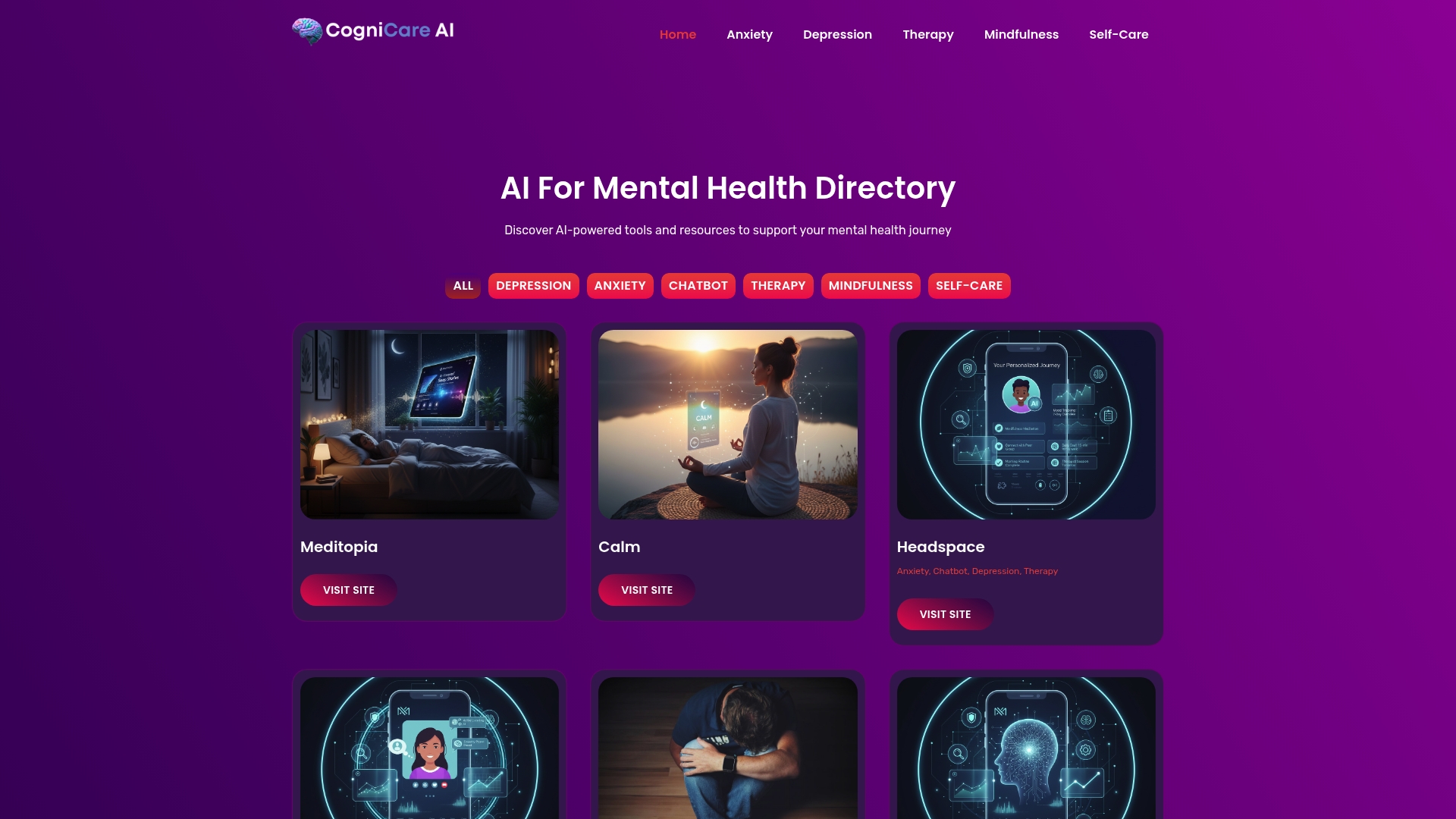
Start with the 2026 AI mental health guide to understand which tool types align with your needs, then explore five AI-powered tools selected for anxiety, depression, and emotional resilience. Cognicareai also covers top mindfulness apps enhanced by AI for users who want to build a daily practice. Every resource on the platform is evaluated for credibility so you spend less time searching and more time improving.
FAQ
What are the main categories of online mental health resources?
The five main online mental health resource categories are crisis intervention, self-assessment tools, treatment navigation, self-care apps, and peer support communities. Each category serves a distinct need and user pathway.
When should I use 988 instead of a mental health app?
Use 988 any time you feel unsafe, experience thoughts of self-harm, or face a mental health situation you cannot manage alone. Apps are for daily maintenance, not emergencies.
Are free online mental health screenings accurate?
Mental Health America’s 14 validated screening tools use clinically recognized scales and are accurate for identifying risk levels. They do not replace a formal diagnosis from a licensed professional.
How do I find a therapist or treatment program online?
SAMHSA’s FindTreatment.gov is the most reliable starting point. Filter by your location and the type of care you need to get the most relevant results.
How do I know if a mental health app is safe to use?
Look for the APA Labs Digital Badge, which evaluates apps on privacy, regulation, safety, scientific principles, and usability. Read the privacy policy before entering any personal health data.