Mindfulness apps designed for anxiety relief are defined as digital tools that deliver structured, evidence-based practices targeting emotion regulation, self-compassion, and exposure to feared thoughts. Apps like Ten Percent Happier, Insight Timer, Calm, and Headspace represent the leading mindfulness app examples for anxiety, each backed by clinical research. A 2026 randomized controlled trial found that self-guided mindfulness modules significantly reduced anxiety and depressive symptoms in adults with generalized anxiety disorder. These are not passive relaxation tools. They are skill-building programs that change how your nervous system responds to stress.
What makes mindfulness app examples for anxiety actually work?
Not every app labeled “mindfulness” reduces anxiety. The difference lies in the active elements built into the program.
A meta-regression of 169 clinical trials found that exposure-based techniques produce the most robust anxiety outcome effect sizes. That means apps teaching you to face feared thoughts directly, rather than simply relax, outperform generic meditation libraries. Attentional training, structured skill modules, and repeated practice sessions also drive measurable results. Generic ambient soundscapes do not.
The three features that separate effective anxiety apps from the rest are:
- Structured skill modules that build progressively over weeks, not random daily meditations
- Exposure-based content that guides you toward feared thoughts rather than away from them
- Emotion regulation training that teaches you to observe feelings without reacting
Pro Tip: When evaluating any app, skip the marketing copy and go straight to the content library. Look for session titles that mention worry, avoidance, or coping. If every session is labeled “relax” or “sleep,” the app is not built for anxiety.
1. Ten Percent Happier
Ten Percent Happier offers structured courses taught by named meditation teachers, including Dan Harris and Joseph Goldstein. Its anxiety-specific programs address worry, stress, and discrimination-related mental health symptoms through progressive skill-building. The app targets people who are skeptical of meditation, which makes it unusually effective for anxious people who overthink whether they are “doing it right.” Courses run across multiple weeks and include short daily sessions that build on each other.
2. Insight Timer
Insight Timer is the largest free meditation library available, with thousands of guided sessions from teachers worldwide. For people with anxiety on a budget, it removes the cost barrier entirely. The app lets you filter by topic, duration, and teacher, so you can find anxiety-specific content without paying a subscription fee. Its customizable timer and community features support consistent practice, which matters because session consistency is directly linked to anxiety symptom reduction.
3. Calm
Calm is one of the most widely downloaded mental health apps globally, with guided sessions covering anxiety, sleep, and stress. Its Daily Calm feature delivers a new guided meditation each day, building a habit without requiring you to choose content. Calm’s sleep stories and breathing exercises address the overlap between anxiety and insomnia, which affects many people with generalized anxiety disorder. The app’s voice-guided format makes it accessible for beginners starting mindfulness with no prior experience.
4. Headspace
Headspace structures its content around emotional regulation and symptom awareness, two mechanisms that research confirms are central to anxiety relief. The app includes mood tracking, which helps you notice patterns between your practice and your anxiety levels over time. Headspace’s “SOS” sessions are designed for acute anxiety moments, giving you a tool to use when symptoms spike rather than only during scheduled practice. Its clean interface reduces friction, which matters for people whose anxiety makes decision-making harder.
5. Smiling Mind
Smiling Mind is a free, nonprofit app developed in Australia with programs grounded in clinical evidence. It offers structured programs for adults, adolescents, and children, making it one of the few apps with age-specific anxiety content. The adult programs follow a progressive format similar to Mindfulness-Based Stress Reduction, a gold-standard clinical protocol. Because it is free and nonprofit, it has no commercial incentive to inflate its evidence claims.
6. Oak
Oak is a minimalist app focused on breathing exercises and meditation for anxiety and stress. Its guided breathing techniques, including box breathing and 4-7-8 breathing, directly activate the parasympathetic nervous system to lower physiological arousal. Oak is free with no subscription required, making it a strong entry point for people who want to test breathing techniques for anxiety before committing to a paid platform. The app’s simplicity reduces the cognitive load that can itself trigger anxiety.
How mindfulness techniques within these apps reduce anxiety symptoms
Emotion regulation and self-compassion are the two primary mechanisms explaining why digital mindfulness reduces anxiety. Emotion regulation means you learn to observe an anxious thought without immediately reacting to it. Self-compassion means you stop treating every anxious moment as evidence of personal failure.
Repeated practice builds these skills the same way physical training builds muscle. A 2026 RCT found that participants who completed approximately 240 minutes of meditation across around 25 sessions achieved clinically meaningful anxiety reductions. That works out to roughly 10 minutes per day over four weeks. The dose is achievable, but consistency is non-negotiable.
The specific exercises that produce these results include:
- Breath observation: Anchors attention to the present moment and interrupts the rumination cycle
- Body scan: Teaches you to notice physical anxiety symptoms without catastrophizing them
- Thought labeling: Creates distance between you and anxious thoughts by naming them as mental events
- Exposure meditation: Guides you to sit with feared thoughts rather than avoid them, reducing their power over time
Pro Tip: Set a fixed daily time for your app session, even if it is only five minutes. Research on anxiety apps consistently shows that scheduled, habitual practice outperforms longer but irregular sessions.
App-based mindfulness practice delivers consistent anxiety relief compared to traditional time-intensive programs, largely because low-barrier formats remove the scheduling obstacles that cause people to quit.
Comparison of top mindfulness apps for anxiety relief
| App | Primary anxiety features | Evidence level | Cost | Best for |
|---|---|---|---|---|
| Ten Percent Happier | Structured courses, worry-focused content | RCT-supported | Paid subscription | Skeptics and overthinkers |
| Insight Timer | Large free library, customizable sessions | Community-validated | Free with paid tier | Budget-conscious users |
| Calm | Daily guided sessions, sleep and stress overlap | Widely studied | Paid subscription | Habit-building beginners |
| Headspace | Emotion tracking, SOS sessions | Clinical partnerships | Paid subscription | Symptom-aware practice |
| Smiling Mind | Age-specific structured programs | Nonprofit clinical | Free | Families and adolescents |
| Oak | Breathing exercises, parasympathetic activation | Mechanism-based | Free | Acute anxiety relief |
When and how to choose the best anxiety app for your needs
Choosing the right app starts with matching its active elements to your specific anxiety pattern. If your anxiety centers on worry and rumination, prioritize apps with thought-labeling and structured cognitive modules. If physical symptoms like rapid heartbeat dominate, start with Oak or Calm’s breathing tools.
The UK Medicines and Healthcare products Regulatory Agency published guidance for mental health app users in 2026 outlining five checks before using any app: verify evidence-supported claims, confirm the intended user matches your situation, review the app’s evaluation history, check data security practices, and confirm regulatory registration. These checks take ten minutes and protect you from apps that market clinical outcomes they have not earned.
Practical steps for selecting your app:
- Start free. Insight Timer, Smiling Mind, and Oak cost nothing. Test the format before paying.
- Check the content, not the brand. Look for session titles addressing worry, avoidance, or coping skills specifically.
- Read the privacy policy. Mental health data is sensitive. Confirm the app does not sell your usage data.
- Commit to four weeks. Clinical trials show meaningful anxiety reduction requires consistent engagement over weeks, not days.
Pro Tip: If you have a diagnosed anxiety disorder, look for apps that reference Mindfulness-Based Stress Reduction or Mindfulness-Based Cognitive Therapy in their methodology. These are the two clinical protocols with the strongest anxiety evidence base.
For a broader view of digital mental health tools, including how AI is personalizing anxiety support, Cognicareai maintains an updated directory of vetted options.
Key takeaways
Mindfulness apps reduce anxiety most effectively when they deliver structured skill-building, exposure-based content, and consistent practice totaling around 240 minutes over four weeks.
| Point | Details |
|---|---|
| Active elements matter most | Choose apps with exposure techniques and emotion regulation modules, not just relaxation audio. |
| Dose drives results | Aim for roughly 240 minutes of practice across 25 sessions to achieve clinically meaningful anxiety reduction. |
| Free apps are clinically valid | Insight Timer, Smiling Mind, and Oak deliver evidence-based anxiety relief at no cost. |
| Verify before you download | Check evidence claims, data privacy, and intended user fit before committing to any app. |
| Consistency beats duration | Ten minutes daily outperforms one-hour sessions done sporadically for anxiety symptom relief. |
Where the evidence is pointing next
I have spent years tracking the research on digital mental health tools, and the clearest trend right now is this: the apps winning clinical trials are not the ones with the most content. They are the ones with the most structure.
Generic meditation libraries are losing ground to apps that guide people through progressive skill-building the way a therapist would. The 2026 RCT data on generalized anxiety disorder apps makes this concrete. Staged modules beat open libraries for symptom reduction. That tells me the next generation of effective apps will look less like Spotify for meditation and more like a structured therapy program you carry in your pocket.
AI has a real role to play here. Personalized session recommendations based on your mood logs, adaptive pacing that adjusts to your engagement patterns, and real-time feedback on breathing exercises are all technically feasible now. The gap is evidence. Most AI-enhanced features have not yet been tested in rigorous trials. I would not dismiss them, but I would not choose an app solely because it advertises AI either.
The most underrated issue in this space is digital literacy. Many people with anxiety download apps without checking a single evidence claim. Regulatory bodies like the MHRA are now publishing consumer guidance precisely because the market has outpaced the evidence. That gap will close, but until it does, you need to be your own gatekeeper.
My honest recommendation: pair an app with at least occasional contact with a mental health professional. Apps are not a replacement for therapy in moderate to severe anxiety. They are a powerful supplement, and the evidence supports exactly that role.
— dushyantha
Cognicareai’s curated resources for anxiety and mindfulness
Cognicareai tracks the latest AI-powered mental health tools so you do not have to sort through hundreds of apps alone. Its directory covers vetted mindfulness apps, therapy chatbots, and personalized anxiety resources, all organized by use case and evidence level.
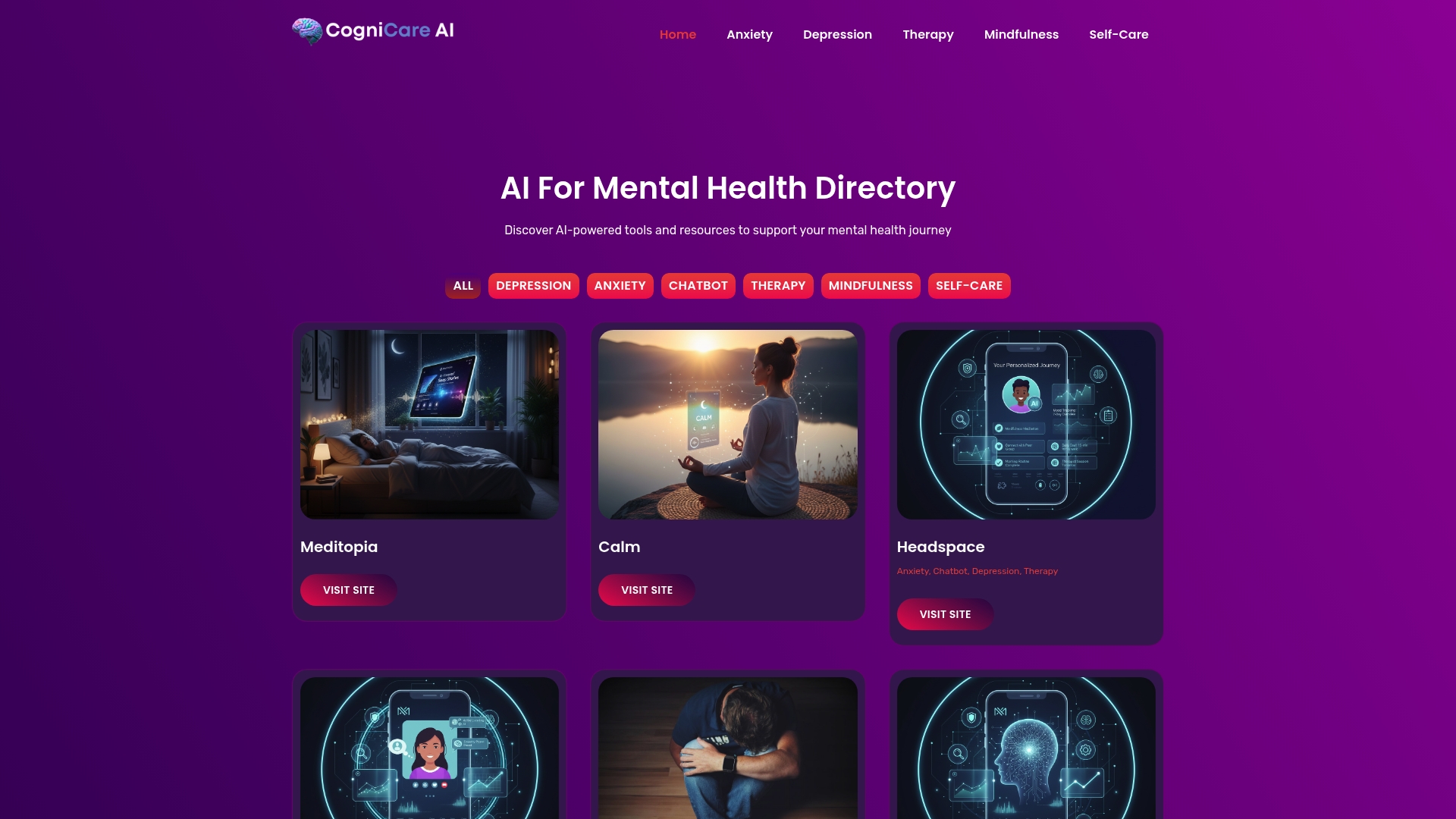
Whether you are looking for a free starting point or a clinically grounded program for generalized anxiety, Cognicareai’s AI mental health tools guide gives you a clear, up-to-date picture of what works and why. The platform also highlights AI-powered tools that go beyond standard meditation apps to offer adaptive, personalized anxiety support. If you want a starting point grounded in 2026 evidence, Cognicareai is the right place to begin.
FAQ
What are the best mindfulness apps for anxiety in 2026?
Ten Percent Happier, Headspace, Calm, Insight Timer, Smiling Mind, and Oak are the leading options, each offering anxiety-specific features backed by clinical research. The best choice depends on your anxiety pattern and whether you prefer structured courses or flexible meditation libraries.
How long does it take for a mindfulness app to reduce anxiety?
Clinical trials show meaningful anxiety reduction after approximately 240 minutes of practice across around 25 sessions, which is roughly four weeks of daily ten-minute sessions. Consistency matters more than session length.
Are free mindfulness apps effective for anxiety?
Yes. Insight Timer, Smiling Mind, and Oak are free and deliver evidence-based anxiety relief. Free apps can be as effective as paid options when they include structured, anxiety-targeted content rather than generic relaxation audio.
How do I know if a mindfulness app is safe to use?
Check that the app makes evidence-supported claims, clearly states its intended users, has a transparent data privacy policy, and is registered with relevant health regulators. The MHRA’s 2026 consumer guidance outlines these five checks in detail.
Can mindfulness apps replace therapy for anxiety?
Mindfulness apps are not a replacement for professional therapy in moderate to severe anxiety. They are most effective as a supplement to therapy or as a first step for mild anxiety symptoms, providing daily skill practice between professional sessions.