

AI tools for anxiety relief are digital platforms that use algorithms to deliver personalized mental health support, combining evidence-based therapies like cognitive behavioral therapy (CBT) with real-time monitoring and 24/7 access. Understanding how AI tools support anxiety relief matters because these platforms now offer structured, clinically grounded interventions that were once available only through in-person therapy. Tools like PocketCalm, PATH, and STARStarter use CBT modules and GAD-7 monitoring to track symptoms and guide users through targeted exercises. The result is measurable symptom reduction, available on demand, at any hour.
How do AI tools use therapeutic approaches to ease anxiety symptoms?
AI anxiety tools deliver therapy through three core methods: structured CBT tasks, mindfulness exercises, and guided breathing programs. Each method targets a different layer of anxiety, from distorted thinking patterns to physical tension in the body.
CBT is the most widely used framework in AI anxiety apps. The approach works by helping you identify negative thought patterns and replace them with more balanced ones. Apps like PATH and PocketCalm translate this into short, interactive exercises where you log a worry, examine the evidence for and against it, and write a more realistic response. This mirrors what a CBT therapist does in session, but you can do it at 2 a.m. on your phone.

Mindfulness and breathing exercises address the physical side of anxiety. Slow, controlled breathing activates the parasympathetic nervous system, which lowers heart rate and reduces the physical tension that feeds anxious thinking. AI platforms deliver these as guided audio sessions or timed visual prompts, making them easy to follow without prior experience.
The most effective platforms combine all three methods. Multi-modal AI systems that pair psychoeducational content with structured CBT tasks and breathing exercises outperform simple chatbot interactions for anxiety management. That combination addresses both the cognitive and physiological roots of anxiety at the same time.
- CBT tasks help you challenge and reframe anxious thoughts through structured written exercises.
- Mindfulness sessions train attention away from worry and toward present-moment awareness.
- Breathing exercises reduce physical symptoms like racing heart and shallow breathing.
- Psychoeducation modules explain what anxiety is and why your body responds the way it does.
- Progress tracking shows symptom trends over time, which builds motivation to keep going.
Pro Tip: Set a specific time each day for your AI app session, just as you would a scheduled appointment. Consistency matters more than session length for building the habit.
What evidence supports the effectiveness of AI tools for anxiety relief?
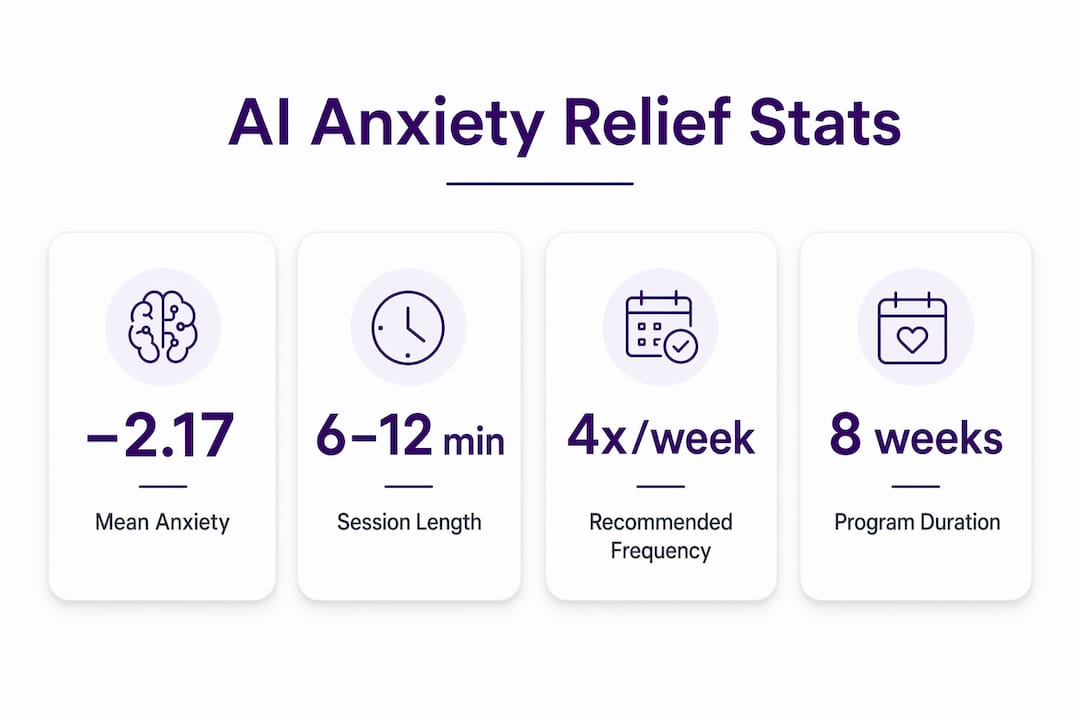
The clinical evidence for AI-driven anxiety support is growing fast, and the numbers are meaningful. Meta-analytic research shows that AI-powered conversational agents reduce anxiety symptoms with a standardized mean difference of −0.20 and a mean difference of −2.17 compared to control groups. Those effect sizes are modest but consistent, which means the benefit is real and repeatable across different populations and study designs.
Structured programs produce stronger results than casual app use. Symptom reductions of up to 80% are possible over 8-week programs when people engage consistently, with the recommended schedule being 6–12 minute sessions four times per week. That is a low time commitment for a meaningful clinical outcome.
“AI anxiety tools function best as adjuncts complementing traditional care. Immediate symptom relief occurs, but long-term symptom management requires consistent program engagement.” — npj Digital Medicine meta-analysis
Sustained benefits are also documented beyond the active program period. People who complete structured AI anxiety programs show continued symptom improvement at follow-up assessments, not just during active use. This suggests the skills learned through CBT and mindfulness exercises carry over into daily life.
| Evidence type | Key finding |
|---|---|
| Meta-analytic effect size | SMD of −0.20 across AI conversational agent trials |
| Mean symptom reduction | MD of −2.17 vs. control groups |
| Structured program outcome | Up to 80% symptom reduction over 8 weeks |
| Recommended session schedule | 6–12 minutes, four times per week |
| Long-term benefit | Symptom improvements sustained at follow-up |
The distinction between adjunct and replacement therapy is critical here. AI tools produce real symptom relief, but they are not a substitute for clinical care in moderate to severe anxiety. They work best alongside a therapist or as a first step for people who are not yet in treatment.
How do different AI platforms compare for anxiety support?
Not all AI anxiety tools are built the same way. The gap between a basic chatbot and a full multi-modal platform is significant, both in features and in clinical outcomes.
Simple chatbot systems respond to text input with scripted or AI-generated replies. They provide a sense of being heard and can offer basic coping suggestions, but they lack the structured therapeutic content that drives measurable symptom change. Multi-modal platforms go further. They combine conversational AI with psychoeducation, validated symptom assessments, breathing exercises, and personalized content that adapts to your progress.
Therapeutic alliance with AI, meaning your sense of connection and trust with the platform, is a key predictor of engagement and symptom reduction. This finding is surprising to many people. The design of the AI persona, its tone, warmth, and consistency, matters as much as the clinical content it delivers. A well-designed AI companion keeps you coming back, which is what produces results.
Transparency is another differentiator. Platforms that use retrieval-augmented generation (RAG) anchor their responses to validated clinical content rather than generating free-form text. This reduces the risk of unhelpful or inaccurate advice, which is a real concern in mental health applications.
| Feature | Basic chatbot | Multi-modal platform |
|---|---|---|
| Therapeutic content | Scripted replies | Structured CBT, mindfulness, psychoeducation |
| Symptom tracking | None or minimal | GAD-7, PHQ-9 validated scales |
| Personalization | Low | Adapts to user progress and goals |
| Transparency | Variable | RAG-anchored clinical responses |
| Availability | 24/7 text | 24/7 voice and text input |
- GAD-7 and PHQ-9 assessments give you a standardized baseline and track change over time.
- Voice input lowers the barrier to engagement when typing feels like too much effort.
- Personalized content adjusts difficulty and focus based on your symptom history.
For a detailed comparison of leading platforms, the best AI chatbot apps reviewed by Cognicareai cover features, pricing, and clinical backing side by side.
What practical tips optimize the use of AI tools for anxiety relief?
Getting the most from an AI anxiety tool requires more than downloading an app and opening it occasionally. The research is clear: structured, consistent engagement drives outcomes. Here is how to set yourself up for success.
- Start with a symptom baseline. Use the GAD-7 or PHQ-9 built into your chosen app before your first session. This gives you a reference point and makes progress visible over time.
- Commit to a schedule. Four sessions per week at 6–12 minutes each is the evidence-backed sweet spot. Block the time in your calendar like any other appointment.
- Use AI as a complement, not a replacement. AI tools work best as adjuncts to traditional care. If you are working with a therapist, share your app progress with them. If you are not in therapy, consider AI as a starting point rather than a ceiling.
- Review the privacy policy before you share anything personal. Privacy practices vary widely across AI mental health apps. Some encrypt your data but use anonymized chat content to train their models. Know what you are agreeing to before you open up.
- Set a specific goal for each program cycle. “Reduce morning anxiety before work” is more useful than “feel less anxious.” Specific goals let you measure whether the tool is working for your situation.
Pro Tip: If you miss a few sessions, do not abandon the program. Research on habit formation shows that returning after a lapse is more important than perfect consistency. Restart where you left off rather than from the beginning.
Privacy deserves extra attention. The data handling practices of mental health apps differ from standard consumer apps because the information shared is sensitive. Look for apps that explicitly state they do not sell your data and that offer end-to-end encryption for chat content. Cognicareai’s directory flags privacy standards for each listed tool, which saves you the time of reading every policy yourself.
For a broader look at how these tools fit into daily mental wellness routines, the AI-assisted anxiety techniques guide from Cognicareai covers integration strategies in practical detail.
Key Takeaways
AI tools reduce anxiety symptoms most effectively when they combine CBT, mindfulness, and consistent structured engagement rather than relying on chatbot conversation alone.
| Point | Details |
|---|---|
| Evidence-backed effect | Meta-analyses show a mean anxiety reduction of −2.17 vs. controls across AI tool trials. |
| Structured programs work best | 6–12 minute sessions four times weekly over 8 weeks produce the strongest outcomes. |
| Multi-modal beats chatbot-only | Platforms combining CBT, breathing, and psychoeducation outperform text-only chatbots. |
| Therapeutic alliance matters | Your trust in the AI interface predicts engagement and symptom reduction as much as content quality. |
| Privacy requires active review | Data practices vary; always check encryption and data training policies before sharing personal information. |
What I have learned from watching people use AI anxiety tools
The most common mistake I see is treating an AI anxiety app like a search engine. People open it when they feel bad, get a coping tip, and close it. That pattern produces almost no lasting benefit. The tools that actually move the needle are the ones people use on a schedule, even on days when anxiety feels manageable.
What surprises me most about the research is the therapeutic alliance finding. The idea that your emotional connection to an AI interface predicts outcomes as strongly as the clinical content it delivers challenges the assumption that these tools are purely informational. Design and tone are doing real therapeutic work. That has implications for how developers build these platforms and how users choose between them.
I am also cautious about the replacement narrative. AI tools are genuinely useful, and the evidence supports their role in anxiety management. But they are not a ceiling. People with moderate to severe anxiety need human clinical support, and no app changes that. The best use case is as a first step, a daily practice tool, or a bridge between therapy sessions.
The personalized AI mental health care space is moving fast. The platforms available in 2026 are meaningfully better than what existed three years ago, and the gap will keep widening. If you have been hesitant to try these tools, the evidence now justifies giving them a serious attempt.
— dushyantha
Discover vetted AI tools for anxiety relief
Cognicareai curates a directory of AI-powered mental health tools tested against the evidence discussed in this article. Every tool in the directory is evaluated for therapeutic content quality, privacy standards, and clinical backing.
Whether you are looking for a structured CBT program, a mindfulness app with AI personalization, or a chatbot that tracks your GAD-7 scores over time, the top AI mental health tools listed on Cognicareai give you a shortcut past the noise. The directory also flags which tools work best as standalone support and which are designed to complement existing therapy. Start with the 5 AI-powered tools guide for a quick, evidence-ranked starting point.
FAQ
Can AI tools actually reduce anxiety symptoms?
Yes. Meta-analytic evidence shows AI conversational agents reduce anxiety with a mean difference of −2.17 compared to control groups. Structured 8-week programs show the strongest results.
How long does it take to see results from an AI anxiety app?
Consistent use of 6–12 minutes four times per week over 8 weeks produces measurable symptom reduction. Casual or infrequent use produces much smaller benefits.
Are AI anxiety tools a replacement for therapy?
No. AI tools work best as adjuncts to clinical care, not replacements. They provide immediate support and skill-building, but moderate to severe anxiety requires a licensed therapist.
What features should I look for in an AI anxiety app?
Look for validated symptom tracking like GAD-7 or PHQ-9, structured CBT modules, mindfulness exercises, and transparent privacy policies. Multi-modal platforms consistently outperform chatbot-only tools.
Is my data safe in an AI mental health app?
Privacy practices vary significantly across apps. Some encrypt data but use anonymized conversations for model training. Always read the privacy policy before sharing personal information.