

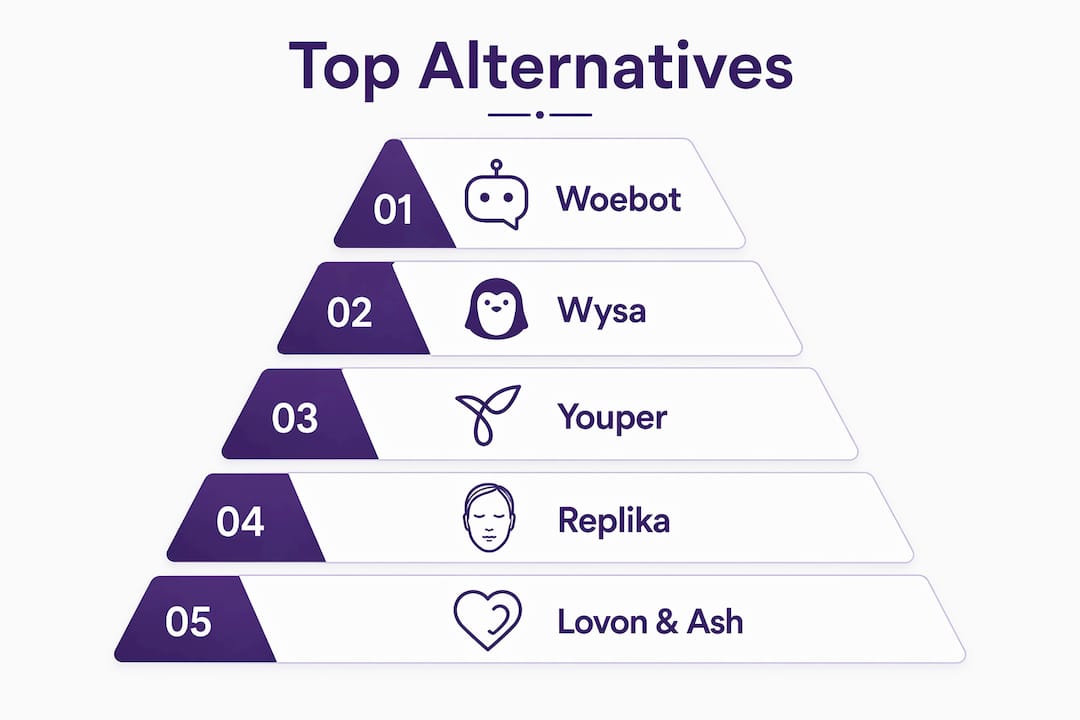
If you’re looking for the best evaai.health alternatives right now, the short list is: Woebot (strongest published clinical evidence), Wysa (best balance of evidence and affordability), Youper (best for mood tracking and personalization), and Cognicareai as the recommended starting point for U.S. users who want a curated directory of vetted options rather than a single app gamble. Replika, Lovon, and Ash round out the field for users who prioritize AI companionship or voice-first emotional support.
EvaAI.health is a voice-first mental wellbeing platform built on Acceptance and Commitment Therapy (ACT), designed for burnout, emotional numbness, and anxiety. Its primary delivery is through VR on Meta Quest hardware, which makes it genuinely immersive but also narrows who can actually use it. It explicitly states it is not a psychotherapist and does not replace licensed care. If you need something browser-based, text-first, or clinically validated with published RCTs, you need a different tool.
- Woebot: Best for evidence-backed CBT-style text support; multiple published clinical studies
- Wysa: Best for affordability and a solid free tier with CBT and DBT techniques
- Youper: Best for mood tracking, journaling, and AI-driven personalization
- Replika: Best for AI companionship and open-ended emotional conversation
- Lovon: Best for relationship-focused emotional support
- Ash: Best for LGBTQ±affirming mental wellness support
- Cognicareai: Best for finding and comparing vetted AI mental health tools in one place
Table of Contents
- Which EvaAI.health alternatives actually compare on the features that matter?
- How do you choose the right alternative to EvaAI.health?
- What does each top alternative actually do for you?
- Why trust this guide — how Cognicareai evaluates these tools
- What’s the best pick for your specific situation?
- Key Takeaways
- A note on AI mental wellness tools and why curation matters
- Cognicareai: your shortcut to vetted AI mental health tools
- Sources and further reading
Which EvaAI.health alternatives actually compare on the features that matter?
| App | Best for | Modality | Pricing / Free tier | Clinical evidence | Privacy & HIPAA | Platforms | Crisis handling |
|---|---|---|---|---|---|---|---|
| Woebot | CBT-style text support | Text | Free (consumer); enterprise pricing | Multiple published studies | HIPAA-eligible (enterprise); privacy policy published | iOS, Android, Web | Safety escalation built in |
| Wysa | Affordable daily check-ins | Text + voice | Free tier; around $9.99/month | Published peer-reviewed research | HIPAA-compliant (enterprise); anonymized by default | iOS, Android | Crisis resources + escalation |
| Youper | Mood tracking, personalization | Text | Free tier; ~$9.99/month | Published pilot studies | Privacy policy published; not HIPAA-certified for consumers | iOS, Android | Safety check-ins; crisis links |
| Replika | AI companionship | Text + voice | Free tier; around $9.99/month | Limited published evidence | Privacy policy published; data stored on U.S. servers | iOS, Android, Web | Basic safety prompts |
| Lovon | Relationship emotional support | Text | Free tier; paid plans vary | Limited published evidence | Privacy policy published | iOS, Android | Safety resources listed |
| Ash | LGBTQ±affirming wellness | Text | Free tier; paid plans vary | Limited published evidence | Privacy policy published | iOS, Android | Crisis resources listed |
| EvaAI.health | VR-immersive ACT coaching | Voice + VR | Paid (Meta Quest hardware required) | ACT/CBT-adjacent; no consumer RCTs published | Privacy policy at evaai.health/privacy-policy | Meta Quest only | States it is not a psychotherapist |
| Cognicareai | Curated directory and match service | Directory (all modalities) | Free to browse; affiliate model | Curates apps with published evidence | Evaluates privacy posture of listed tools | Web | Links to crisis-ready apps |
A note on trials and U.S. availability: Woebot, Wysa, Youper, and Replika are all available on the U.S. App Store and Google Play with free tiers you can start today. Lovon and Ash are available in the U.S. but have smaller user bases. EvaAI.health requires Meta Quest hardware, which limits its reach considerably. Cognicareai’s directory is web-based and accessible from any U.S. browser.
Clinical evidence is the single biggest differentiator in this category. Most AI wellness apps market themselves with therapy-adjacent language, but only a handful have peer-reviewed studies behind them. Woebot is the most-cited example of an app with published RCT-level evidence in the mental health chatbot space.
How do you choose the right alternative to EvaAI.health?
Seven questions cut through the noise when you’re evaluating any AI mental health app:
-
Does it have published clinical evidence? Look for peer-reviewed studies, not just “evidence-based” in the marketing copy. Woebot and Wysa both have published research. If an app can’t link you to a study, treat its therapeutic claims skeptically.
-
What modality fits your life? Voice-first tools like EvaAI.health work well for emotional resonance and presence. Text-first chatbots scale better for journaling, tracking, and quiet environments. Know which one you’ll actually use at 10 PM on a hard day.
-
What is the app’s HIPAA posture? Consumer apps are generally not covered entities under HIPAA, but some offer HIPAA-eligible tiers for enterprise or clinical partners. Check the privacy policy for data-sharing with third-party analytics, advertisers, or AI training pipelines.
-
How does it handle a crisis? Any app you use for mental wellness should have a clear escalation path: a crisis hotline link, a safety check-in prompt, or a direct referral to the 988 Suicide and Crisis Lifeline. If you can’t find that in the app or its documentation, move on.
-
How does it personalize over time? The best apps adapt to your mood history, not just your onboarding answers. Youper’s mood tracking is a good example of genuine personalization. Generic daily prompts that never change are a sign the “AI” is mostly scripted.
-
Does it integrate with your existing tools? Some apps connect with Apple Health, Google Fit, or wearables. If you’re already tracking sleep or activity, an app that pulls that data gives you a richer picture.
-
What does the real cost look like? Free tiers often gate the most useful features. Calculate what you’d actually pay monthly for the features you need, not the entry-level plan.
Red flags to watch for: no published clinical evidence anywhere on the site; vague data storage language (“we may share with partners”); no crisis escalation path; marketing that calls the app “therapy” without a licensed clinician in the loop.
Pro Tip: Before you download, search “[app name] privacy policy” and “[app name] clinical study” in Google Scholar or PubMed. A legitimate app will have both findable in under two minutes. If neither turns up, that tells you something.
The Texas Department of Insurance and the Illinois Department of Insurance both note that non-traditional health arrangements often lack the consumer protections of regulated products. The same logic applies: an app that calls itself a “therapy tool” without regulatory backing or published evidence is making a claim it can’t fully support.
What does each top alternative actually do for you?
Woebot
Woebot is a text-based chatbot built on CBT principles, developed with input from Stanford psychologists. It checks in daily, guides you through mood tracking, and delivers short CBT and DBT exercises in a conversational format. The key differentiator is its evidence base: Woebot has been referenced in multiple comparative reviews as one of the few consumer mental health chatbots with published clinical studies behind it.

| Dimension | Details |
|---|---|
| Strengths | Strong clinical evidence; free consumer tier; widely available |
| Limitations | Text-only on consumer tier; less immersive than voice-first tools |
| Pricing | Free (consumer); enterprise/clinical pricing not publicly listed |
| Platforms | iOS, Android, Web |
| Crisis features | Built-in safety escalation; crisis resource links |
Best for: Anyone who wants the most evidence-backed text chatbot available and values knowing there’s real research behind the product.
Wysa
Wysa is a text-first AI chatbot that covers CBT, DBT, mindfulness, and behavioral activation. Its free tier is genuinely useful, not a stripped-down teaser. Wysa has published peer-reviewed research and offers a HIPAA-compliant enterprise tier for clinical and employer deployments. For U.S. users on a budget, it’s the most credible low-cost option in the field. The AI-assisted techniques for managing anxiety that Wysa uses map closely to what clinical psychologists recommend for between-session support.
| Dimension | Details |
|---|---|
| Strengths | Solid free tier; published research; HIPAA-compliant enterprise option |
| Limitations | Consumer tier is not HIPAA-certified; voice features limited |
| Pricing | Free tier; around $9.99/month for premium |
| Platforms | iOS, Android |
| Crisis features | Crisis escalation; 988 Lifeline links |
Best for: Budget-conscious users who still want clinical credibility and a free tier that doesn’t feel like a demo.
Youper
Youper leads on personalization. Its AI tracks your mood over time, identifies patterns, and adjusts its check-in questions based on your history rather than a static script. It also offers a journaling feature and a symptom tracker that can generate a summary you bring to a therapist. Pricing sits around $9.99/month after a free tier.

| Dimension | Details |
|---|---|
| Strengths | Strong mood tracking; genuine personalization; therapist-shareable reports |
| Limitations | Not HIPAA-certified for consumers; limited crisis features |
| Pricing | Free tier; ~$9.99/month |
| Platforms | iOS, Android |
| Crisis features | Safety check-ins; crisis resource links |
Best for: Users already in therapy who want a between-session tracking tool, or anyone who wants an app that actually learns their patterns.
Replika
Replika is the most open-ended of the group. It’s an AI companion designed for emotional conversation, not structured CBT exercises. Users build a relationship with their AI avatar over time. It’s not the right tool if you want clinical rigor, but it fills a real gap for people who need a low-pressure space to process thoughts. The personalization features in AI mental health care that Replika uses are more relational than clinical.
“AI companions are best for between-session support, habit tracking, and low-acuity stress management — not acute crises or primary clinical treatment.” This framing from clinical psychologist guidance applies directly to Replika: it works well as an emotional outlet, not as a treatment.
| Dimension | Details |
|---|---|
| Strengths | Highly engaging; voice and text; strong personalization |
| Limitations | Limited clinical evidence; not suitable for acute mental health needs |
| Pricing | Free tier; around $9.99/month |
| Platforms | iOS, Android, Web |
| Crisis features | Basic safety prompts |
Best for: Users who want an AI companion for daily emotional processing rather than structured therapeutic support.
Lovon and Ash
Lovon focuses on relationship-centered emotional support, making it useful for people navigating interpersonal stress or loneliness. Ash is built specifically for LGBTQ±affirming mental wellness, with content and tone designed for that community. Both have smaller user bases than Woebot or Wysa, and neither has the same volume of published clinical evidence. For workplace stress management, the 2026 stress management guide covers how apps like these fit into a broader self-care routine.
Pro Tip: If you’re evaluating Lovon or Ash, look specifically at their crisis resource pages before you commit. Smaller apps sometimes have thinner safety nets than the category leaders.
Why trust this guide — how Cognicareai evaluates these tools
Cognicareai operates as a curated directory of AI-powered mental health tools, not as a single-app vendor. Every tool featured in this guide was evaluated against six criteria: published clinical evidence, privacy policy transparency, modality fit, crisis handling, user experience, and U.S. pricing availability.
Evaluation criteria used:
- Clinical evidence: Does the app have peer-reviewed studies, RCTs, or published pilot data? Apps with no published evidence are noted as such.
- Privacy and HIPAA posture: What does the privacy policy say about data sharing, third-party analytics, and data retention? HIPAA-eligible tiers are flagged separately from consumer tiers.
- Modality: Voice, text, or mixed. Matched to use case.
- Crisis handling: Does the app have a clear escalation path to the 988 Lifeline or a licensed professional?
- User experience: Onboarding friction, personalization depth, and platform availability.
- Pricing: Free tier availability and real monthly cost for the features most users need.
The Texas Department of Insurance warns that non-regulated health arrangements often lack consumer protections. That same principle guided this guide’s emphasis on privacy policy transparency and crisis escalation: an app without both is a product, not a wellness tool.
To verify any claim in this guide: check the app’s privacy policy directly, search PubMed for the app name plus “RCT” or “clinical trial,” and look for the app’s crisis resource page before you download.
What’s the best pick for your specific situation?
- Daily mood tracking and journaling: Youper. Its pattern recognition and therapist-shareable reports make it the most practical tool for people already in care.
- Voice-first immersive support (and you have Meta Quest hardware): EvaAI.health still delivers a genuinely unique ACT-based VR experience. Nothing else on this list replicates that.
- Low-cost daily check-ins with clinical credibility: Wysa. The free tier is real, and the published research is there.
- Strongest evidence-backed CBT text support: Woebot. It’s the benchmark for clinical evidence in this category.
- AI companionship and open-ended emotional conversation: Replika. Don’t expect clinical rigor; do expect a surprisingly engaging experience.
- Finding the right tool without guessing: Cognicareai’s directory. Filter by evidence, privacy, and modality to get a shortlist matched to your needs.
Safety callout: None of these apps replace licensed psychotherapy. AI tools in mental health are best suited for between-session support, low-acuity stress management, and habit tracking. If you’re in acute distress, call or text 988 (Suicide and Crisis Lifeline) or go to your nearest emergency room. An app is not the right tool for a crisis.
Pro Tip: Start with a free tier for two weeks before paying for anything. The app you actually open at the end of a hard day is the right app, regardless of what any comparison says.
Key Takeaways
The most evidence-backed evaai.health alternatives for U.S. users are Woebot and Wysa for clinical credibility, Youper for personalization, and Cognicareai as the curated directory that helps you find and compare vetted options without testing every app yourself.
| Point | Details |
|---|---|
| Clinical evidence matters most | Only Woebot and Wysa have substantial published peer-reviewed research among consumer AI mental health apps. |
| Privacy policy is non-negotiable | Check for data-sharing clauses and HIPAA posture before entering personal mental health data into any app. |
| Modality shapes real-world use | Voice-first tools suit emotional resonance; text-first tools suit tracking and quiet environments. |
| Crisis handling is a baseline requirement | Any app you use for mental wellness should link clearly to the 988 Lifeline or a licensed professional escalation path. |
| Cognicareai simplifies the search | The Cognicareai directory filters by evidence, privacy, and modality so you can match to a vetted tool without trial and error. |
A note on AI mental wellness tools and why curation matters
The AI mental health app market has a real signal-to-noise problem. Dozens of apps use therapy-adjacent language, reference “evidence-based” techniques, and market themselves with clinical-sounding authority. Most of them have never published a study. A few have genuinely earned their credibility.
What I find underappreciated in most comparison guides is the gap between modality preference and actual engagement. The research on AI wellbeing tools consistently shows that the best app is the one you open. A voice-first tool that feels natural to you will outperform a text chatbot with better clinical evidence if you never actually type into it. That’s not a knock on evidence. It’s a reminder that fit matters as much as credentials.
Disclosure: This guide is published by Cognicareai, which operates an affiliate model. Referral fees may be earned when readers sign up with partner apps. Editorial decisions, including which apps are featured and how they are evaluated, are made independently of affiliate relationships. No app paid to be included in this comparison.
Cognicareai: your shortcut to vetted AI mental health tools
Sorting through dozens of AI mental health apps on your own takes hours you probably don’t have. Cognicareai’s directory does that work for you: every listed tool is evaluated for clinical evidence, privacy posture, modality, and U.S. availability before it appears in the results.
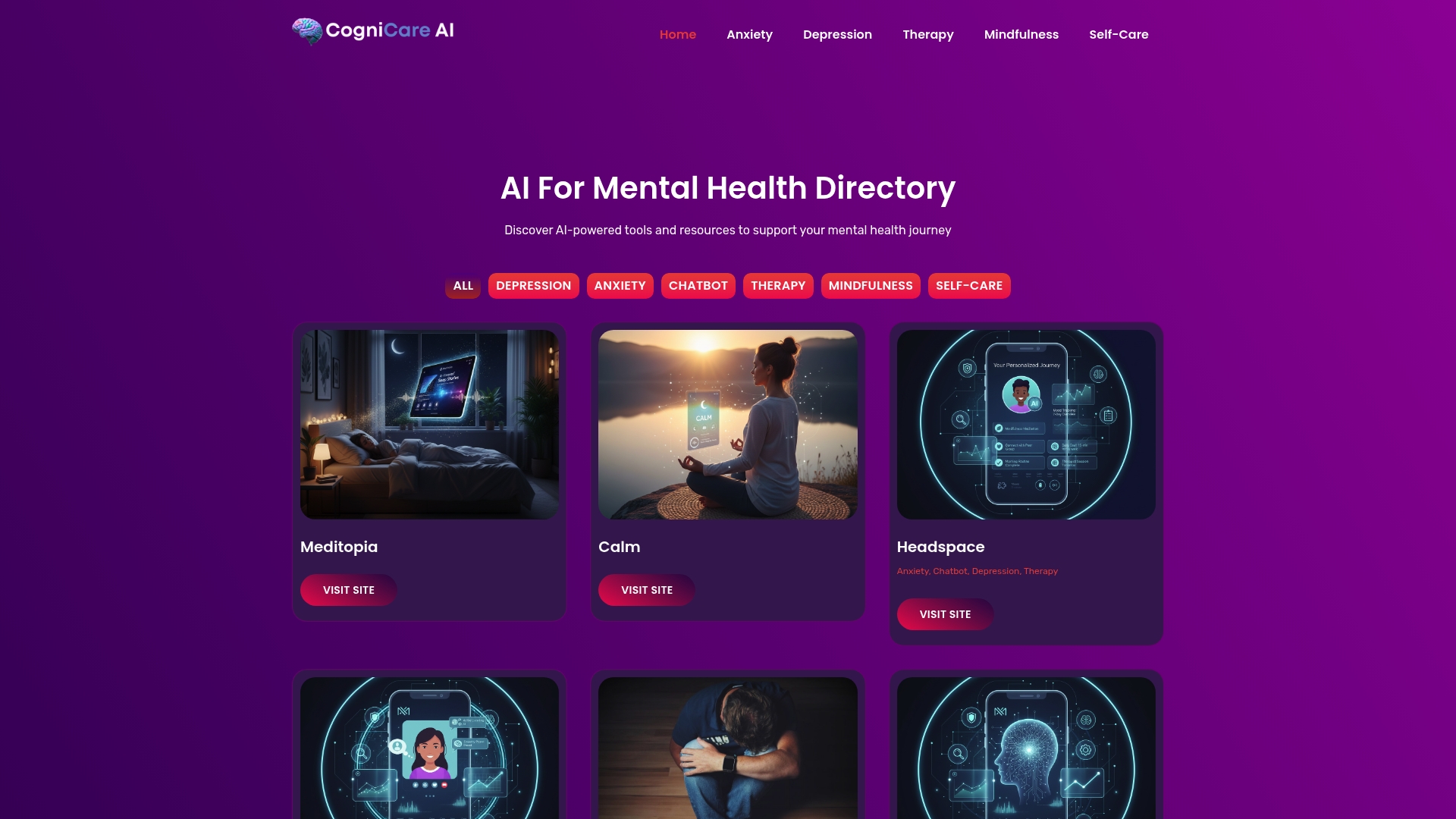
The directory includes filters for evidence level, HIPAA posture, free tier availability, and platform, so you can narrow from the full field to a two-app shortlist in minutes. Clinician-reviewed notes flag where the evidence is strong and where it’s thin. You get the same information a careful researcher would compile, without the research time.
Browse the AI mental health tools guide to start filtering by what actually matters for your situation, or go straight to the full curated directory to see every vetted option available to U.S. users today.
Sources and further reading
| Source | How it was used |
|---|---|
| EvaAI — Quest Store DB | EvaAI modality, scope statements, and “not a psychotherapist” disclosure |
| EvaAI — Exa.ai profile | Clinical evidence context for Woebot and comparative app profiles |
| EvaAI — official site | Baseline product description, ACT framework, and voice-first modality |
| Texas Department of Insurance — alternative health plans | Consumer protection context; regulatory gaps in non-traditional health arrangements |
| Illinois Department of Insurance — health insurance guidance | Distinction between app-based wellbeing tools and regulated health insurance |
| clinical psychologist guidance on AI tools | Appropriate use cases and safety limits for AI mental wellness apps |
| Cognicareai — AI’s role in therapy | Context on when AI tools are appropriate versus licensed care |
| Cognicareai — anxiety and stress techniques | Evidence-based technique context for app profiles |
This article is general informational content, not professional mental health advice. Verify app features, pricing, and privacy policies directly with each provider before making a decision. If you are experiencing a mental health crisis, contact the 988 Suicide and Crisis Lifeline by calling or texting 988.