
The most effective calming music playlists for anxiety combine slow tempos, ambient or instrumental textures, and predictable rhythms that give your nervous system something steady to hold onto. A Mindlab International study found that Marconi Union’s “Weightless” reduced anxiety by 65% in participants solving stressful puzzles, making it the most clinically cited track in this space. That result doesn’t mean one song fixes everything, but it does confirm that the right musical structure genuinely moves the needle on stress physiology. The playlists and strategies below are built on that same science.
Best calming music playlists for anxiety relief right now
These playlists are widely trusted for anxiety relief, available on major platforms, and built around the musical qualities that music therapists consistently recommend: slow tempo, minimal surprises, and gentle instrumental textures.
- “Weightless” by Marconi Union (full track and extended versions) — The most clinically studied piece of relaxation music available. Starts at 60 BPM and gradually slows to 50 BPM, deliberately guiding your heart rate downward. Find it on Spotify and Apple Music.
- “Anxiety & Stress Relief Music” by Element Earth (Spotify) — Features ambient tracks, healing frequencies including 528Hz tones, and slow instrumental layers. Designed specifically for stress and anxiety reduction.
- “Calming Music for Anxiety / Stress / HSP (Instrumentals)” by Meditation Station (Spotify) — Over 200,000 saves and 175 tracks running about 8 hours 30 minutes. Covers a wide range of gentle instrumental styles suited to highly sensitive listeners.
- “Binaural Beats: Calm Your Anxiety” by Lullify Music Group (Spotify) — 348 tracks, about 14 hours of ambient pulses and droning tones designed to ease mental chatter and reduce anxiety.
- “Calm Mind 2026” by Klangspot Recordings (Apple Music) — 157 songs across nearly 10 hours of atmospheric drone, peaceful soundscapes, and frequencies curated to soothe the nervous system and restore focus.
- Brian Eno ambient works (Spotify and Apple Music) — Eno’s albums, particularly Ambient 1: Music for Airports, are foundational to the genre and appear across dozens of therapist-recommended playlists. His soundscapes are specifically designed to be heard without active attention, making them ideal for background anxiety relief.
- NPR’s “Songs to Calm the Nerves” (npr.org) — A curated listening guide from NPR’s All Songs Considered, featuring tracks selected by music journalists and listeners for their nerve-calming qualities.
- Spotify’s “Peaceful Piano” and “Deep Focus” editorial playlists — Both are regularly updated by Spotify’s editorial team and consistently feature slow-tempo, instrumental tracks that align with anxiety-reduction principles.
What genres and musical qualities actually reduce anxiety?
Not every slow song works. The genres and specific musical characteristics below are what music therapists reach for when building anxiety-focused playlists.
Genres most effective for anxiety relief:
- Ambient music — Pioneered by Brian Eno, this genre uses sustained tones, minimal melodic movement, and long decay times to create a sound environment that doesn’t demand attention.
- Classical music — Particularly Baroque and Romantic period works with steady tempos and predictable harmonic progressions. Think Satie, Debussy, or Bach’s slower pieces.
- Nature sounds and soundscapes — Rain, ocean waves, and forest recordings activate the parasympathetic nervous system in ways similar to music, and they layer well with gentle instrumental tracks.
- Soft instrumental and new age — Acoustic guitar, piano, and ambient synthesizer combinations with no lyrics, which removes the cognitive load of processing words.
- Binaural beats — Audio tracks that play slightly different frequencies in each ear, theoretically encouraging brainwave entrainment toward calmer states.
Musical characteristics that matter most:
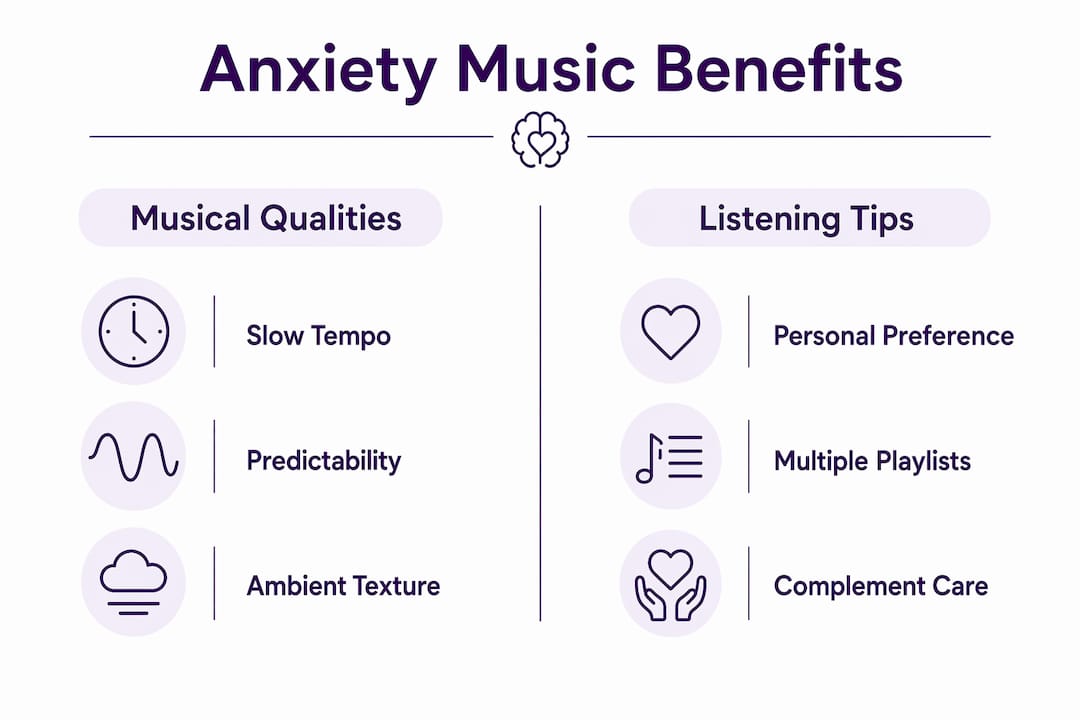
- Slow tempo, typically 50–70 BPM
- Repetitive, predictable patterns with no sudden dynamic shifts
- Low frequency range and soft timbre
- Minimal or no lyrics
- Gradual, smooth transitions between sections
The key principle is predictability. As music therapist Lyz Cooper of the British Academy of Sound Therapy explained about sedative music: “It’s not going to have large leaps compositionally. It’s not going to have any surprises. The music should have good predictability but not be boring.”
Pro Tip: Start with a genre you already find pleasant. If classical music has never appealed to you, forcing it won’t help. Try ambient electronic or soft acoustic instead, and pay attention to whether your shoulders drop within the first two minutes. That physical response is your best guide.
How calming music physically changes your anxiety response
Music doesn’t just feel relaxing. It produces measurable changes in the body through a process called physiological entrainment, where your heart rate, breathing, and blood pressure begin to align with the music’s tempo. Slow, steady music essentially gives your autonomic nervous system a pacing signal to follow.
“When we’re anxious, our executive functioning is really compromised and music can help to tame that very powerful circuitry in the brain. We can see the way that we can provide the right sensory input, to shift brain functioning from the stress response into the relaxation response.” — Lyz Cooper, British Academy of Sound Therapy
Marconi Union designed “Weightless” around this mechanism deliberately. The track opens at 60 BPM, matching the average adult resting heart rate, then gradually slows to 50 BPM to guide the listener’s heart rate downward. The composition also uses low frequencies and soft timbres to activate the brain’s reward system, releasing dopamine and reinforcing the calm state. A University of Pennsylvania study found “Weightless” as effective as the sedative midazolam in reducing preoperative anxiety, with no adverse effects.
Slow ambient music also engages the parasympathetic nervous system, the branch responsible for rest and digestion, and suppresses the sympathetic “fight or flight” response. The result is lower cortisol, slower breathing, and reduced muscle tension. These aren’t subtle effects. They’re the same physiological targets that anxiety therapy and relaxation techniques aim for through different means.
Music works best as a complement to clinical care, not a replacement. People with clinical anxiety disorders typically need therapy, medication, or both alongside any music-based practice.
How to listen for maximum anxiety relief
Passive background listening helps, but intentional, mindful listening produces stronger anxiety relief. The difference is attention. When you actively follow the music rather than letting it play behind other tasks, you engage the autonomic nervous system in a more controlled way, which deepens the relaxation response.
Practical guidelines from music therapy practice:
- Session length: 20–30 minutes is the sweet spot for most people. Shorter sessions can still help, but the physiological entrainment effect builds over time.
- Timing: Before a stressful event, during a wind-down routine before sleep, or at the first sign of anxiety escalation. Morning listening can also set a calmer baseline for the day.
- Environment: Use headphones when possible. They reduce competing sounds and help the music’s frequencies reach you more directly.
- Combine with breathing: Slow your exhale to match the music’s tempo. This amplifies the parasympathetic response.
- Avoid multitasking: Scrolling through your phone while the playlist runs cuts the benefit significantly.
Music therapists consistently caution against searching for one universally perfect track. What soothes one person may feel irritating or even triggering to another, depending on personal associations with certain sounds or instruments. A song that reminds you of a difficult period in your life won’t relax you regardless of its BPM.
Pro Tip: Build two or three short playlists for different anxiety states: one for acute stress (10–15 minutes, very slow and minimal), one for general unwinding (30 minutes, slightly more melodic), and one for sleep preparation (45–60 minutes, fading into nature sounds). Rotating between them prevents the habituation effect where familiar music loses its calming power.
What the clinical research says about music therapy for anxiety
The evidence base for music therapy in anxiety management has grown steadily, and the clinical picture is consistent: music works, within specific contexts, as a complementary treatment alongside approaches like cognitive behavioral therapy and medication.
Key findings and clinical applications:
- Preoperative anxiety: Multiple studies, including the University of Pennsylvania trial comparing “Weightless” to midazolam, show music reduces anxiety in surgical patients without side effects.
- Chemotherapy and oncology: Music therapy during infusion sessions reduces reported anxiety and nausea, and is used by practitioners including Lyz Cooper in active clinical settings.
- Hospice and palliative care: Music therapy supports emotional regulation and comfort in end-of-life care, where pharmaceutical options are often limited.
- General anxiety disorder: Research published on PubMed supports music’s role in reducing state anxiety, though effects vary by individual and musical selection.
- Sleep quality: A University of Nevada, Reno study found that listening to “Weightless” significantly improved sleep metrics compared to a placebo track.
“Music can indeed be a very powerful way to reduce stress and tamp down anxiety.” — Lyz Cooper, British Academy of Sound Therapy
The clinical consensus is that individualized approaches outperform generic prescriptions. A PMC review of music therapy trials reinforces that personal preference, cultural context, and the listener’s current emotional state all shape outcomes. Music therapy integrated with mindfulness-based cognitive therapy tends to produce stronger results than either approach alone.
Cognicareai’s directory of AI-powered mental health tools includes resources that incorporate music therapy principles alongside mindfulness apps and personalized self-care strategies, giving you a structured way to build music into a broader anxiety management plan.
If your anxiety is persistent, severe, or interfering with daily life, music playlists are a useful support tool but not a sufficient treatment on their own. A licensed therapist or psychiatrist should be part of your care.
Calming music playlists for anxiety work best when the music is slow, predictable, and matched to your personal preferences, combined with intentional listening and integrated into a broader care approach.
| Point | Details |
|---|---|
| Entrainment drives the effect | Slow music aligns your heart rate and breathing to its tempo, shifting the body toward calm. |
| 65% anxiety reduction is possible | Marconi Union’s “Weightless” reduced anxiety by 65% in a Mindlab International study. |
| Personalization matters more than any single track | Individual associations and preferences determine whether a song soothes or triggers; no track is universal. |
| Intentional listening outperforms background play | Focused, mindful listening engages the autonomic nervous system more effectively than passive listening. |
| Music complements clinical treatment | Music therapy works alongside CBT and medication; it does not replace professional anxiety care. |