

AI mental health assessment is defined as the use of artificial intelligence tools, including chatbots, digital phenotyping, and automated screening systems, to evaluate emotional well-being and support early mental health intervention. This is the standard clinical term you will see in peer-reviewed literature, though “AI wellness evaluation” and “digital mental health assessment” are used interchangeably in consumer contexts. Tools like Aichologist and the WiseMind framework have pushed diagnostic accuracy up to 85.6%, approaching the performance of board-certified psychiatrists. That number matters because it signals these tools are no longer novelties. They are credible first-line supports for millions of people who cannot access a therapist immediately. The key word is “support.” AI handles triage and low-acuity care. Human clinicians handle complexity.
What do you need before starting an AI mental health assessment?
Getting the setup right determines whether you get useful data or noise. Most platforms require only a smartphone and a stable internet connection. That low barrier is intentional. The goal is to remove friction from mental health access.
Before you choose a platform, check three things:
- Privacy compliance. HIPAA and GDPR compliance are the minimum standard. Platforms that do not meet both should be avoided. Look for biometric locks, encrypted storage, and data export features that let you own your records.
- Clinical instruments. Reliable platforms embed validated tools like the WHO-5 Wellbeing Index and the Perceived Stress Scale (PSS). These are not optional extras. They are what separates a clinically grounded assessment from a mood quiz.
- Subscription model. Most platforms offer free trials with basic chatbot access. Premium tiers add human clinician oversight. Highly engaged users report a 9% improvement in mental well-being scores over low-engagement users. That gap shows up most in premium tiers where accountability features are stronger.
Here is a quick comparison of what to look for across platform tiers:
| Feature | Free Tier | Premium Tier |
|---|---|---|
| Chatbot triage | Yes | Yes |
| WHO-5 / PSS instruments | Limited | Full access |
| Human clinician oversight | No | Yes |
| Biometric lock | Varies | Standard |
| Data export | Rarely | Usually included |
| Safety monitoring (e.g., ASTRA) | Basic | Real-time alerts |
Privacy is not a feature. It is a right. True data ownership means you can export your mental health records, delete them, and lock them behind biometrics. If a platform does not offer all three, keep looking.
How do you perform an ai-driven mental health self-assessment?
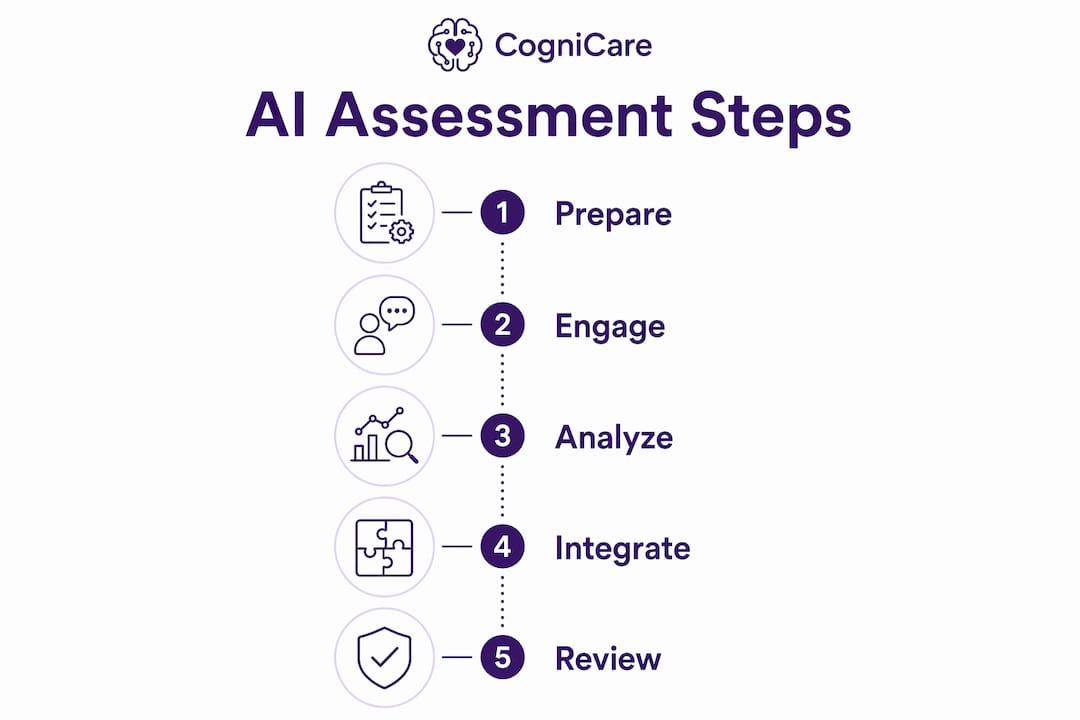
The process is more structured than most people expect. A good AI assessment is not a free-form chat. It follows a clinical logic that mirrors stepped-care models used in professional settings.
Here is how a typical session works, step by step:
- Create your account and set privacy preferences. Enable biometric lock immediately. Choose your data sharing settings before you answer a single question.
- Complete the intake questionnaire. Tools like Aichologist begin with a structured intake that covers sleep, stress, mood, and recent life events. This baseline takes 3–5 minutes and uses validated instruments like the WHO-5.
- Engage with the chatbot. The AI asks follow-up questions based on your intake responses. WiseMind-style multi-agent frameworks route your responses through specialized diagnostic modules, which is why their accuracy outperforms standard large language model baselines by 15–54 percentage points.
- Allow sensor data collection if prompted. Some platforms use digital phenotyping, which reads behavioral signals from your smartphone such as sleep duration, movement patterns, and messaging latency. Digital phenotyping detects mood shifts before you consciously notice them. It complements conversational data rather than replacing it.
- Review your results. The platform generates a risk profile and a set of recommendations. Read these as supportive guidance, not a clinical diagnosis. The AI is flagging patterns, not prescribing treatment.
- Act on the output. If the tool recommends professional consultation, take that seriously. If it suggests mindfulness exercises or journaling, try them for two weeks before reassessing.
Pro Tip: Focus on the quality of your responses, not the speed. Research shows that dialogue quality is three times more predictive of positive outcomes than how often you use the app. One honest, detailed session beats five rushed check-ins.
The WiseMind framework is a useful reference point here. It uses a multi-agent architecture where separate AI modules handle symptom analysis, empathy modeling, and risk flagging simultaneously. That parallel processing is what drives its accuracy advantage. When you engage thoughtfully with a platform built on this architecture, you give each module better data to work with.

What are common mistakes when using AI mental health assessments?
The most damaging mistake is treating AI output as a clinical diagnosis. AI tools lack cultural nuance and can produce hallucinations, meaning confident-sounding responses that are factually wrong. Clinicians significantly outperform AI in complex diagnostics. That gap is not closing fast enough to change how you should interpret results today.
Watch for these specific pitfalls:
- Over-reliance on frequency. Using an app daily does not guarantee progress. Shallow, repetitive interactions produce diminishing returns. Depth matters more than habit streaks.
- Ignoring escalation signals. If the platform flags suicidal ideation, trauma responses, or severe anxiety, do not dismiss the alert. Safety protocols in well-built platforms auto-trigger crisis resources and can pre-fill crisis text lines when risk signs appear. These are not false alarms.
- Skipping the safety monitor check. Not all platforms use independent safety monitoring. ASTRA, validated in 2026, scans conversations in real time to detect risk behaviors across multiple risk categories. A platform without equivalent monitoring is a gap in your safety net.
- Expecting AI to replace your therapist. The stepped-care model positions AI as a first-line support that frees human therapists to focus on complex cases. AI handles volume. Therapists handle depth.
“AI supplements therapists by providing persistent, empathetic support during times when human access is limited. It does not replace clinical care.” — WiseMind research team, npj Digital Medicine, 2026
The cultural nuance gap deserves extra attention. Current AI models are trained predominantly on Western clinical data. If your cultural background, language, or expression of distress falls outside that training set, the tool’s accuracy drops. Use results as one data point among several, not as the final word on your mental state.
How are AI mental health assessments evolving in 2026?
The field is moving faster than most users realize. Three developments are worth tracking closely.
Natural language processing and multi-agent architectures
Multi-agent frameworks like WiseMind assign specialized AI modules to different diagnostic tasks simultaneously. This is a structural improvement over single-model chatbots. The result is higher accuracy and better empathy modeling. Expect this architecture to become the standard for premium platforms within two years.
Integration with electronic health records
AI assessments are beginning to connect with electronic health records (EHR) systems. This integration means your AI-generated risk profile can inform your primary care physician’s decisions without you having to manually relay information. The AI role in treatment triage becomes more powerful when it feeds into a coordinated care system.
Digital phenotyping at scale
Smartphone sensor data is becoming a primary diagnostic signal, not a secondary one. Sleep quality, movement patterns, and even typing speed are now inputs for mental health inference. Behavioral sensor data catches early warning signs days before mood changes surface in conversation. The implication is significant: future assessments may flag a depressive episode before you feel it.
Pro Tip: When evaluating new platforms, ask specifically whether they use passive sensor data and how that data is stored. Passive collection is powerful, but it requires stronger privacy controls than conversational data alone.
Here is a comparison of current versus emerging AI assessment capabilities:
| Capability | Current State (2026) | Emerging Direction |
|---|---|---|
| Diagnostic accuracy | Up to 85.6% (WiseMind) | Approaching specialist-level |
| Data inputs | Conversation + basic sensors | Full behavioral phenotyping |
| EHR integration | Limited pilots | Broad clinical adoption |
| Safety monitoring | ASTRA real-time scanning | Predictive risk modeling |
| Cultural adaptation | Limited | Multilingual, culturally trained models |
| User data ownership | Platform-dependent | Standardized export and portability |
The call for user data ownership is growing louder among researchers and developers. Transparency about how your data trains future models is the next frontier. Platforms that give you control over your data today are building the trust infrastructure that the entire field needs.
Key takeaways
AI mental health assessments work best when you treat them as structured, privacy-protected tools for early insight, not as replacements for professional clinical care.
| Point | Details |
|---|---|
| Accuracy is real but limited | WiseMind reaches 85.6% diagnostic accuracy, but clinicians still outperform AI on complex cases. |
| Privacy setup comes first | Choose platforms with HIPAA and GDPR compliance, biometric locks, and data export before starting. |
| Quality beats frequency | Dialogue quality predicts positive outcomes three times more reliably than how often you use the app. |
| Safety monitoring is non-negotiable | Platforms should use independent tools like ASTRA to detect risk behaviors in real time. |
| AI supports, not replaces, therapists | The stepped-care model uses AI for triage and low-acuity support, freeing clinicians for complex care. |
Why i think most people are using these tools wrong
I have spent years watching people download AI mental health apps with genuine hope and then abandon them within three weeks. The pattern is almost always the same. They open the app daily, tap through the mood check-in in under a minute, and then wonder why nothing changes. They are confusing activity with engagement.
The research is clear on this. Dialogue quality is three times more predictive of improvement than frequency. That finding should change how you approach every session. Treat the chatbot like a thoughtful journal prompt, not a notification to dismiss.
The second mistake I see constantly is privacy negligence. People hand over their most sensitive personal data without reading a single privacy policy. I get it. Nobody reads those documents. But checking two things takes 90 seconds: whether the platform is HIPAA compliant, and whether you can export or delete your data. Those two checks protect you from becoming a training dataset without your knowledge.
My honest view on the future is cautiously optimistic. Multi-agent frameworks like WiseMind represent a genuine leap in accuracy. Digital phenotyping is catching signals that even experienced clinicians miss in a 50-minute session. But the technology is only as good as the human judgment layered on top of it. The future of AI in therapy is a collaboration, not a handoff. Use these tools to show up better prepared for your next human conversation, whether that is with a therapist, a counselor, or a trusted friend.
— dushyantha
Start your AI mental health journey with Cognicareai
Cognicareai curates a directory of the most effective AI-powered mental health tools available in 2026, from chatbot-based triage to mindfulness apps and specialized therapy platforms. Every tool in the directory is evaluated for clinical grounding, privacy compliance, and real user outcomes.
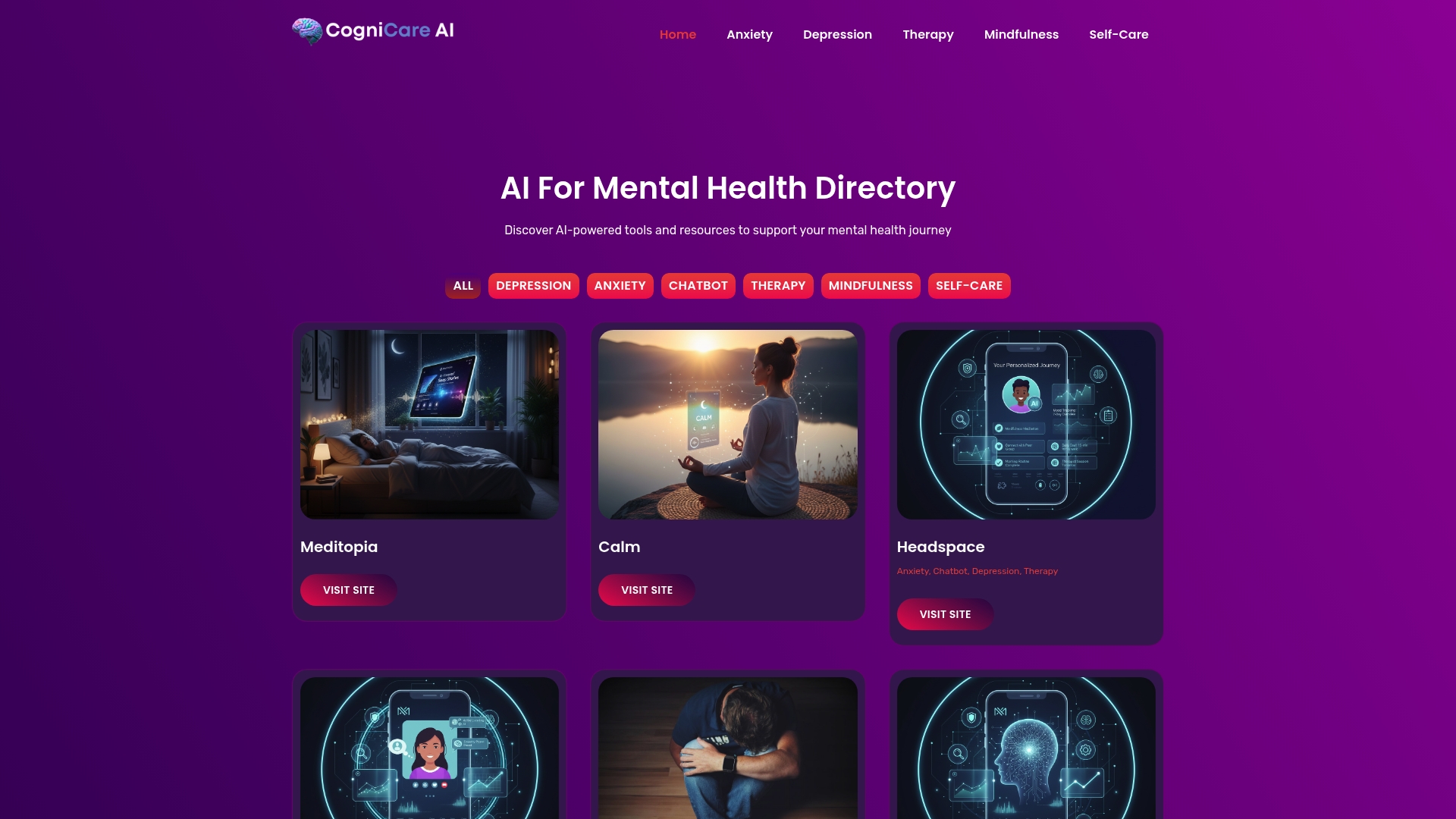
Whether you are managing daily stress, tracking mood patterns, or looking for a structured way to prepare for therapy, Cognicareai connects you with the right resource at the right level. Explore top AI mental health tools with free trial options, or browse the full 2026 AI tools guide to find the platform that fits your specific needs. Your mental health data deserves both protection and purpose.
FAQ
What is an AI mental health assessment?
An AI mental health assessment is a structured evaluation of emotional well-being conducted through artificial intelligence tools such as chatbots, validated questionnaires like the WHO-5, and behavioral sensor analysis. These tools provide supportive insight and triage, not clinical diagnoses.
How accurate are AI mental health assessment tools?
The WiseMind framework achieves up to 85.6% diagnostic accuracy, outperforming standard large language model baselines by 15–54 percentage points. Human clinicians still outperform AI in complex or high-risk cases.
Are AI mental health apps safe to use?
Reputable platforms use independent safety monitors like ASTRA, which detect risk behaviors in real time and trigger crisis protocols automatically. Always choose platforms with HIPAA and GDPR compliance and biometric data protection.
Can AI replace my therapist?
No. AI operates within a stepped-care model, handling low-acuity support and triage while human therapists manage complex, high-risk cases. AI supplements professional care; it does not substitute for it.
How do i get the most out of an AI mental health assessment?
Prioritize the quality of your responses over how often you check in. Research shows that interaction quality is three times more predictive of positive outcomes than frequency alone. One thorough session delivers more value than daily superficial check-ins.