

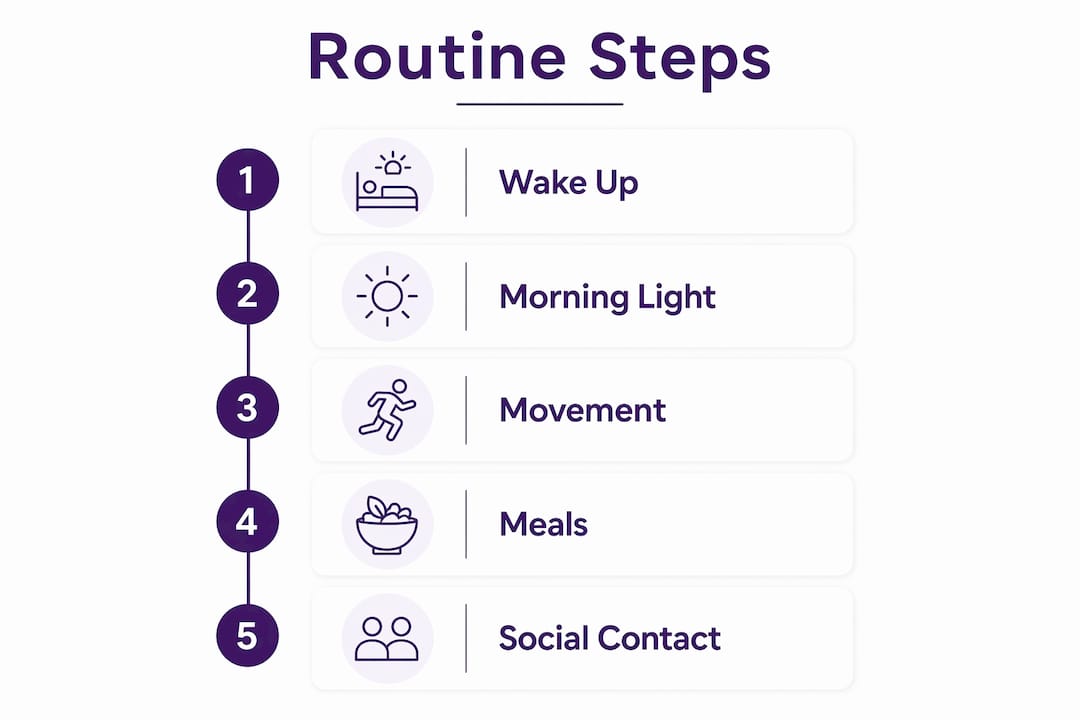
A stable daily routine is one of the most accessible, evidence-backed tools available for depression recovery. It works by restoring predictability, cutting decision fatigue, and stabilizing the sleep and activity cues your brain uses to regulate mood. Clinical frameworks like Behavioral Activation and Social Rhythm Therapy both treat routine regularity as a core mechanism, not a side benefit. UCLA Health reports that people with consistent sleep and wake times had a 38% lower risk of depression in a referenced study. That number alone makes the case.
Three things you can do today, before reading further:
- Set a fixed wake time and keep it tomorrow, even if sleep was poor.
- Take a 10–15 minute walk outside, ideally in morning light.
- Eat one meal at a scheduled time rather than whenever hunger hits.
These are not feel-good suggestions. They are the same anchors used in structured clinical programs. Cognicareai’s resource library covers the tools and templates that support exactly this kind of structured approach, which you’ll find useful as you build out a fuller plan.
Table of Contents
- How does routine actually help with depression?
- Why does routine affect your mood? The science explained
- Which routine elements move the needle most for mood?
- How to build a routine you can actually keep
- Sample morning and evening routines for every energy level
- What does the research actually say?
- When routine isn’t enough: red flags and when to get help
- Key Takeaways
- Why the “just be consistent” advice misses the point
- How digital tools can support your routine-building
- Useful sources
How does routine actually help with depression?
Depression pulls hard toward withdrawal: staying in bed, skipping meals, canceling plans. Each of those skips feels like relief in the moment but deepens the cycle. A structured daily schedule interrupts that pattern at the behavioral level, before motivation has a chance to return on its own.
The concrete benefits break down like this:
- Reduced decision fatigue. When wake time, meals, and basic tasks are pre-decided, your brain spends less energy on low-stakes choices. That freed-up capacity matters when depression has already depleted your cognitive reserves.
- Circadian stabilization. Regular light exposure, consistent meal timing, and a fixed wake time act as biological cues that synchronize your internal clock. Disrupted circadian rhythms are directly linked to worsened mood and sleep quality.
- Behavioral activation. Scheduling small activities, even ones you don’t feel like doing, creates a feedback loop where completing the task shifts affect upward. Mood follows behavior, not the other way around.
- Reduced isolation. Brief, scheduled social contact, a morning text to a friend, a standing phone call, gives the day an interpersonal anchor that counters the withdrawal depression encourages.
- Small wins. Completing even a micro-task (making coffee, opening a window) builds a sense of agency that depression erodes. Those small wins accumulate.
Routine disruptions tracked across large population surveys are statistically associated with higher depression and anxiety symptoms, and those effects persist over time. The inverse is also true: recovering routine regularity is one of the strongest behavioral predictors of symptomatic improvement.
The NIMH frames it plainly: even small acts of self-care in your daily life can have a big impact on mental health. The daily habits for mental health that matter most are not elaborate. They are consistent.

Why does routine affect your mood? The science explained
Routines change behavior, and behavior changes mood. That is the core mechanism, and two clinical frameworks have built entire treatment models around it.
Behavioral Activation is a well-validated approach rooted in the observation that depression is maintained by avoidance and withdrawal. When you stop doing things, you stop getting the positive reinforcement those things provide, which deepens low mood. The fix is counterintuitive: schedule activity before you feel ready. UCLA Health guidance on behavioral activation confirms that completing scheduled activities tends to shift affect and interrupt withdrawal, even when motivation is absent at the start.
Social Rhythm Therapy (SRT) and its clinical extension, Interpersonal and Social Rhythm Therapy (IPSRT), take a biological angle. The theory, called Social Zeitgeber theory, holds that social routines act as external time-givers that entrain your circadian clock. Regular timing of wake, meals, and social contact stabilizes circadian rhythms, which in turn stabilizes mood. IPSRT randomized controlled trials in bipolar disorder show longer periods without new mood episodes when social rhythms are targeted. The evidence in unipolar depression is less extensive but directionally consistent.
At the biological level, consistent wake time and morning light exposure influence serotonin and dopamine regulation. A graduate nursing review found that circadian cues, specifically light, meals, and activity timing, strongly influence the physiological processes tied to mood. Shift workers, whose routines are chronically disrupted, show markedly higher rates of psychological distress. That is not coincidence.
Pro Tip: The Social Rhythm Metric (SRM) tracks five core daily behaviors: getting out of bed, first social contact, starting work or daily activities, dinner, and going to bed. Logging these five times each day for one week gives you a concrete baseline for your own routine regularity, and a clinician can use that data to identify where your circadian anchors are weakest.
Which routine elements move the needle most for mood?
Not all habits carry equal weight. For depression recovery, the highest-impact anchors are sleep/wake timing, light exposure, and brief movement. Everything else builds on that foundation.
Sleep and wake timing
Research consistently shows that consistent wake time is more protective for mood than total sleep hours alone. A fixed wake time, kept even after a bad night, anchors your circadian clock and prevents the sleep-phase drift that worsens depression. Bedtime matters less than wake time for most people.
- Pick one wake time and hold it seven days a week, at least initially.
- Avoid sleeping in more than 60 minutes past your target, even on weekends.
- Reduce blue-light exposure from screens in the 60–90 minutes before bed.
Light exposure
Morning light is a direct circadian cue. Getting outside within 30–60 minutes of waking, even on a cloudy day, signals your brain that the day has started and helps regulate the cortisol and melatonin cycles that affect energy and sleep.
Movement
The American Psychological Association’s summary, cited by UCLA Health, links 10–15 minutes of daily walking to a meaningful reduction in depression risk. You do not need a gym or a structured workout. A short walk outside covers both movement and light exposure simultaneously. The NIMH recommends 30 minutes of walking daily for mood support, noting that small amounts add up when you can’t do it all at once.

Meals and hydration
Regular meal timing functions as a zeitgeber, a biological time-cue, in the same way light does. Skipping meals or eating at erratic times disrupts blood sugar, energy, and appetite regulation, all of which feed into low mood and fatigue. Aim for meals at roughly the same times each day, even if appetite is low.
Hygiene and basic self-care
Getting dressed, washing your face, or brushing your teeth might seem trivial when depression is severe. They are not. These behaviors send a behavioral signal that the day has structure, and completing them creates the same small-win effect as any other scheduled task. The depression self-care strategies that hold up clinically almost always include basic hygiene as a non-negotiable anchor.
Social contact
Brief, low-effort social contact, a text, a short call, sitting near another person, reduces isolation without requiring energy you may not have. Schedule one brief contact point per day as an anchor, not as a social obligation.
Digital breaks
Scheduled screen-free windows, particularly in the evening, reduce rumination and improve sleep onset. Even a 30-minute break from screens before bed makes a measurable difference in sleep quality for many people.
Pro Tip: Start with just two anchors: wake time and one timed meal. Adding too many new behaviors at once is the fastest way to abandon all of them. Once those two feel automatic, layer in a third.
How to build a routine you can actually keep
The biggest mistake people make is designing a routine for their best days. Depression means most days won’t be your best. Build for your worst days first.
Step-by-step sequence
- Choose one anchor. Wake time is the highest-leverage starting point. Set it, write it down, and commit to it for seven days regardless of how sleep went.
- Add one more anchor. After three to five days, add a timed meal or a 10-minute walk. Keep it small enough that skipping feels harder than doing it.
- Build your minimum viable routine (MVR). Identify the two or three behaviors that must happen even on your lowest-energy days. These are your floor, not your ceiling.
- Use environmental cues. Put your walking shoes by the door. Set a phone alarm labeled with the behavior, not just a time. Cues reduce the decision load that depression amplifies.
- Track simply. A paper checklist or a basic habit-tracking app works. Self-monitoring is itself a behavioral intervention: seeing a streak builds motivation to continue it.
- Plan for disruptions. Write a three-step resumption plan now, before you need it. Something like: “If I miss my routine, I will (1) do my MVR only, (2) reset my wake time for tomorrow, (3) not add anything new for 48 hours.”
When a setback happens
Setbacks are not failures. They are expected. The goal is not a perfect streak; it is a shorter gap between disruption and resumption.
- Use your MVR as the re-entry point, not the full routine.
- Avoid the “all or nothing” trap: one missed day does not erase prior gains.
- Self-talk matters: “I got off track, and I’m starting again today” is more useful than any self-criticism.
For low-energy days, micro self-care routines offer ready-made templates you can adapt without building from scratch.
Pro Tip: Write your resumption plan on a sticky note and put it somewhere visible. The plan should be three steps maximum. When you’re in a depressive episode, you won’t have the bandwidth to remember a complex protocol, so make it automatic before you need it.
Behavioral techniques that help sustain routines include implementation intentions (“If it’s 7:30 AM, I will put on my shoes and walk outside”), habit stacking (attaching a new behavior to an existing one, like taking a vitamin with morning coffee), and graded tasks (starting with a version of the behavior so small it’s almost impossible to skip). Recovery is a process, not a switch, and understanding that arc helps reduce the guilt that derails routine-building.
Sample morning and evening routines for every energy level
These are templates. Adapt them. The wake time anchor is the one non-negotiable across all three levels.
Morning routines
High-energy day
- 7:00 AM: Wake, open blinds or step outside for 5–10 minutes of light exposure.
- 7:15 AM: Drink a glass of water before coffee.
- 7:30 AM: Light movement, a 15-minute walk or stretching.
- 8:00 AM: Breakfast at the table, not in bed.
- 8:30 AM: One brief social contact, a text or a short call.
Medium-energy day
- 7:00 AM: Wake at the same time. Sit up immediately rather than lying back down.
- 7:10 AM: Open a window or step onto a porch for 5 minutes.
- 7:20 AM: Eat something small, even just toast or a banana.
- 7:45 AM: Get dressed before doing anything else.
Low-energy day (minimum viable routine)
- Wake at your anchor time. Sit up.
- Drink water.
- Get dressed, even if you go nowhere.
That’s it. Three steps. On the hardest days, those three steps are a win.
Evening routines
High-energy day
- 8:30 PM: Begin winding down. Dim lights, put on calm music or a podcast.
- 9:00 PM: Screens off or switched to night mode.
- 9:15 PM: Brief reflection: one thing that went okay today.
- 9:30 PM: Consistent bedtime, aligned with your wake anchor.
Medium-energy day
- 9:00 PM: Screens off. Read or listen to something low-stimulation.
- 9:30 PM: Prepare tomorrow’s anchor cues (shoes by the door, alarm set).
- 10:00 PM: Lights out.
Low-energy day
- Screens off 30 minutes before bed, no matter what.
- Alarm set for your anchor wake time.
- That’s enough.
For immediate relief techniques on the hardest evenings, a few targeted strategies can help bridge the gap until routine takes hold.
What does the research actually say?
Multiple large studies and clinical frameworks converge on one finding: routine regularity is a meaningful mediator of improved depressive outcomes. The evidence is strongest for sleep timing, brief physical activity, and social rhythm stability.
| Source | Population / Context | Measure | Outcome |
|---|---|---|---|
| UCLA Health (referenced study) | General population | Consistent sleep/wake timing | 38% lower depression risk |
| APA summary via UCLA Health | General population | 10–15 min daily walking | Meaningful reduction in depression risk |
| IPSRT RCTs (Springer review) | Bipolar disorder patients | Social Rhythm Metric (SRM) | Longer time without new mood episodes |
| PMC longitudinal surveys | General population, multi-wave | Routine disruption tracking | Higher depression/anxiety symptoms with greater disruption |
| ScienceDirect COVID-19 analysis | Large community samples | Routine disruption severity | Persistent psychological distress linked to disruption |
A few important caveats. The IPSRT evidence base is most robust for bipolar disorder; the evidence for unipolar depression is directionally consistent but less extensive in randomized trial form. Socioeconomic factors also moderate these effects: large-scale evidence shows that people with fewer resources face greater routine disruption and worse outcomes, which means routine-building advice needs to account for real-world constraints, not just behavioral willpower.
The Simply Psychology synthesis of the available evidence confirms that consistent routines reduce decision fatigue, improve sleep quality, and support behavioral activation, three pathways that each independently contribute to depression recovery.
When routine isn’t enough: red flags and when to get help
Routine is a genuine clinical adjunct. It is not a substitute for treatment when symptoms are moderate to severe or when safety is at risk.
Seek help immediately if you experience:
- Suicidal thoughts or thoughts of self-harm.
- Inability to meet basic needs (eating, hygiene, getting out of bed) for several consecutive days.
- Psychotic symptoms: hallucinations, delusions, or severe disorganization.
- Severe insomnia lasting more than a few days.
- Marked functional decline at work, school, or in relationships.
Call or text 988 (Suicide and Crisis Lifeline, US) for immediate support. For emergencies, call 911 or go to the nearest emergency room.
When to combine routine with professional treatment:
The NIMH recommends seeking professional help when distressing symptoms, including difficulty sleeping, changes in appetite, difficulty concentrating, or loss of interest in activities you usually enjoy, have lasted two weeks or more. Routine-building works best as an adjunct to therapy or medication, not a replacement.
When you see a clinician, bring:
- Your wake and sleep times for the past week.
- A brief log of daily activities (even rough notes).
- Notes on which routine elements you’ve tried and what happened.
That information gives a clinician a concrete starting point for a recovery treatment plan that integrates behavioral and clinical approaches. Equity matters here too: if access to care is a barrier, community mental health centers, federally qualified health centers, and telehealth platforms have expanded availability significantly in recent years.
Key Takeaways
A stable daily routine, anchored by consistent wake time, brief movement, and timed meals, is an evidence-backed foundation for depression recovery that works by stabilizing circadian biology and interrupting behavioral withdrawal.
| Point | Details |
|---|---|
| Wake time is the top anchor | Consistent wake time, held even after poor sleep, is more protective for mood than total sleep hours. |
| Behavior precedes motivation | Scheduling activity before you feel ready is the core of Behavioral Activation; mood follows action, not the reverse. |
| Start with two anchors | Adding too many habits at once leads to abandonment; begin with wake time and one timed meal, then build. |
| Build a minimum viable routine | Identify two or three non-negotiable behaviors for your lowest-energy days to maintain gains during setbacks. |
| Cognicareai supports the process | Cognicareai’s directory of AI mental health tools includes habit trackers, reminder apps, and guided templates that complement routine-building. |
Why the “just be consistent” advice misses the point
The conventional wisdom around routine and depression tends to flatten into one instruction: be consistent. That framing puts the burden entirely on willpower, which is exactly what depression depletes. It also ignores the clinical reality that the structure of a routine matters as much as the fact of having one.
What the research actually shows is more specific and more useful. The behaviors that stabilize mood are not arbitrary. Wake time, light exposure, brief movement, and social contact work because they target the biological and behavioral mechanisms that depression disrupts. Telling someone to “just build a routine” without specifying those anchors is like telling someone to “just eat better” without mentioning what food does in the body.
The other thing most advice gets wrong is the recovery timeline. People often expect to feel better within days and abandon the routine when they don’t. The honest picture is that circadian stabilization takes weeks, and the mood benefits of behavioral activation accumulate gradually. Small wins, completing the MVR on a hard day, keeping the wake time after a rough night, are real data points that the system is working, even when it doesn’t feel that way yet.
Routine also isn’t a solo project. The social rhythm component of SRT exists precisely because other people’s schedules, meal times, and contact patterns help regulate your own. Isolation doesn’t just feel bad; it removes the external cues your circadian clock depends on. Building even one brief social anchor into a daily structure does more than most people expect.
How digital tools can support your routine-building
Digital tools can track your anchors, send reminders at the right moments, and suggest low-energy alternatives when your planned routine isn’t realistic. That kind of adaptive support is where AI-powered resources add something a paper checklist can’t.

Cognicareai’s directory of AI mental health tools covers habit-tracking apps, mindfulness tools with built-in reminders, and AI-supported self-care resources that adapt to your energy level and goals. These aren’t replacements for clinical care, but they fill the gap between therapy sessions and daily life, which is exactly where routine-building happens. If you’re ready to add a layer of structured support to your recovery plan, browse the Cognicareai directory to find tools matched to your specific needs.
Useful sources
-
NIMH: Caring for Your Mental Health — Primary US government guidance on self-care, sleep, exercise, and when to seek professional help. Essential reference for clinical thresholds and red flags.
-
UCLA Health: How a Daily Routine Can Boost Your Mental Health — Summarizes key study findings on sleep consistency (38% lower depression risk) and walking benefits; covers behavioral activation principles.
-
Social Rhythm Therapies for Mood Disorders: an Update (Springer) — Peer-reviewed update on IPSRT and SRT evidence, including Social Rhythm Metric methodology and RCT outcomes in bipolar disorder. Recommended for clinicians seeking full trial details.
-
Trajectories of Daily Routine Disruptions (PMC) — Longitudinal population data linking routine disruption to persistent depression and anxiety symptoms across demographic groups.
-
ScienceDirect: Routine Disruption and Psychiatric Symptoms — Large-sample analysis of COVID-19-era routine disruptions and their association with psychological distress; includes socioeconomic moderators.
-
Simply Psychology: Mental Health Benefits of Daily Routine — Accessible synthesis of evidence on decision fatigue, sleep quality, and behavioral activation as routine-linked pathways.
-
The Rhythm of Your Life: Effects of Daily Routine on Mental Health (Southern University Graduate Nursing) — Narrative review of circadian cues (light, meals, activity) and their physiological links to mood; useful background on zeitgeber mechanisms.
This article is general information, not professional medical advice. If you are experiencing symptoms of depression, consult a qualified mental health professional or your primary care provider for guidance specific to your situation.