

AI support tools for depression are defined as software applications that use artificial intelligence to deliver evidence-based mental health interventions, monitor symptoms, and provide emotional support between clinical appointments. A meta-analysis of 48 randomized controlled trials involving 28,071 participants found that conversational AI agents produce small-to-moderate, statistically significant reductions in depressive symptoms. That finding matters because it places AI tools on the same evidence spectrum as many first-line behavioral interventions. Understanding the full range of ai support tool depression benefits helps you make informed decisions about your mental health care, whether you are managing mild symptoms or supplementing professional treatment.
1. How do AI support tools reduce depression symptoms?
AI support tools reduce depression symptoms through structured, evidence-based interactions delivered consistently over time. The meta-analysis cited above recorded a standardized mean difference of −0.27 across 48 trials. That number reflects a real, measurable shift in how people feel and function day to day.
A separate randomized clinical trial of 995 participants found that an AI-based emotional support platform produced a mean difference of −1.99 in depression scores compared to a control group. The trial also showed that AI outperformed group therapy on the same measure. These are not anecdotal results. They come from controlled research with thousands of participants.

The mechanism is straightforward. AI tools prompt you to examine negative thought patterns, practice coping skills, and track your mood over time. Repetition of these exercises builds new mental habits, which is the same process that makes traditional cognitive behavioral therapy (CBT) effective.
2. How do AI support tools detect and monitor symptoms early?
Early detection is one of the clearest ai support tool depression benefits because catching a symptom spike before it escalates gives you more options. AI tools analyze patterns in your responses, mood logs, and engagement data to flag changes that might otherwise go unnoticed for weeks.
Many apps use standardized scales like the PHQ-9 at regular intervals to track your progress objectively. That data creates a timeline of your mental health, which is far more useful than a single snapshot taken at a quarterly appointment. When scores trend upward, the tool can prompt you to use a coping skill, contact a support person, or reach out to your provider.
Some platforms pair with wearable devices to monitor sleep quality, activity levels, and heart rate variability. These physical signals often shift before mood symptoms become obvious. Catching them early gives you a window to intervene.
- Mood logging: Daily check-ins create a data trail that reveals patterns you might not notice in real time.
- PHQ-9 tracking: Standardized assessments at set intervals give you and your provider objective progress data.
- Behavioral signals: Changes in app engagement, response time, or session length can indicate symptom changes.
- Wearable integration: Sleep and activity data add a physical layer to emotional monitoring.
- Escalation prompts: When patterns suggest risk, the tool directs you toward appropriate resources immediately.
Pro Tip: Set your mood check-in at the same time each day, ideally in the evening. Consistency in timing produces cleaner data and makes it easier to spot weekly patterns.
Privacy is a real consideration here. Reputable AI mental health tools use encrypted data storage and clearly explain what data they collect and how it is used. Read the privacy policy before you start logging personal information.
3. What are the therapeutic benefits of AI-driven CBT?
CBT, DBT, and ACT are the three clinical frameworks most commonly built into effective AI mental health tools. These frameworks work because they target the thought patterns and behaviors that maintain depression, not just the symptoms. AI delivers these frameworks in short, repeatable sessions that fit into daily life.
Structured AI CBT programs typically require 10–20 minutes of daily engagement over a period of 2 weeks to 90 days. Total engagement of around 18–25 hours is associated with noticeable clinical improvement. That is roughly equivalent to 6–8 traditional therapy sessions, but spread across weeks of daily practice.
Here is what a well-designed AI CBT program delivers:
- Thought records: You log a negative thought, identify the cognitive distortion, and practice a balanced response. This is the core CBT skill.
- Behavioral activation: The tool assigns small, achievable activities to counteract withdrawal and low motivation.
- Mood tracking with feedback: Your logged mood data feeds back into session content, making each interaction relevant to your current state.
- Psychoeducation modules: Short lessons explain how depression affects thinking and behavior, which reduces self-blame.
- Progress reviews: Regular PHQ-9 assessments show you whether the work is producing results, which sustains motivation.
- Personalized pacing: AI adjusts session difficulty and content based on your history and responses.
- Skill reinforcement: The tool revisits skills you have practiced before, strengthening them through spaced repetition.
Pro Tip: Treat your AI CBT session like a scheduled appointment. Block 15 minutes on your calendar at the same time each day. People who treat sessions as optional rarely complete enough practice to see results.
Therapeutic alliance and emotional engagement also shape outcomes. People who feel heard and respected by an AI tool engage more consistently, and consistent engagement drives results. The best tools are designed to feel warm and responsive, not transactional.
4. How do AI support tools improve access to mental health care?
Access is the most underrated ai support tool depression benefit. Traditional therapy requires a provider in your area, an open appointment slot, insurance coverage or out-of-pocket funds, and the willingness to show up in person. AI tools remove most of those barriers at once.
- 24/7 availability: You can use an AI tool at 2:00 AM on a Sunday. No waiting room, no scheduling delay.
- Low or no cost: Many AI mental health apps are free or cost a fraction of a single therapy session.
- Privacy by default: Using an app on your phone carries none of the social visibility of walking into a therapist’s office.
- Geographic reach: People in rural areas or underserved communities gain access to structured mental health support that simply does not exist locally.
- Cultural adaptability: Some platforms offer content in multiple languages and allow users to select communication styles that match their background.
Nearly 60% of people with major depression also meet criteria for an anxiety disorder. AI tools that address both conditions simultaneously are especially valuable because they reduce the need to manage multiple separate resources. Cognicareai’s directory highlights tools that address overlapping depression and anxiety symptoms in one place.
The stigma barrier is real and often underestimated. Many people delay seeking help for years because they fear judgment. An app on a personal device sidesteps that fear entirely, which means people start sooner and stay longer.
5. What features drive long-term engagement and sustained benefits?
Sustained use is what separates meaningful improvement from a brief mood lift. Persistent memory of your history is one of the most important design features for long-term engagement. When a tool remembers your previous sessions, you do not have to re-explain your situation every time. That continuity makes the experience feel more like a relationship and less like filling out a form.
Pro Tip: When starting a new AI mental health tool, spend the first week completing the onboarding thoroughly. The more context the tool has about your history and goals, the more relevant its support becomes over time.
The table below compares feature categories that affect long-term engagement:
| Feature category | Impact on sustained use |
|---|---|
| Persistent memory | Reduces repetitive input; builds continuity across sessions |
| Multiple therapist personas | Lets you find a communication style that fits your personality |
| Crisis detection protocols | Provides safety assurance, which increases trust and willingness to engage |
| Structured goal-setting | Creates measurable progress that motivates continued use |
| Cognitive restructuring exercises | Active skill practice produces better outcomes than passive reading |
Crisis detection is a non-negotiable safety feature. Reputable AI tools recognize language that signals acute risk and immediately direct you to resources like the 988 Suicide and Crisis Lifeline or emergency services. This is not a replacement for crisis care. It is a safety net that ensures the tool never leaves you without a path to human support.
Active participation in structured exercises consistently outperforms passive use. Reading content without completing exercises produces minimal benefit. The tools that produce the best outcomes are the ones that require you to do something, not just consume information.
6. How to integrate AI support tools into your depression management plan
AI tools work best as a supplement to professional care, not a replacement for it. Combining CBT-based AI tools with medication or human therapy produces better outcomes than either approach alone for moderate-to-severe depression. That combination is the standard to aim for when your symptoms are significant.
- Tell your provider: Inform your doctor or therapist that you are using an AI tool. They can help you select one that aligns with your treatment goals.
- Use AI between appointments: AI tools are most valuable in the gaps between sessions, reinforcing skills and tracking mood in real time.
- Set realistic expectations: AI tools reduce symptoms and build coping skills. They do not cure depression or replace the depth of human therapeutic relationships.
- Know when to escalate: If your PHQ-9 scores worsen over two consecutive weeks, contact your provider rather than relying solely on the app.
- Combine with self-care: Pairing AI-led CBT with consistent sleep, physical activity, and social connection amplifies results.
Personalizing your mental health care with AI works best when you treat the tool as one part of a broader plan. No single intervention addresses every dimension of depression. The goal is a layered approach where each element reinforces the others.
User trust and privacy are central to whether you will actually use a tool consistently. Choose platforms that are transparent about data practices, offer clear opt-out options, and have published their clinical evidence. If a tool cannot explain how it was validated, look for one that can.
Key takeaways
AI support tools deliver clinically validated depression benefits through structured CBT frameworks, persistent engagement features, and 24/7 accessibility that traditional care cannot match alone.
| Point | Details |
|---|---|
| Clinically validated symptom reduction | A meta-analysis of 48 RCTs found significant depressive symptom reduction with AI tools. |
| CBT frameworks drive results | Daily 10–20 minute sessions over weeks produce measurable clinical improvement. |
| Accessibility removes key barriers | AI tools provide 24/7, low-cost support that reaches underserved and rural populations. |
| Active engagement is required | Completing structured exercises, not just reading content, produces meaningful outcomes. |
| Use AI as a supplement | Combining AI tools with therapy or medication outperforms either approach used alone. |
What I have learned about AI tools and depression after years of watching this space
The most common mistake people make with AI mental health tools is treating them like a search engine. They open the app when they feel bad, read a few tips, and close it. That is passive use, and passive use does not move the needle on depression.
What actually works is showing up consistently, even on days when you feel fine. Depression has a way of convincing you that you do not need to practice coping skills when you are not in crisis. That is exactly when the practice matters most. The people who see real results from AI tools are the ones who treat their daily session as non-negotiable, the same way they treat brushing their teeth.
I also want to address a misconception I see repeatedly. AI tools are not crisis intervention services. They are maintenance and coping tools. If you are in acute distress, the right resource is a human being, whether that is a therapist, a crisis line, or an emergency room. The best AI tools know this and will tell you so directly. That honesty is a sign of a well-designed product, not a limitation.
The research trends I find most promising involve personalization at the individual level, where AI adjusts not just content but pacing, tone, and therapeutic approach based on your specific response patterns. That is where the field is heading, and it is genuinely exciting. The ethical questions around data use and algorithmic bias are real and deserve serious attention from developers and regulators alike. But the core premise, that structured, evidence-based support delivered consistently can reduce suffering, is already proven.
— dushyantha
Cognicareai’s curated tools for your depression support
Finding the right AI mental health tool takes time, and the options can feel scattered across dozens of app stores and websites. Cognicareai organizes that search for you by curating a directory of AI-powered mental health tools vetted for clinical grounding and user trust.
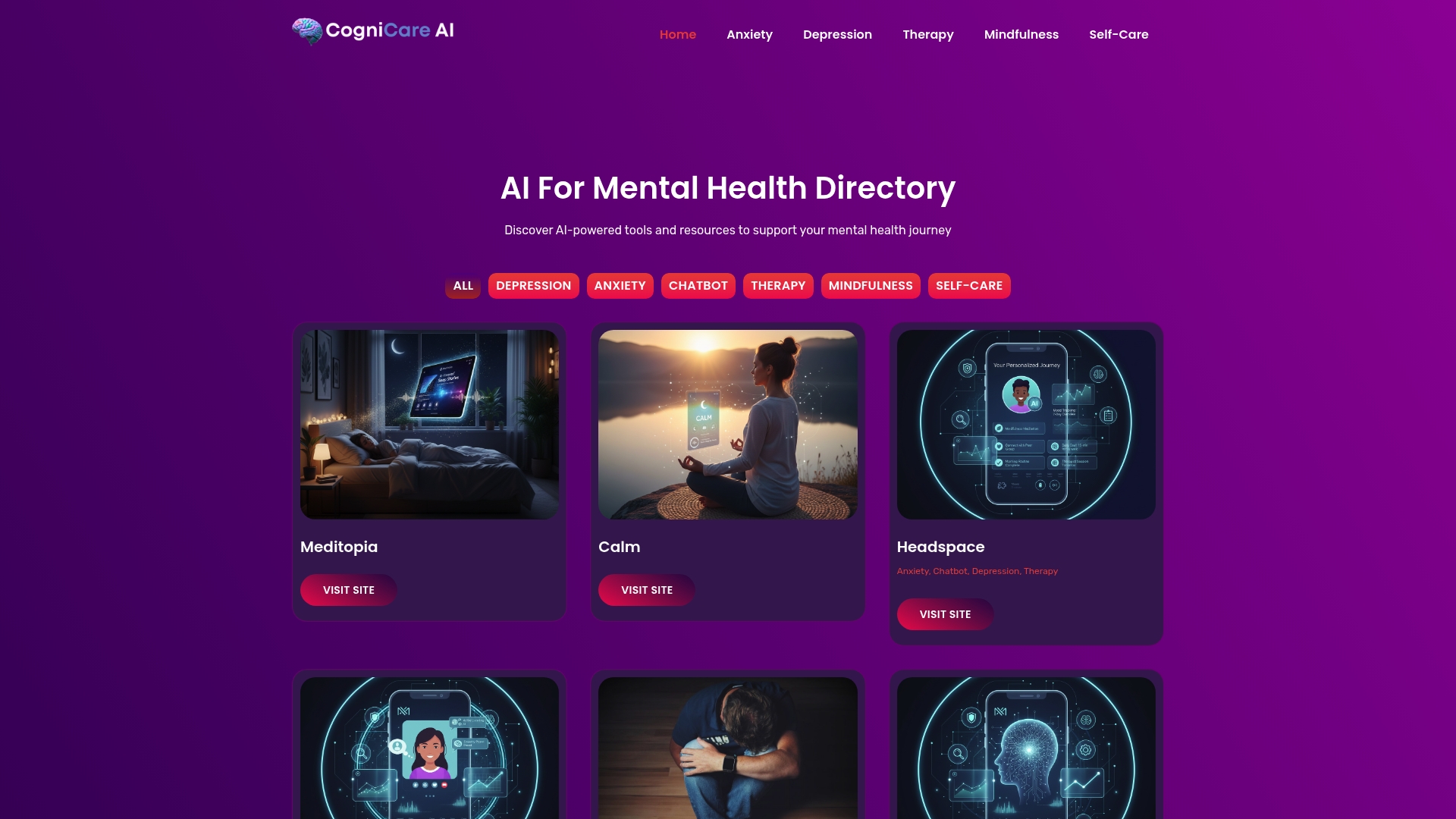
Whether you are looking for a CBT-based daily practice tool, a mindfulness app for anxiety, or a broader overview of what depression assistance software can do, Cognicareai has organized the options by category and use case. The 5 AI-powered mental health tools guide is a strong starting point if you want a focused, practical list to work from. You do not need to sort through hundreds of options alone.
FAQ
What is an AI support tool for depression?
An AI support tool for depression is a software application that uses artificial intelligence to deliver evidence-based mental health support, such as CBT exercises, mood tracking, and emotional coaching. These tools are designed to supplement professional care, not replace it.
Do AI tools actually reduce depression symptoms?
Yes. A meta-analysis of 48 randomized controlled trials with 28,071 participants found that AI conversational agents produce statistically significant reductions in depressive symptoms. A separate clinical trial of 995 participants showed meaningful improvement compared to both a control group and group therapy.
How long does it take to see results from an AI mental health tool?
Structured AI CBT programs typically require daily sessions of 10–20 minutes over 2 weeks to 90 days for noticeable clinical improvement. Total engagement of around 18–25 hours is associated with measurable symptom reduction.
Are AI mental health tools safe to use?
Reputable AI mental health tools include crisis detection protocols that direct users to resources like the 988 Suicide and Crisis Lifeline when acute risk is detected. Always choose tools that are transparent about their data practices and clinical validation.
Can I use an AI tool alongside my therapist or medication?
Yes, and research supports doing so. Combining CBT-based AI tools with medication or human therapy produces better outcomes than either approach alone, particularly for moderate-to-severe depression.