

Gratitude is defined as a conscious recognition of positive elements in your life, and it reduces anxiety by calming the nervous system and lowering stress hormone levels. Mindfulness-based interventions that include gratitude components show a moderate reduction in anxiety symptoms with an effect size of g = -0.56 across more than 24,000 participants. That number is significant. It places gratitude-inclusive practices in the same effectiveness range as many structured psychological therapies. The brain’s threat-detection system drives anxiety, and gratitude directly interrupts that process by activating what Compassion Focused Therapy calls the soothing system. Understanding why gratitude reduces anxiety is not just reassuring. It is the first step toward using it deliberately.
Why gratitude reduces anxiety at the neurological level
Gratitude produces measurable changes in the body, not just the mind. Cortisol levels drop with regular gratitude practice, and heart rate variability (HRV) improves. HRV measures how well your autonomic nervous system adapts to stress. Higher HRV signals better stress regulation and a calmer baseline state.
The parasympathetic nervous system, often called the “rest and digest” system, activates during gratitude practice. This directly counters the sympathetic nervous system’s “fight or flight” response that fuels anxiety. When you shift into parasympathetic dominance, your heart rate slows, your breathing deepens, and your body stops treating ordinary situations as threats.
EEG research from a 12-month mindfulness and gratitude study shows increased alpha brain wave activity and decreased beta and gamma power in people who practiced consistently. Alpha waves are associated with relaxed alertness. Beta and gamma waves spike during anxious, hypervigilant states. The shift in brain wave patterns directly mirrors the reduction in anxiety symptoms participants reported.
| Physiological marker | Before gratitude practice | After consistent practice |
|---|---|---|
| Cortisol | Elevated (stress response active) | Reduced (stress response dampened) |
| Heart rate variability | Low (poor autonomic balance) | Improved (better stress regulation) |
| Alpha brain waves | Suppressed | Increased (relaxed alertness) |
| Beta/gamma brain waves | Elevated (hypervigilance) | Decreased (reduced threat scanning) |
Pro Tip: Track your resting heart rate each morning for two weeks while practicing daily gratitude. A gradual downward trend is a concrete sign your autonomic nervous system is responding.
What psychological mechanisms explain gratitude’s effect on anxiety?
Anxiety runs on automatic threat scanning. Your brain constantly searches for danger, even when none exists. Gratitude interrupts this cycle by redirecting attention toward stable, positive elements of your life. The shift is not denial. It is a reallocation of mental resources.
Compassion Focused Therapy (CFT) identifies three emotional regulation systems: the threat system, the drive system, and the soothing system. Anxiety lives in the threat system. Gratitude activates the soothing system, which is associated with feelings of safety, connection, and calm. When the soothing system is engaged, the threat system loses its grip.
Cognitive flexibility also improves with gratitude practice. People who practice regularly show a greater ability to reframe negative events without dismissing them. This is a critical distinction. Gratitude is not forced positivity. It is balanced recognition of what is working alongside what is difficult. That balance is what makes it a genuine anxiety management tool rather than a superficial coping trick.
Key psychological benefits of gratitude for anxiety relief include:
- Reduced rumination: Gratitude shifts focus away from repetitive negative thought loops.
- Improved emotional regulation: Regular practice trains the brain to respond rather than react to stressors.
- Greater sense of social connection: Recognizing others’ contributions reduces isolation, a major anxiety amplifier.
- Increased psychological flexibility: Gratitude broadens your attention, making catastrophic thinking less automatic.
- Stronger sense of meaning: Appreciating what matters reduces existential anxiety about uncertainty.
Pro Tip: If gratitude feels hollow or forced, start smaller. Instead of listing big life blessings, name one specific moment from the past 24 hours that went better than expected. Specificity beats generality every time.
How does gratitude build resilience against anxiety over time?
Gratitude practice works like a mental gym. Each session strengthens neural pathways associated with appreciation and calm. Over weeks and months, those pathways become the brain’s default route. This is neuroplasticity in action: the brain physically rewires itself based on repeated patterns of thought.
The longitudinal EEG study referenced earlier tracked participants over 12 months. Sustained reductions in anxiety, depression, and stress correlated with measurable changes in brain wave patterns. This is not a placebo effect. The brain’s structure and activity genuinely shift with consistent practice.
A multinational megastudy across 34 countries found that gratitude practices consistently improved positive affect, life satisfaction, and reduced negative affect and envy. The effects varied by country and practice type, but the direction was consistent everywhere. That cross-cultural consistency suggests gratitude taps into something fundamental about human emotional regulation, not just a cultural preference.
A simple four-week gratitude practice plan:
- Week 1: Daily three-item journaling. Each evening, write three specific things that went well. Focus on concrete details, not abstract concepts.
- Week 2: Add a thankfulness pause. Once per day, stop for 60 seconds and silently acknowledge one person or situation you are grateful for.
- Week 3: Written gratitude letters. Write one letter per week to someone who helped you. You do not need to send it. The act of writing is what matters.
- Week 4: Morning gratitude intention. Before checking your phone, name one thing you are looking forward to or appreciate about the day ahead.
| Gratitude technique | Primary benefit | Evidence base |
|---|---|---|
| Journaling (3 items daily) | Reduces negative affect, improves mood | Multinational megastudy, 34 countries |
| Mindfulness with gratitude | Reduces anxiety symptoms (g = -0.56) | Meta-analysis, 24,000+ participants |
| Gratitude letters | Increases positive affect and social connection | Cross-cultural longitudinal research |
| Thankfulness pauses | Activates soothing system, lowers cortisol | Physiological studies, HRV and cortisol data |
Regular practice also carries physical health benefits beyond mental well-being. Research involving nearly 50,000 older women found a nine percent lower risk of death, particularly from cardiovascular causes, among those with higher gratitude levels. That finding underscores that the physiological effects of gratitude accumulate meaningfully over a lifetime.
How does gratitude compare to other anxiety management techniques?
Gratitude is not a replacement for clinical treatment. It is a complement that makes other approaches work better. Cognitive behavioral therapy (CBT) targets distorted thinking patterns. Mindfulness reduces anxiety by training present-moment awareness. Pharmacological treatments address neurochemical imbalances. Gratitude works alongside all three by training the brain’s attention system toward balance.
The practical advantage of gratitude is accessibility. CBT requires a trained therapist. Medication requires a prescription and monitoring. Mindfulness takes time to learn. Gratitude journaling takes five minutes and costs nothing. That scalability makes it a genuinely useful addition to any anxiety management plan, not just an afterthought.
Mindfulness-based cognitive therapy and gratitude share a common mechanism: both interrupt automatic negative thinking. When combined, they produce stronger outcomes than either approach alone. AI-supported therapy tools now integrate both techniques, offering personalized prompts and tracking that help people stay consistent.
Comparing gratitude to other anxiety approaches:
- Versus CBT: Gratitude lacks CBT’s structured cognitive restructuring but is easier to practice independently and daily.
- Versus mindfulness: Both calm the threat system. Gratitude adds a positive attentional focus that pure mindfulness does not always include.
- Versus medication: Gratitude has no side effects and no dependency risk, but it does not address severe clinical anxiety on its own.
- Versus no treatment: Gratitude consistently outperforms passive coping in reducing anxiety symptoms across multiple study designs.
Pro Tip: Pair your gratitude journal with a mindfulness app that includes guided breathing. The combination activates both the attentional and physiological pathways to anxiety relief simultaneously.
Key Takeaways
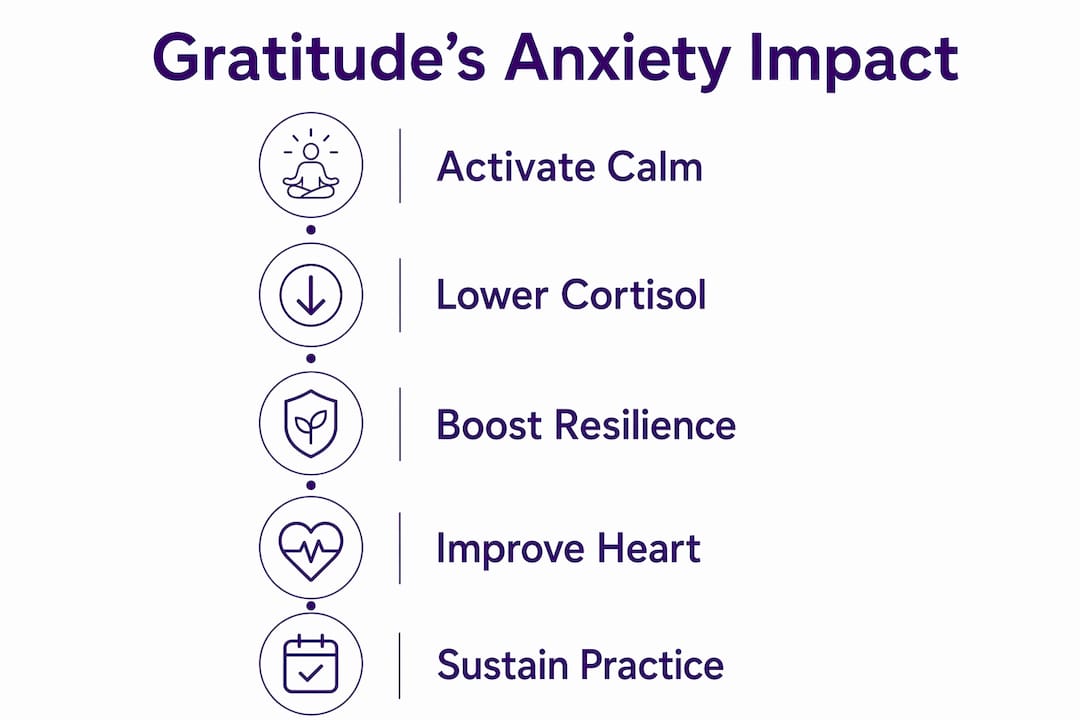
Gratitude reduces anxiety by activating the brain’s soothing system, lowering cortisol, improving heart rate variability, and retraining attention away from automatic threat scanning toward balanced emotional awareness.
| Point | Details |
|---|---|
| Physiological impact | Gratitude lowers cortisol and improves HRV, directly calming the stress response. |
| Neurological change | Consistent practice increases alpha waves and decreases beta/gamma waves linked to hypervigilance. |
| Psychological mechanism | Gratitude activates the soothing system in CFT, interrupting automatic threat scanning. |
| Long-term resilience | A 12-month practice produces sustained reductions in anxiety, depression, and stress. |
| Complementary value | Gratitude works best alongside CBT, mindfulness, or AI-supported therapy, not as a standalone cure. |
Gratitude as a practice, not a personality trait
Most people treat gratitude as something you either feel or you don’t. That framing is the biggest obstacle to using it effectively for anxiety. After working closely with mental health research and tools for years, what I’ve found is that gratitude functions more like a skill than a mood. You build it through repetition, not inspiration.
The common pitfall is expecting gratitude to feel good immediately. When you’re anxious, forcing yourself to list blessings can feel dishonest. That resistance is normal. The goal is not to feel grateful. The goal is to train your attention to notice what is stable and safe, even briefly, while anxiety is loud. Over weeks, that practice shifts your brain’s default scanning pattern. The anxiety does not disappear. It just stops running the whole show.
What the research confirms, and what I find most useful to share, is that gratitude works best as one layer in a broader plan. Pair it with structured support, whether that is therapy, mindfulness, or AI-assisted tools, and the results compound. Treat it as the whole solution, and you’ll likely feel disappointed. Treat it as a daily mental training habit, patient and unglamorous, and it genuinely changes how your nervous system responds to stress over time.
— dushyantha
Cognicareai’s tools for anxiety and gratitude support
Gratitude practice is most effective when it fits naturally into your daily routine. Cognicareai offers a curated directory of AI mental health tools that integrate mindfulness and gratitude-based approaches, making it easier to stay consistent without adding friction to your day.

These tools adapt to your specific needs, offering personalized prompts, mood tracking, and guided exercises that reinforce the neural pathways gratitude builds. Whether you are new to anxiety management or looking to add structure to an existing practice, Cognicareai connects you with resources designed to support real, sustained progress. Visit Cognicareai to find the right tools for your mental health goals.
FAQ
Why does gratitude reduce anxiety in the brain?
Gratitude activates the parasympathetic nervous system and the brain’s soothing system, reducing cortisol and shifting brain wave activity from hypervigilant beta/gamma patterns to calmer alpha states. This directly counters the threat-detection activity that drives anxiety.
How long does it take for gratitude to reduce anxiety?
Longitudinal research shows measurable reductions in anxiety symptoms over a 12-month consistent practice period, though many people report mood improvements within the first few weeks of daily journaling or thankfulness exercises.
Can gratitude replace therapy or medication for anxiety?
Gratitude is a complement to clinical treatment, not a replacement. It works best alongside approaches like CBT, mindfulness, or pharmacological treatment, particularly for moderate to severe anxiety.
What is the most effective gratitude practice for anxiety relief?
Mindfulness-based interventions that include gratitude components show the strongest evidence, with an effect size of g = -0.56 for anxiety reduction across more than 24,000 participants. Daily journaling combined with mindfulness practice produces the most consistent results.
Does gratitude work for anxiety across different cultures?
A multinational megastudy across 34 countries found that gratitude practices consistently improved positive affect and reduced negative affect regardless of cultural context, confirming that the emotional regulation benefits are not culturally specific.