

Depression and isolation coping methods are defined as structured self-care, social reconnection, and behavioral activation strategies that reduce loneliness and stabilize mood. These approaches are not just feel-good advice. They are backed by clinical research and recommended by mental health professionals at institutions like Harvard T.H. Chan School of Public Health and Spring Health. The core insight is this: you do not need to feel motivated before you act. Small, consistent actions rebuild the neural and social pathways that depression erodes. Tools like behavioral activation, mindfulness apps, and structured social engagement are the foundation of effective self-care for depression. AI-powered platforms like Cognicareai now make these tools more accessible than ever.
What are the best depression and isolation coping methods?
Moderate-intensity exercise for 30 minutes most days is the single most evidence-backed self-care strategy for depression as of 2026. That finding matters because it means you do not need a gym membership, a therapist on speed dial, or a perfect morning routine. You need movement, consistency, and a low enough barrier to start.
Exercise reduces cortisol and adrenaline while promoting the release of endorphins and serotonin. Both of those chemical shifts directly counter the flat, heavy feeling that depression produces. The effect compounds over weeks, not days, so consistency beats intensity every time.
Here are physical activities that work across varying fitness levels:
- Brisk walking outdoors for 20–30 minutes, especially in green spaces
- Cycling at a comfortable pace, indoors or outside
- Swimming or water aerobics, which reduces joint stress
- Yoga or stretching, which combines movement with breath awareness
- Dancing at home, which requires zero equipment and zero audience
Pro Tip: Start with 10-minute sessions at the same time each day. Research shows that consistent timing builds habit faster than longer, irregular workouts. Once the habit locks in, extending the duration feels natural.
The goal is not athletic performance. The goal is showing your nervous system that your body is safe, capable, and worth caring for.
How can social connection relieve loneliness and depression?
Loneliness is a biological signal, not a personal flaw. Harvard T.H. Chan School of Public Health frames loneliness as the body’s way of signaling that connection is needed, the same way hunger signals that food is needed. Reframing it this way removes shame and opens the door to practical action.

Research recommends a specific social network structure for emotional health: 1–2 close confidants, 3–5 regular companions, and 5–10 casual acquaintances. That tiered structure matters because it distributes emotional weight. You are not relying on one person for everything, and you are not trying to maintain 50 deep friendships at once.
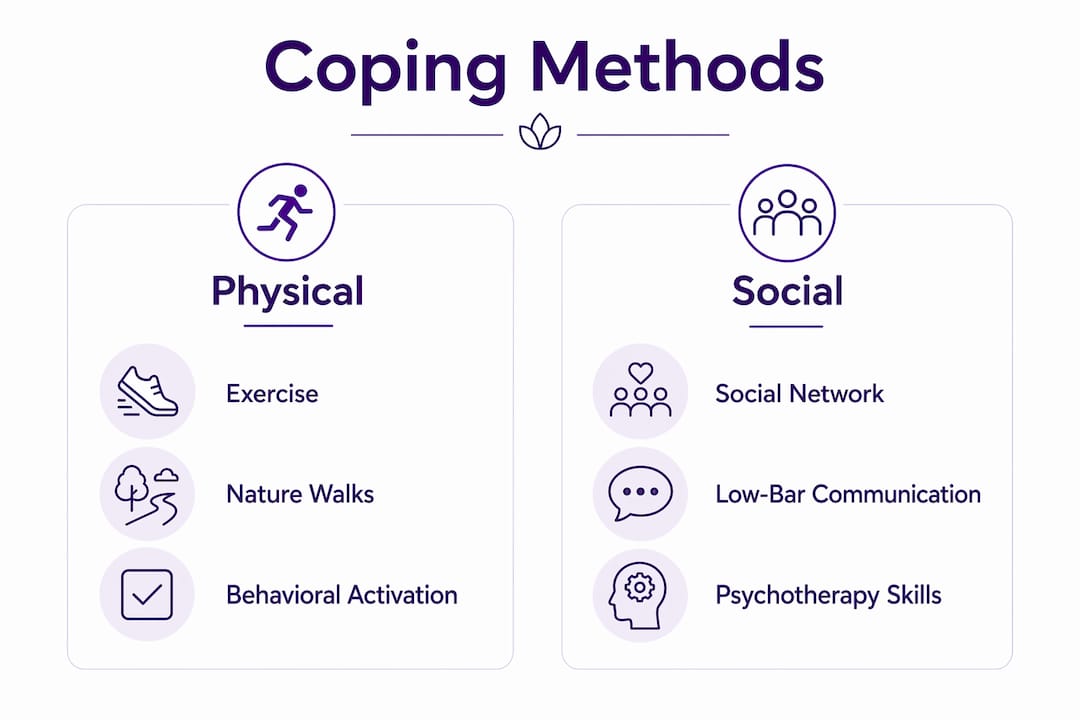
When depression makes reaching out feel impossible, low-bar communication is the answer. Brief texts or short check-ins maintain social bonds with minimal energy. A two-word reply to a friend’s meme counts. A voice note instead of a typed message counts. The bar is intentionally low because depression raises the cost of every social action.
Micro-connections also carry real weight. Brief exchanges with neighbors or cashiers reduce the stress response without requiring emotional vulnerability. You do not need to open up to a stranger. You just need to make eye contact and exchange a few words. That small act signals to your nervous system that the world is not hostile.
Here are low-barrier strategies to rebuild social connection:
- Send a voice note instead of a text when typing feels like too much
- Reply to one social media post from someone you care about
- Join a recurring group activity, like a weekly walk or a book club, where attendance is the only requirement
- Say hello to one person you see regularly but rarely speak to
Pro Tip: Interpersonal psychotherapy (IPT) teaches specific behavioral connection skills. If you are working with a therapist, ask about IPT techniques for rebuilding social bonds gradually and without pressure.
What role does behavioral activation play in coping with depression?
Behavioral activation is defined as the practice of taking action first and letting motivation follow. Spring Health identifies this as a critical shift for breaking the depression cycle. In healthy mental states, motivation precedes action. In depression, that order reverses. Waiting to feel ready means waiting indefinitely.
The depression-inactivity cycle works like this: low mood leads to withdrawal, withdrawal leads to fewer rewarding experiences, and fewer rewards deepen the low mood. Behavioral activation interrupts that cycle at the action point, not the feeling point. You act, and the feeling adjusts afterward.
Routine plays an equally important role. Consistent sleep-wake times stabilize circadian rhythms and function as a biological antidepressant. Sleep consistency regulates cortisol, improves emotional processing, and reduces the cognitive fog that makes depression feel permanent. It works independently of positive thinking, which means it works even on days when you cannot muster optimism.
Here is a step-by-step behavioral activation approach for beginners:
- List three small activities you used to enjoy or that feel neutral, not exciting.
- Schedule one activity for tomorrow at a specific time. Write it down.
- Do the activity regardless of how you feel when the time arrives.
- Rate your mood before and after on a scale of 1–10. Most people see at least a small shift.
- Add one more activity the following week. Build the schedule gradually.
- Use a simple calendar or app like Google Calendar or a paper planner to track your plan.
- Review weekly. Notice patterns. Adjust activities that consistently feel draining.
The numbered structure matters because depression impairs decision-making. A pre-made plan removes the need to decide in the moment, which is when depression has the most power.
How do mindfulness and nature exposure improve emotional well-being?
Mindfulness meditation reduces stress, improves emotional wellness, and supports mental health during periods of isolation. The mechanism is straightforward: mindfulness trains attention away from rumination and toward present-moment experience. Rumination is one of depression’s most damaging features, and mindfulness directly targets it.
Nature exposure adds a physiological layer. 30-minute outdoor walks reduce stress hormones by 12–20%. That reduction is measurable and meaningful. It means a daily walk is not just pleasant. It is a documented intervention for stress regulation.
You do not need a forest or a national park. Urban parks, tree-lined streets, and even sitting near a window with natural light produce measurable mood benefits. The key variable is exposure to natural elements, not distance from the city.
Practical ways to build mindfulness and nature into your day:
- Use apps like Calm, Headspace, or Insight Timer for guided 5–10 minute meditations
- Take your lunch break outside, even for 15 minutes
- Practice a body scan meditation before sleep to reduce nighttime rumination
- Combine movement and nature by walking in a park instead of on a treadmill
Pro Tip: AI-enhanced mindfulness apps now adapt session length and content to your mood and progress. That personalization increases the likelihood you will actually use them consistently, which is the only variable that matters.
Key takeaways
The most effective approach to managing depression and isolation combines physical movement, structured social connection, behavioral activation, and mindfulness into a consistent daily practice.
| Point | Details |
|---|---|
| Exercise is the top self-care tool | 30 minutes of moderate activity most days is the most evidence-backed depression intervention. |
| Social structure reduces overwhelm | Aim for 1–2 confidants, 3–5 companions, and 5–10 acquaintances to distribute emotional weight. |
| Act before you feel ready | Behavioral activation works by reversing the motivation-action order that depression disrupts. |
| Sleep consistency is non-negotiable | Stable sleep-wake times regulate circadian rhythms and improve mood independently of mindset. |
| Nature and mindfulness compound results | A 30-minute outdoor walk cuts stress hormones by 12–20%, and mindfulness reduces rumination directly. |
What i have learned about coping that most articles skip
The hardest part of depression is not the sadness. It is the belief that reaching out will burden the people you love. Spring Health identifies this feeling as one of the primary drivers of isolation in depression. I have seen it play out repeatedly, and it is almost always wrong. The people in your life want to hear from you. They just do not know you are struggling.
What I have found actually works is not the grand gesture. It is the absurdly small one. Sending a single text. Walking to the end of the block. Eating breakfast at the same time two days in a row. These actions feel meaningless in the moment. Over two weeks, they shift something real.
The other thing most articles skip is this: setbacks are not failures. They are data. If a strategy stops working, that tells you something useful about what your nervous system needs right now. Adjust and continue. Progress in mental health is rarely linear, and expecting it to be linear is one of the fastest ways to quit.
Self-care methods work best as a complement to professional support, not a replacement for it. If symptoms are severe or persistent, a licensed therapist or psychiatrist is the right next step. The healthy coping mechanisms covered in this article are most powerful when they run alongside, not instead of, clinical care.
— dushyantha
Explore ai-powered tools that support your mental health
The strategies in this article work. They work even better when you have consistent support between therapy sessions or during moments when reaching out to another person feels impossible.
Cognicareai curates a directory of AI-powered mental health tools designed to complement the coping methods you have just read about. From mood-tracking apps to AI-guided mindfulness sessions and therapy chatbots, these tools adapt to your specific needs and meet you where you are. Explore the Cognicareai directory to find the right combination of digital support and self-care strategies for your mental health journey.
FAQ
What are the most effective depression and isolation coping methods?
The most effective methods combine 30 minutes of daily moderate exercise, behavioral activation, structured social connection, and mindfulness practice. Research from Simply Psychology and Spring Health supports all four as evidence-backed strategies.
How do i start when depression makes everything feel impossible?
Start with the smallest possible action, such as a 10-minute walk or a single text to a friend. Behavioral activation research shows that action precedes motivation in depression, so starting small is the correct approach, not a compromise.
Can mindfulness really help with isolation and depression?
Yes. Mindfulness meditation reduces stress and improves emotional wellness, and 30-minute outdoor walks reduce stress hormones by 12–20%. Both are accessible, low-cost interventions with documented benefits.
How many social connections do i actually need?
Research recommends a tiered network of 1–2 close confidants, 3–5 regular companions, and 5–10 casual acquaintances. That structure provides emotional support without overwhelming someone already managing depression.
Are AI mental health tools a replacement for therapy?
No. AI tools and self-care practices are most effective as complements to professional treatment. If symptoms are severe, a licensed therapist or psychiatrist remains the primary resource.