
If you’ve tried mindfulness and still felt anxious, you probably assumed it wasn’t working. That’s one of the most common misunderstandings about how mindfulness reduces anxiety, explained clearly here for the first time: mindfulness doesn’t switch anxiety off. It changes your relationship with it. This distinction matters enormously. The clinical term for what mindfulness actually does is metacognitive decentering, which means learning to observe anxious thoughts as mental events rather than treating them as facts or emergencies. Once you understand that mechanism, everything about the practice starts to make sense.
Table of Contents
- Key takeaways
- How mindfulness reduces anxiety: the core mechanism
- What the research actually shows
- How mindfulness rewires emotional regulation
- Practical techniques for managing acute anxiety
- Building a practice that lasts
- My honest take on why mindfulness gets misunderstood
- Explore AI-powered tools for anxiety and mindfulness
- FAQ
Key takeaways
| Point | Details |
|---|---|
| Mindfulness changes your relationship with anxiety | It teaches you to observe anxious thoughts without reacting, not to eliminate them instantly. |
| Science supports 8-12 week programs | Structured practice over two to three months delivers the most consistent anxiety relief according to 2026 research. |
| Emotion regulation is the core mechanism | Mindfulness reduces anxiety by improving how you process and respond to difficult feelings, not by suppressing them. |
| Technique choice matters during panic | Grounding through external senses often works better than breath focus when anxiety is acute. |
| Consistency beats intensity | Short daily sessions build the neural patterns that ease anxiety over time far better than occasional long sessions. |
How mindfulness reduces anxiety: the core mechanism
Most anxiety lives outside the present moment. You worry about what might go wrong tomorrow, replay a conversation from last week, or catastrophize about next month’s deadline. Mindfulness, defined as present-moment, nonjudgmental awareness, directly interrupts that pattern by anchoring attention to what is actually happening right now.
The clinical explanation connects to how anxiety sustains itself. Anxious thinking follows a loop: a triggering thought leads to a physical sensation, which triggers more worried thinking, which amplifies the sensation. Mindfulness interrupts these “what if” loops by inserting a pause between the trigger and your reaction. That pause is not a magic switch. It’s a skill you develop with practice.
Here is what makes this different from simply “trying to relax”:
- Nonjudgmental observation: You notice the anxious thought without labeling it as dangerous or wrong
- Decentering: You recognize that having a thought is not the same as being the thought. “I am noticing a worry” is fundamentally different from “I am worried”
- Metacognitive awareness: You become aware of your thinking process itself, which gives you room to choose a response instead of automatically reacting
Mindfulness fosters a decentered stance that treats thoughts as passing mental events rather than directives. This is not a philosophical idea. It’s a cognitive shift with measurable neurobiological effects, including changes to how the prefrontal cortex regulates the amygdala, your brain’s threat-detection center.
What the research actually shows
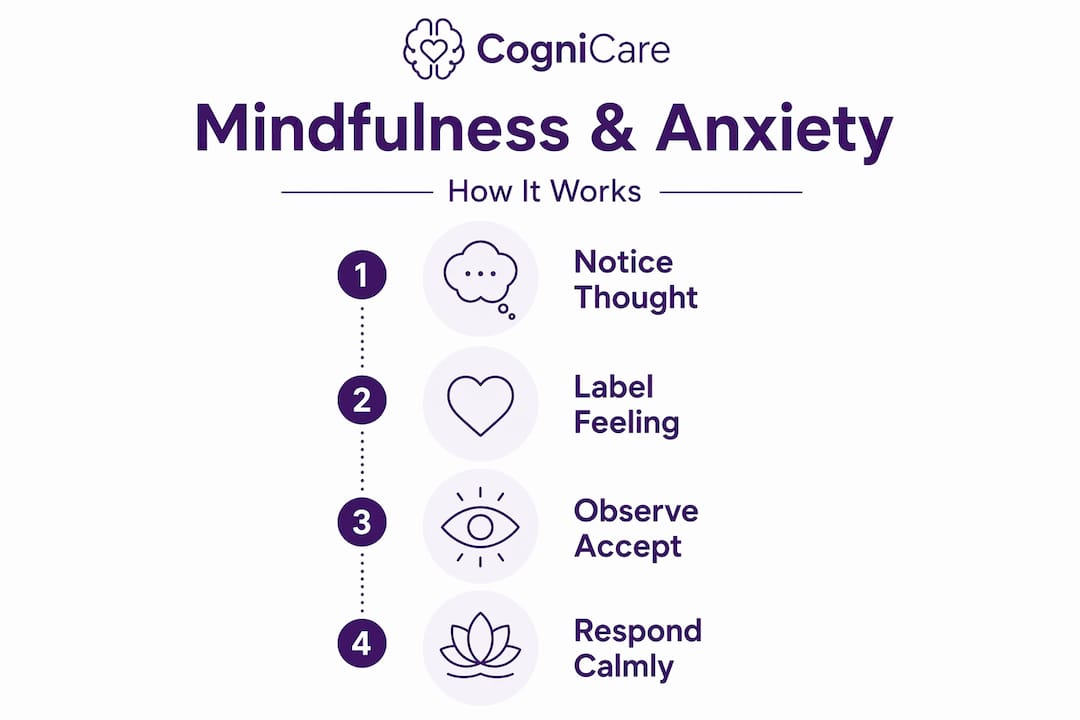
The evidence base for mindfulness and anxiety is now substantial, and the 2026 data makes a strong case. A large meta-analysis drawing from over 24,000 participants across 30 randomized controlled trials found small-to-moderate anxiety reductions with a Hedges’ g of 0.56. That’s a meaningful effect size in clinical psychology.
| Study type | Finding | Population |
|---|---|---|
| 2026 meta-analysis (30 RCTs) | Consistent anxiety improvement, Hedges’ g = 0.56 | 24,000+ participants |
| Randomized controlled trial (GAD) | Improved clinician-rated and self-reported anxiety, better sleep, stronger mindfulness skills | Generalized anxiety disorder patients |
| PCORI medication comparison | Comparable anxiety symptom relief with significantly fewer side effects | Adults with anxiety disorders |
A separate randomized controlled trial focused specifically on generalized anxiety disorder found that an 8-week mindfulness-based intervention significantly reduced both clinician-rated and self-reported anxiety scores. Participants also showed improvements in sleep quality and cognitive patterns associated with worry. These weren’t subtle changes.
For those who avoid or can’t tolerate medication, the comparison data is worth knowing. A PCORI-funded study found that mindfulness shows comparable anxiety reductions to medication while nearly 80% of medication users reported side effects compared to only 15% in the mindfulness group.
Pro Tip: If you’re just starting out, look for structured programs rather than freeform apps. The research consistently shows that programs with clear 8-to-12-week structures outperform informal or sporadic use for anxiety relief.
How mindfulness rewires emotional regulation
Understanding the neuroscience here doesn’t require a PhD. Think of emotional regulation as your brain’s ability to respond to difficult feelings without being overwhelmed by them. Most people with anxiety have one dominant strategy: suppression. Push the feeling down, don’t think about it, stay busy. It doesn’t work long term. In fact, it often intensifies anxiety by making you more vigilant about not feeling anxious.
Mindfulness builds a different toolkit. Emotion regulation partially mediates the relationship between mindfulness practice and reduced anxiety, specifically through a process called cognitive reappraisal. Where suppression says “don’t feel this,” reappraisal says “let me reframe what this feeling means.” One shuts down processing, the other opens it up.
Here’s what that shift looks like in practice:
- From suppression to observation: Instead of pushing away an anxious feeling, you note it. “There’s tightness in my chest. I’m noticing anxiety.”
- From reactivity to response: Rather than immediately acting on the anxious impulse (checking your phone, leaving the situation, reassurance-seeking), you pause and choose
- From identification to observation: You stop being your anxiety and start watching it, which reduces emotional reactivity significantly
This shift from reactive to accepting doesn’t happen overnight. It builds across weeks of consistent practice, which is exactly why the research points to structured multi-week programs rather than five minutes of app use when you feel stressed.
Practical techniques for managing acute anxiety
Knowing the theory helps. But when anxiety spikes, you need something you can actually use. These techniques are specifically adapted for anxious nervous systems, not just general meditation beginners.
- The 5-4-3-2-1 grounding method: Name 5 things you can see, 4 you can physically touch, 3 you can hear, 2 you can smell, and 1 you can taste. Sensory grounding exercises like this work by redirecting attention to external reality rather than internal catastrophe
- Mindful walking: Focus on the physical sensation of each step. Feel the ground, notice the rhythm, observe the environment without judgment. This works especially well when sitting still increases anxiety rather than reducing it
- Body scan practice: Move your attention slowly through different body parts, noticing sensation without trying to change anything. Start at your feet and work upward over 10 to 15 minutes
- Sound-anchored awareness: Instead of focusing on breath (which can worsen panic for some people), use external sounds as your anchor. Listen to ambient noise and observe it as you would music, without labeling it as good or bad
One critical adaptation most guides miss: choosing the right anchor matters more than choosing the “correct” technique. If focusing on your breath triggers more panic because you’re hyperaware of breathing, switch to sounds or touch. Your nervous system knows what it can tolerate. Follow that signal.
Pro Tip: Label your thoughts during practice. Silently saying “worry” or “planning” when a thought arises helps you practice decentering in real time and builds the metacognitive skill that reduces anxiety over weeks, not just in the moment.
Building a practice that lasts
One session of mindfulness won’t fix anxiety. This isn’t a flaw in the practice. It’s how skill-building works. Structured 8-to-12-week programs provide the most consistent and lasting anxiety relief precisely because they give new emotional regulation patterns time to develop and solidify.
For building a practice that actually sticks, here are the principles that matter:
- Consistency over duration: Ten minutes every day beats 60 minutes once a week. The brain learns through repetition, not marathon sessions
- Start with what you’ll actually do: If formal sitting meditation feels too intense, begin with mindful walking or a short body scan before bed
- Drop the “calm now” expectation: Effective mindfulness practice involves recognizing thought patterns and returning to your anchor without judgment, not forcing a feeling of calm. Calm is a byproduct of skill, not the goal itself
- Track patterns, not results: Notice over days and weeks whether your relationship with anxious thoughts is shifting, not whether today’s session felt peaceful
- Use guided resources early on: Beginners benefit significantly from structured guidance. Mindfulness for beginners resources can reduce the guesswork during the critical early weeks
The most common reason people quit is that they try to force calm, notice it isn’t working, and conclude mindfulness “isn’t for them.” What they’re actually doing is practicing suppression with a meditation cushion. Shifting that one misunderstanding changes everything.
My honest take on why mindfulness gets misunderstood
I’ve spent years reading the research on reducing anxiety through mindfulness, and I’ve seen one misconception do more damage than any other. People come to mindfulness wanting to feel better right now. When the anxious thoughts keep coming, they declare the practice a failure.
Here’s what I’ve come to believe: mindfulness doesn’t make you less anxious by making anxiety go away. It makes you less controlled by anxiety. That’s a completely different outcome, and in many ways a better one. An evidence-based look at how mindfulness eases anxiety makes this clear: the therapeutic target is metacognitive awareness, not the elimination of worry.
What I’ve found particularly compelling in the 2026 research is that even moderate, consistent practice produces measurable clinical changes in people with generalized anxiety disorder. These aren’t people with mild nerves. They’re people with chronic, debilitating worry. And structured mindfulness moved the needle for them.
My take is this: treat mindfulness as a skill you’re building, not a state you’re trying to achieve. Every time you notice a thought and return to your anchor, you’re training your brain. You’re not failing at peace. You’re succeeding at decentering. That reframe changes what practice feels like and dramatically increases how long people stick with it.
— dushyantha
Explore AI-powered tools for anxiety and mindfulness
Managing anxiety takes the right support at the right time. Cognicareai makes that support more accessible by connecting you with AI-powered mindfulness apps and personalized mental health tools built specifically for anxiety and stress relief.
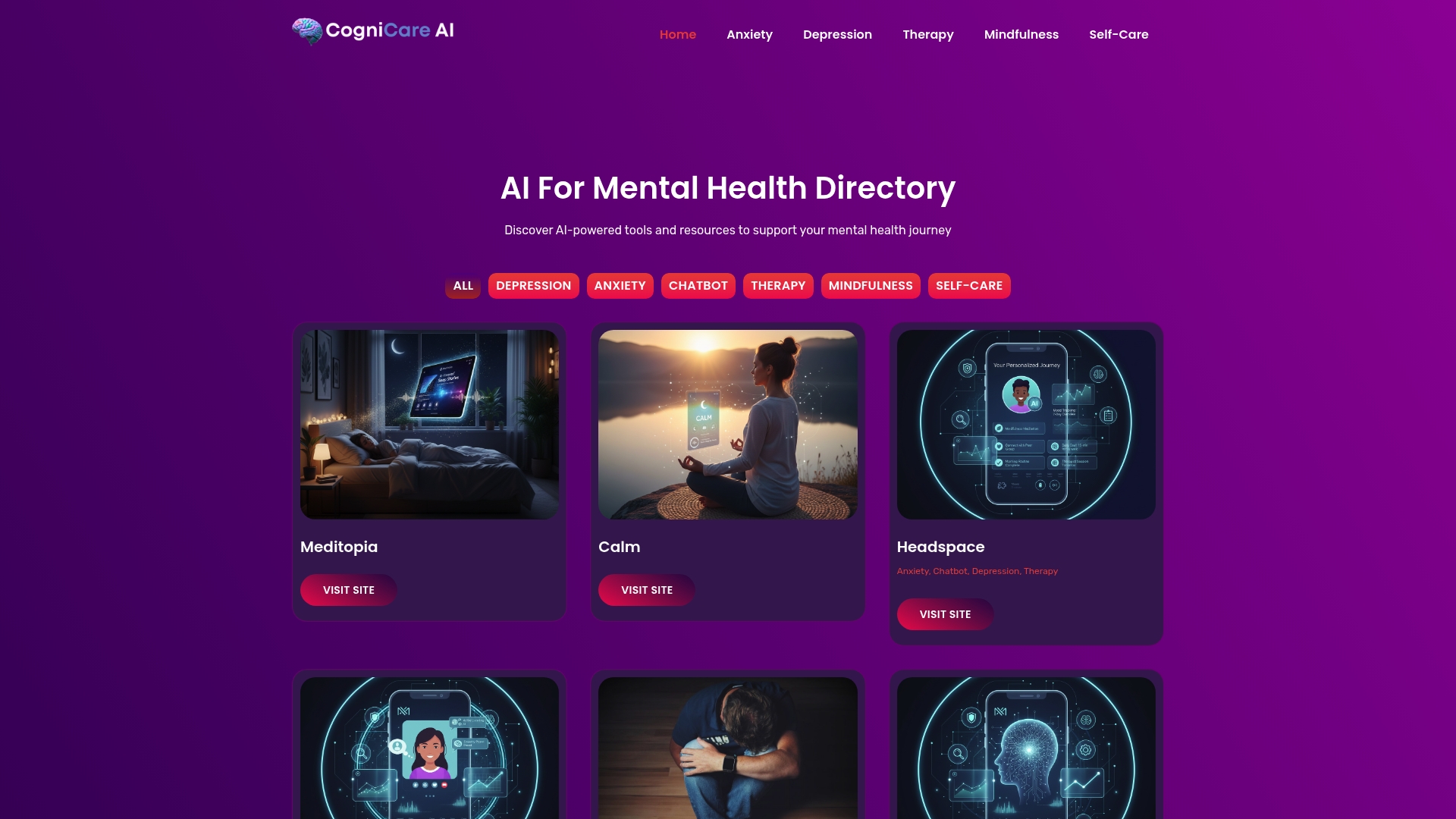
Whether you’re starting your first mindfulness practice or looking to deepen an existing one, Cognicareai’s directory helps you find tools that adapt to your pace, your preferences, and your actual nervous system. From AI-assisted anxiety techniques to guided apps with structured programs, the platform cuts through the noise so you can find what works. You can also explore AI tools for anxiety designed to complement everything you’ve learned here, making consistent practice easier to build and sustain.
FAQ
What does mindfulness actually do for anxiety?
Mindfulness teaches you to observe anxious thoughts as passing mental events rather than facts, interrupting the worry cycles that sustain anxiety. Over time, this builds emotional regulation skills that reduce both the frequency and intensity of anxious responses.
How long before mindfulness helps with anxiety?
Research consistently shows that 8-to-12-week structured programs produce the most reliable anxiety relief. Some people notice shifts in their relationship with anxious thoughts within two to three weeks of daily practice, but lasting changes require sustained commitment.
Can mindfulness make anxiety worse?
For some people, certain techniques like breath-focused meditation can temporarily increase anxiety, particularly during panic. Switching to external anchors like sounds or sensory grounding typically resolves this. The practice itself is not harmful when adapted appropriately.
Is mindfulness as effective as medication for anxiety?
A PCORI-funded study found that mindfulness produces comparable results to medication for anxiety with significantly fewer side effects. It works best as part of a broader approach, especially for moderate to severe anxiety disorders.
What is the best mindfulness technique for acute anxiety?
The 5-4-3-2-1 sensory grounding method is one of the most effective for acute anxiety because it redirects attention outward rather than inward. Mindful walking is another strong option when sitting still increases rather than reduces anxious feelings.